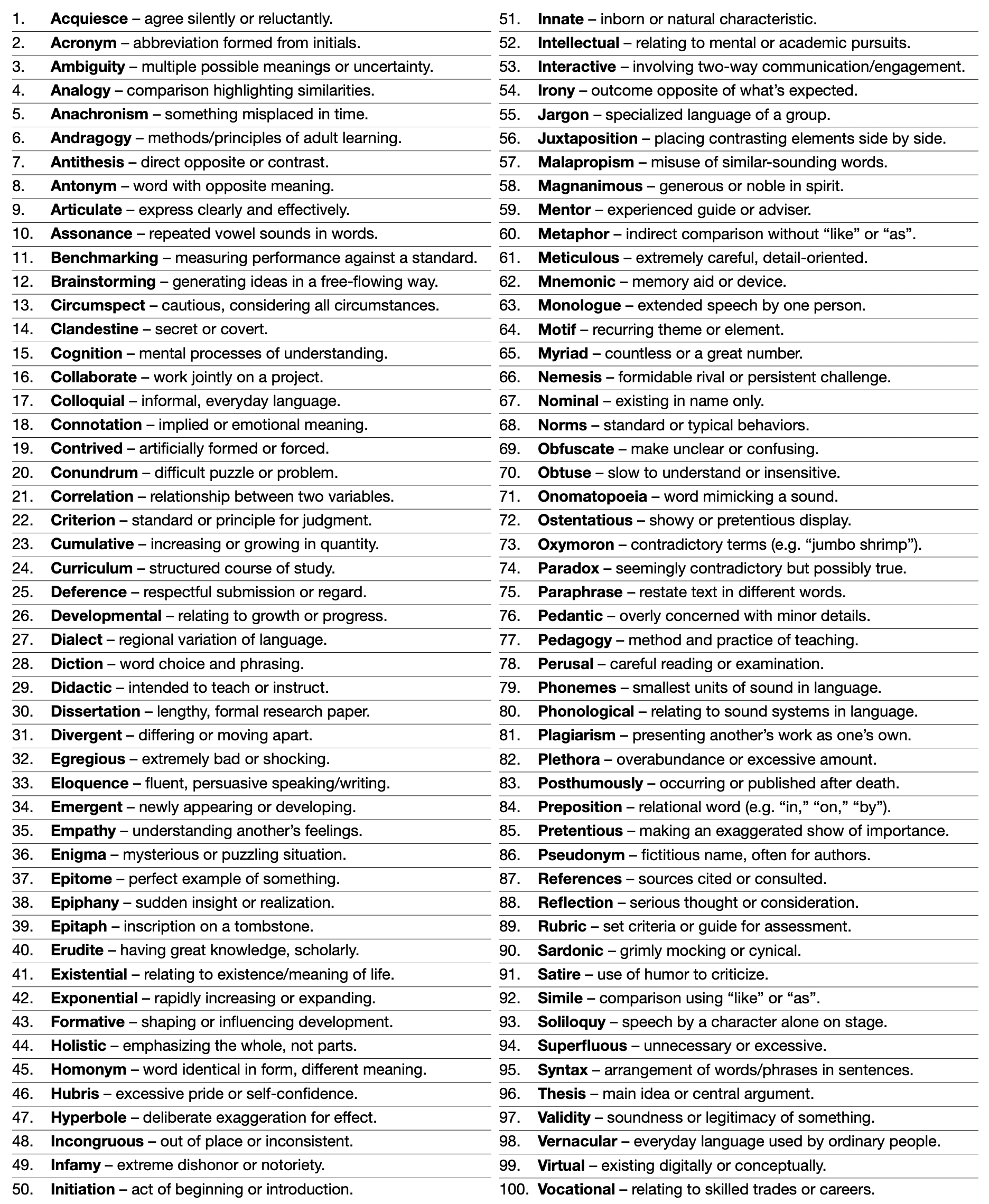
| No. | Term | Definition |
|---|---|---|
| 1. | Acquiesce | To agree silently or reluctantly. |
| 2. | Acronym | Abbreviation formed from initials. |
| 3. | Ambiguity | Multiple possible meanings or uncertainty. |
| 4. | Analogy | Comparison highlighting similarities. |
| 5. | Anachronism | Something misplaced in time. |
| 6. | Andragogy | Methods/principles of adult learning. |
| 7. | Antithesis | Direct opposite or contrast. |
| 8. | Antonym | Word with opposite meaning. |
| 9. | Articulate | To express clearly and effectively. |
| 10. | Assonance | Repeated vowel sounds in words. |
| 11. | Benchmarking | To measure performance against a standard. |
| 12. | Brainstorming | To generate ideas in a free-flowing way. |
| 13. | Circumspect | Cautious, considering all circumstances. |
| 14. | Clandestine | Secret or covert. |
| 15. | Cognition | Mental processes of understanding. |
| 16. | Collaborate | To work jointly on a project. |
| 17. | Colloquial | Informal, everyday language. |
| 18. | Connotation | Implied or emotional meaning. |
| 19. | Contrived | Artificially formed or forced. |
| 20. | Conundrum | Difficult puzzle or problem. |
| 21. | Correlation | Relationship between two variables. |
| 22. | Criterion | Standard or principle for judgment. |
| 23. | Cumulative | Increasing or growing in quantity. |
| 24. | Curriculum | Structured course of study. |
| 25. | Deference | Respectful submission or regard. |
| 26. | Developmental | Relating to growth or progress. |
| 27. | Dialect | Regional variation of language. |
| 28. | Diction | Word choice and phrasing. |
| 29. | Didactic | Intended to teach or instruct. |
| 30. | Dissertation | Lengthy, formal research paper. |
| 31. | Divergent | Differing or moving apart. |
| 32. | Egregious | Extremely bad or shocking. |
| 33. | Eloquence | Fluent, persuasive speaking/writing. |
| 34. | Emergent | Newly appearing or developing. |
| 35. | Empathy | To understand another’s feelings. |
| 36. | Enigma | Mysterious or puzzling situation. |
| 37. | Epitome | Perfect example of something. |
| 38. | Epiphany | Sudden insight or realization. |
| 39. | Epitaph | Inscription on a tombstone. |
| 40. | Erudite | Having great knowledge, scholarly. |
| 41. | Existential | Relating to existence/meaning of life. |
| 42. | Exponential | Rapidly increasing or expanding. |
| 43. | Formative | Shaping or influencing development. |
| 44. | Holistic | Emphasizing the whole, not parts. |
| 45. | Homonym | Word identical in form, different meaning. |
| 46. | Hubris | Excessive pride or self-confidence. |
| 47. | Hyperbole | Deliberate exaggeration for effect. |
| 48. | Incongruous | Out of place or inconsistent. |
| 49. | Infamy | Extreme dishonor or notoriety. |
| 50. | Initiation | Act of beginning or introduction. |
| 51. | Innate | Inborn or natural characteristic. |
| 52. | Intellectual | Relating to mental or academic pursuits. |
| 53. | Interactive | Involving two-way communication/engagement. |
| 54. | Irony | Outcome opposite of what’s expected. |
| 55. | Jargon | Specialized language of a group. |
| 56. | Juxtaposition | To place contrasting elements side by side. |
| 57. | Malapropism | Misuse of similar-sounding words. |
| 58. | Magnanimous | Generous or noble in spirit. |
| 59. | Mentor | Experienced guide or adviser. |
| 60. | Metaphor | Indirect comparison without “like” or “as.” |
| 61. | Meticulous | Extremely careful, detail-oriented. |
| 62. | Mnemonic | Memory aid or device. |
| 63. | Monologue | Extended speech by one person. |
| 64. | Motif | Recurring theme or element. |
| 65. | Myriad | Countless or a great number. |
| 66. | Nemesis | Formidable rival or persistent challenge. |
| 67. | Nominal | Existing in name only. |
| 68. | Norms | Standard or typical behaviors. |
| 69. | Obfuscate | To make unclear or confusing. |
| 70. | Obtuse | Slow to understand or insensitive. |
| 71. | Onomatopoeia | Word mimicking a sound. |
| 72. | Ostentatious | Showy or pretentious display. |
| 73. | Oxymoron | Contradictory terms (e.g. “jumbo shrimp”). |
| 74. | Paradox | Seemingly contradictory but possibly true. |
| 75. | Paraphrase | To restate text in different words. |
| 76. | Pedantic | Overly concerned with minor details. |
| 77. | Pedagogy | Method and practice of teaching. |
| 78. | Perusal | Careful reading or examination. |
| 79. | Phonemes | Smallest units of sound in language. |
| 80. | Phonological | Relating to sound systems in language. |
| 81. | Plagiarism | To present another’s work as one’s own. |
| 82. | Plethora | Overabundance or excessive amount. |
| 83. | Posthumously | Occurring or published after death. |
| 84. | Preposition | Relational word (e.g. “in,” “on,” “by”). |
| 85. | Pretentious | To make an exaggerated show of importance. |
| 86. | Pseudonym | Fictitious name, often for authors. |
| 87. | References | Sources cited or consulted. |
| 88. | Reflection | Serious thought or consideration. |
| 89. | Rubric | A set of criteria or a guide for assessment. |
| 90. | Sardonic | Grimly mocking or cynical. |
| 91. | Satire | Use of humor to criticize. |
| 92. | Simile | Comparison using “like” or “as.” |
| 93. | Soliloquy | Speech by a character alone on stage. |
| 94. | Superfluous | Unnecessary or excessive. |
| 95. | Syntax | Arrangement of words/phrases in sentences. |
| 96. | Thesis | Main idea or central argument. |
| 97. | Validity | Soundness or legitimacy of something. |
| 98. | Vernacular | Everyday language used by ordinary people. |
| 99. | Virtual | Existing digitally or conceptually. |
| 100. | Vocational | Relating to skilled trades or careers. |
