
• Skip to primary navigation
  • Skip to main content
  • Skip to primary sidebar
Home of English Grammar
  • Home
  • Course
  • Exercises
  • Grammar Rules
  • Matches
  • Posts
  • Tools
    • Grammar Checker
    • Very Replacer
    • Word Counter
  • Vocabulary Lists
  • Archives
    • Social Media Posts
    • Writing Guides
  • Join free

Aberrant vs. abhorrent: unusual or deeply offensive?

October 15, 2026

Aberrant vs. Abhorrent

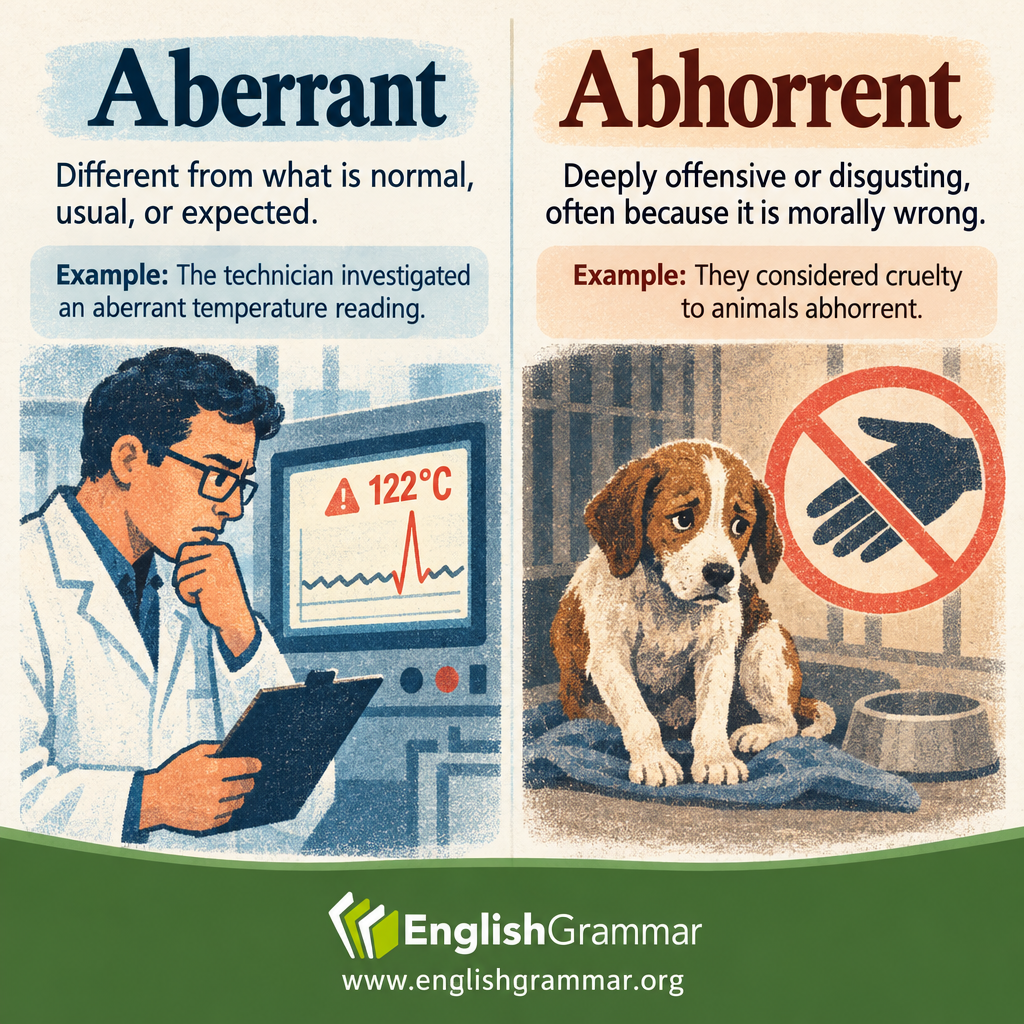
Aberrant and abhorrent look similar, but they answer different questions: Is something outside the usual pattern, or does it cause strong disgust or disapproval? Both words are adjectives, so they can describe a person, action, or situation.

Aberrant means different from what is normal, usual, or expected. It often appears in discussions of behavior, scientific results, or other patterns. It can suggest that something is wrong, but it does not by itself express intense disgust.

  • The researchers checked an aberrant reading that did not match the other results.
  • His sudden outburst was aberrant behavior for someone usually so calm.

Abhorrent means deeply offensive or disgusting, often because something is morally wrong. Choose it when you want to express strong rejection, not simply point out an unusual feature.

  • The deliberate mistreatment of prisoners was abhorrent.
  • She found the company’s use of child labor abhorrent.

The same action could be described with either word, depending on your point. Calling an action aberrant emphasizes how it departs from an expected pattern. Calling it abhorrent emphasizes how strongly you condemn it.

For example, an unexpected laboratory result may be aberrant without being offensive at all. An act of cruelty may be abhorrent even if it happens frequently. Frequency does not make cruelty acceptable, and being unusual does not automatically make something disgusting.

Improve your English grammar, vocabulary and writing

We take you step by step from beginner to advanced, even if you struggled with English at school or always had trouble remembering the rules.

  • 10 modules, 105 lessons and 688 questions
  • Just log in and learn anytime and from anywhere
  • Your personal progress stored in your account
  • Download the 2026 Grammar Guide (PDF)
Join free

Already have an account? Sign in

See what’s in the course

Primary Sidebar

2.4M761.4K165.8K

Free 2026 Grammar Guide

  • Download Grammar Guide (PDF)
  • Online grammar course, A1 to C2
  • Weekly exercises and vocabulary
  • Join over 3 million English learners

We respect your privacy. Unsubscribe anytime.

Already have an account? Sign in

Grammar Checker - Try Now

Latest Posts

  • Aberrant vs. abhorrent: unusual or deeply offensive? October 15, 2026
  • Present Perfect Negative Sentences Exercise October 15, 2026
  • 100 Best Synonyms for “Unfocused” October 15, 2026
  • Review Recommendations Exercise October 15, 2026
  • 100 Best Synonyms for “Capture” October 15, 2026
  • Present Simple Negative Sentences Exercise October 14, 2026
  • 100 Best Synonyms for “Reinforces” October 14, 2026
  • 100 Best Synonyms for “Perplexing” October 14, 2026
  • Improve, enhance, ameliorate, and augment: choosing the right word October 14, 2026
  • The origin and meaning of “no great shakes” October 14, 2026
Home of English Grammar

Free English grammar exercises, rules and vocabulary lists, with new exercises every week. Join the leading English grammar site with over 3 million followers.

Join free

Learn

  • Exercises
  • Matches
  • Grammar rules
  • Vocabulary lists
  • Writing guides
  • Online tools

More

  • Top social media posts
  • Various posts
  • Contact

Account

  • Join free
  • Grammar Course
  • Free grammar guide (PDF)

Copyright © 2026 EnglishGrammar.org

  • Disclaimer
  • Privacy policy
  • Refund policy
  • Terms
  • Sitemap