
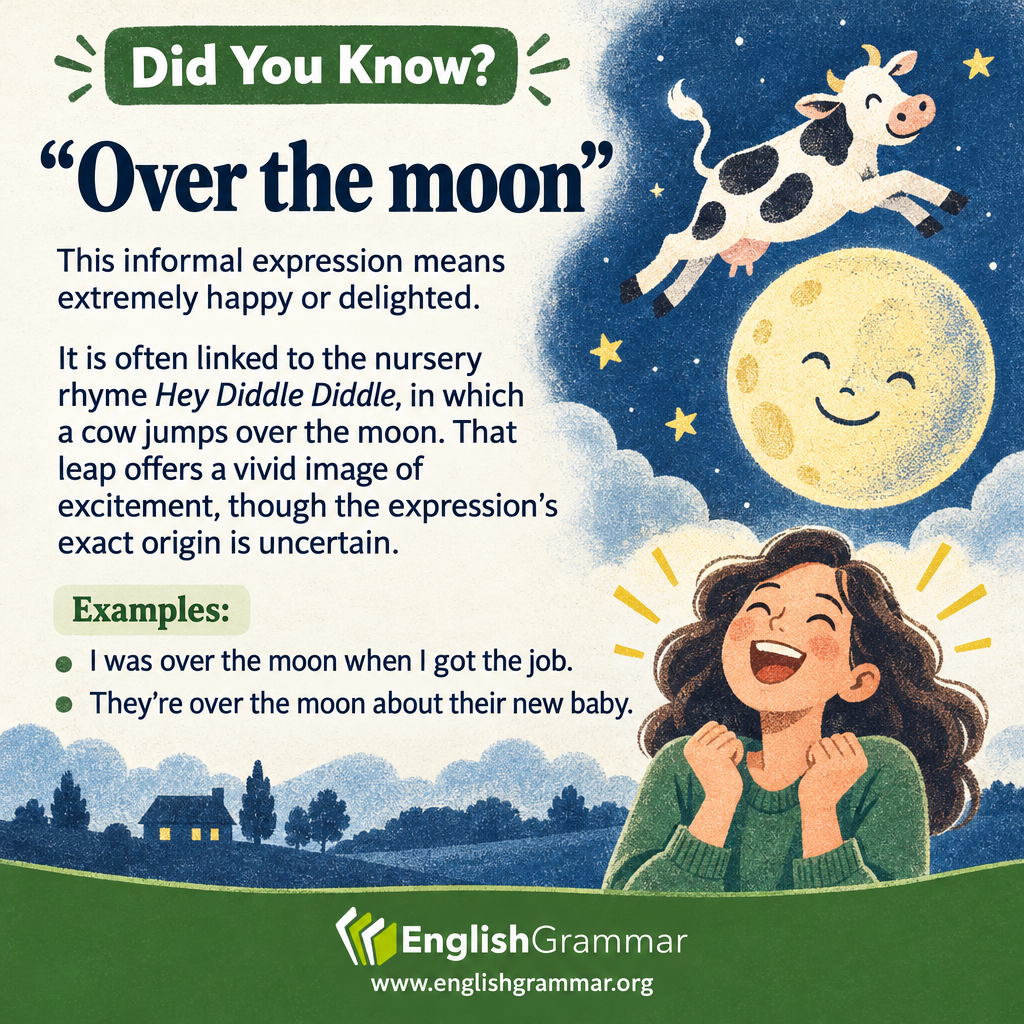
This informal expression means extremely happy or delighted. People often use it when something wonderful happens, such as getting a job, hearing good news, or achieving a personal goal.
A familiar connection is the nursery rhyme Hey Diddle Diddle, in which a cow jumps over the moon. That impossible leap provides a memorable image of extraordinary excitement. The rhyme is often cited as the expression’s source, but the exact origin is uncertain. It is safer to describe this as a traditional association than as a proven explanation of how the modern meaning developed.
Today, the expression describes happiness, not literal movement. You do not need to know the rhyme to understand or use it.
- “I was over the moon when I passed my driving test.”
- “They’re over the moon about their new baby.”
Notice the patterns in these examples. Use be + the expression to describe someone’s feelings. Add when to introduce what happened, or about before the news or situation causing the happiness.
It is stronger than simply saying “happy,” so it suits news that matters a lot to someone. It is especially associated with British English, though it is understood more widely. In formal writing, a straightforward word such as delighted may fit the tone better.