
• Skip to primary navigation
  • Skip to main content
  • Skip to primary sidebar
Home of English Grammar
  • Home
  • Course
  • Exercises
  • Grammar Rules
  • Vocabulary Matches
  • Posts
  • Tools
    • Grammar Checker
    • Very Replacer
    • Word Counter
  • Vocabulary Lists
  • Archives
    • Social Media Posts
    • Writing Guides
  • Sign in
  • Join free

Absquatulate: meaning, origin, and how to use it

May 11, 2026

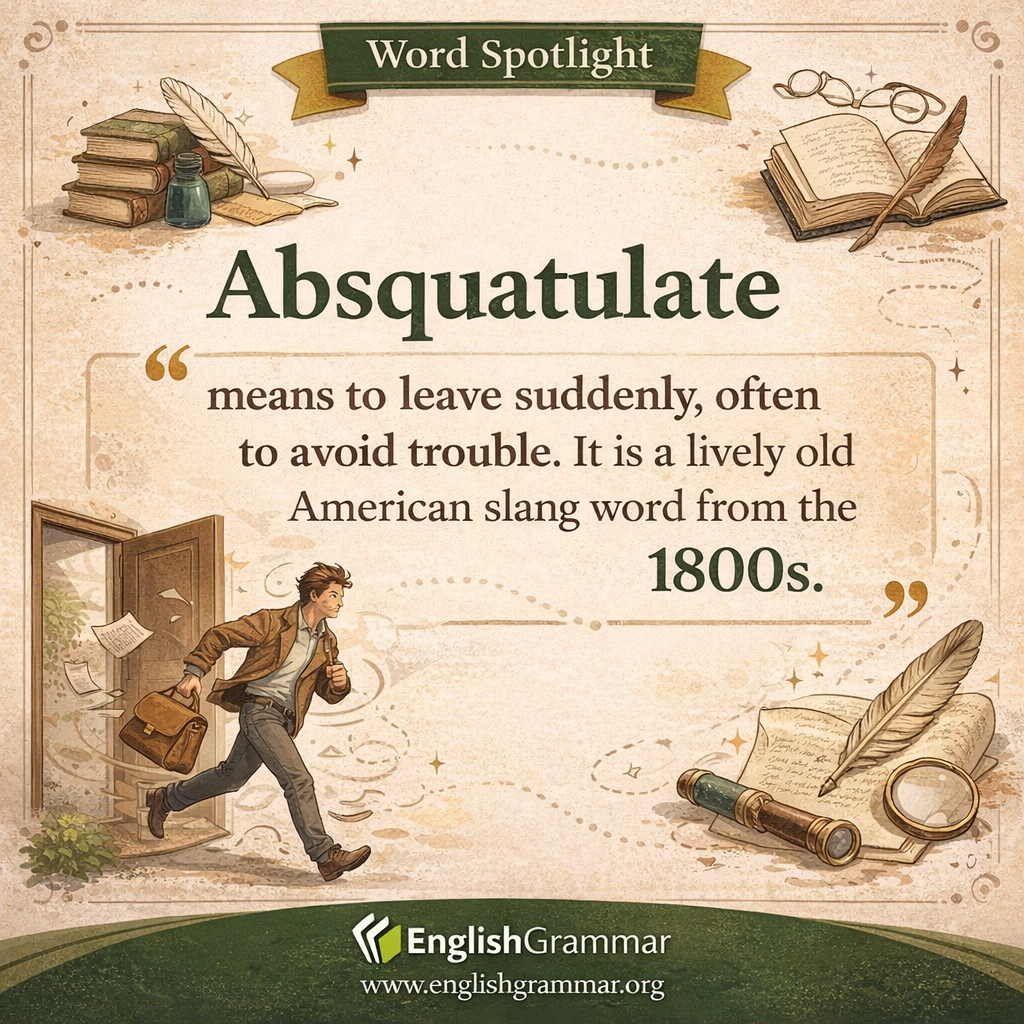
Absquatulate

Absquatulate is an old American slang verb that means to leave abruptly, often with a sense of sneaking off or escaping trouble. It has a comic, exaggerated tone, so people usually use it for humor rather than in formal writing.

The word became popular in the United States in the 1800s. Its exact origin is uncertain, but it is strongly associated with lively frontier era speech and playful slang. That unusual sound is part of its charm, which is why it still shows up in word lists and conversations about colorful vocabulary.

In modern use, absquatulate is best treated as a vivid, joking alternative to words like leave, run off, or disappear. It works especially well when you want your sentence to sound theatrical or amused.

  • Example: When the bill arrived, he absquatulated before anyone could ask him to pay.
  • Tone: humorous, old fashioned, informal.
  • Use it when: you want a rare word that makes a quick exit sound memorable.

If you want to expand your vocabulary with expressive words, absquatulate is a great one to keep around. It is precise enough to be useful and strange enough to be unforgettable.

Improve your English grammar, vocabulary and writing

We take you step by step from beginner to advanced, even if you struggled with English at school or have always had trouble remembering the rules.

  • 10 modules, 112 lessons and 730 questions
  • Just log in and learn anytime and anywhere
  • Your progress is saved in your account
  • Download the 2027 Grammar Guide (PDF)
Join free

Already have an account? Sign in

See what’s in the course

Primary Sidebar

2.4M760.9K165.9K

Free 2027 Grammar Guide

  • Download Grammar Guide (PDF)
  • Online grammar course, A1 to C2
  • Weekly exercises and vocabulary
  • Join over 3 million English learners

We respect your privacy. Unsubscribe anytime.

Already have an account? Sign in

Grammar Checker - Try Now

Latest Posts

  • “How come?” has meant “why?” since the 1800s November 3, 2026
  • 100 Best Synonyms for “Vary” November 3, 2026
  • 100 Best Synonyms for “Individuals” November 3, 2026
  • Temporary vs. passing vs. fleeting vs. transient vs. ephemeral vs. evanescent November 3, 2026
  • 100 Best Synonyms for “Restless” November 3, 2026
  • Hard, firm, solid, rigid, stiff and unyielding: How to choose November 3, 2026
  • The origin of “out of the blue” November 3, 2026
  • 100 Best Synonyms for “Individualised” November 3, 2026
  • 100 Best Synonyms for “Varied” November 3, 2026
  • Fewer vs. less: counting things and measuring amounts November 3, 2026
Home of English Grammar

Free English grammar exercises, rules and vocabulary lists, with new exercises every week. Join the leading English grammar site with over 3 million followers.

Join free

Learn

  • Exercises
  • Matches
  • Grammar rules
  • Vocabulary lists
  • Writing guides
  • Online tools

More

  • Top social media posts
  • Various posts
  • Contact

Account

  • Join free
  • Grammar Course
  • Free grammar guide (PDF)

Copyright © 2026 EnglishGrammar.org

  • Disclaimer
  • Privacy policy
  • Terms
  • Sitemap