
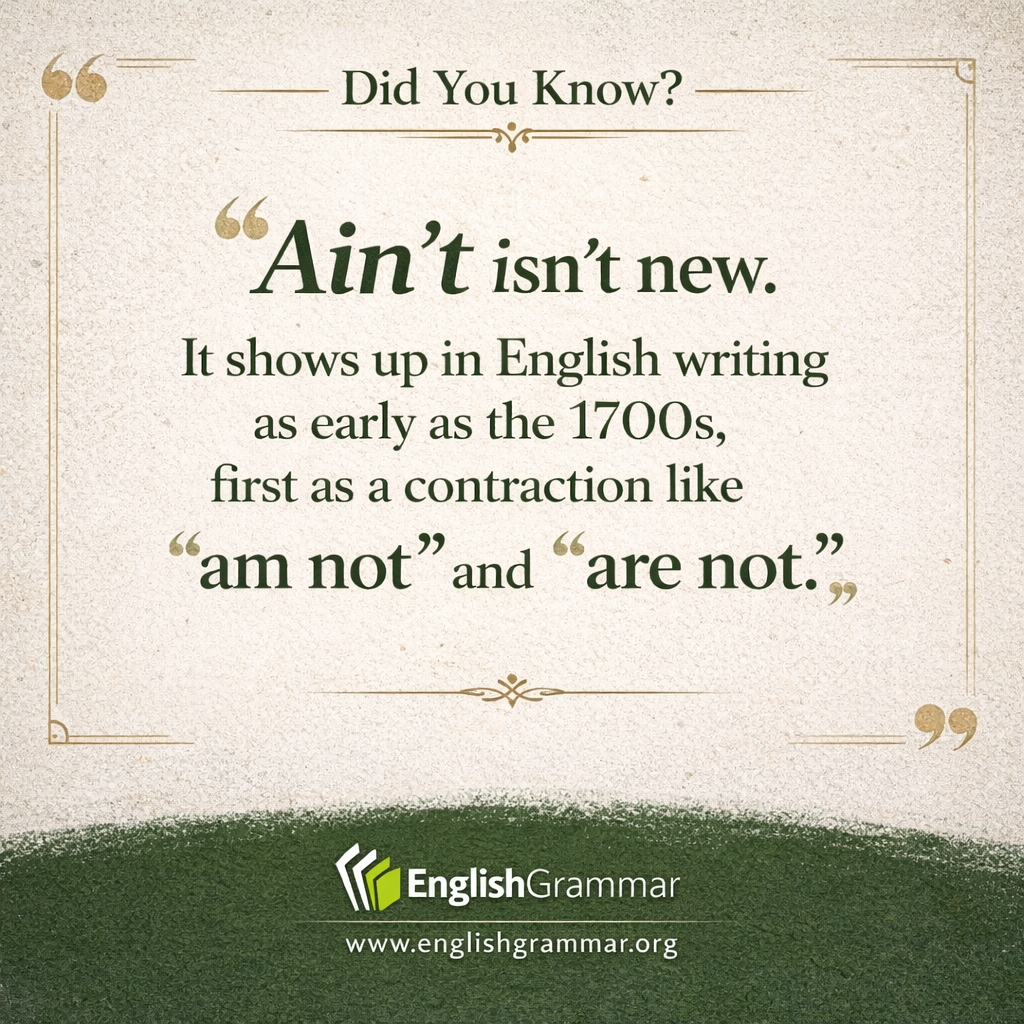
Ain’t feels modern to many readers, but it has a long paper trail. In English texts, it appears by the 1700s, and it likely grew from everyday speech where people regularly shortened common verb phrases.
Early on, ain’t could stand in for several negatives, especially forms related to be and have. It is often explained as developing from pronunciations and spellings connected to phrases like am not and are not, and it later spread to other patterns in speech.
What changed was not the word’s age, but its social meaning. Over time, style guides and school norms treated ain’t as nonstandard, so it became a marker of informal, regional, or working class speech in many settings. That is why it is common in dialogue and lyrics, but avoided in formal writing.
Examples and contrasts:
- Informal: I ain’t ready yet.
- More formal: I’m not ready yet.
- Informal: They ain’t coming.
- More formal: They aren’t coming.
If you want a safe rule, use ain’t intentionally for voice, character, or casual tone, and choose isn’t, aren’t, or haven’t in formal contexts.
