
• Skip to primary navigation
  • Skip to main content
  • Skip to primary sidebar
Home of English Grammar
  • Home
  • Exercises
  • Matches
  • Posts
  • Rules
  • Social Media Archive
  • Tools
    • Grammar Checker
    • Very Replacer
    • Word Counter
  • Vocabulary
  • Writing Guides
  • Upgrade to Pro

Ain’t is older than many people think

April 9, 2026 pdf

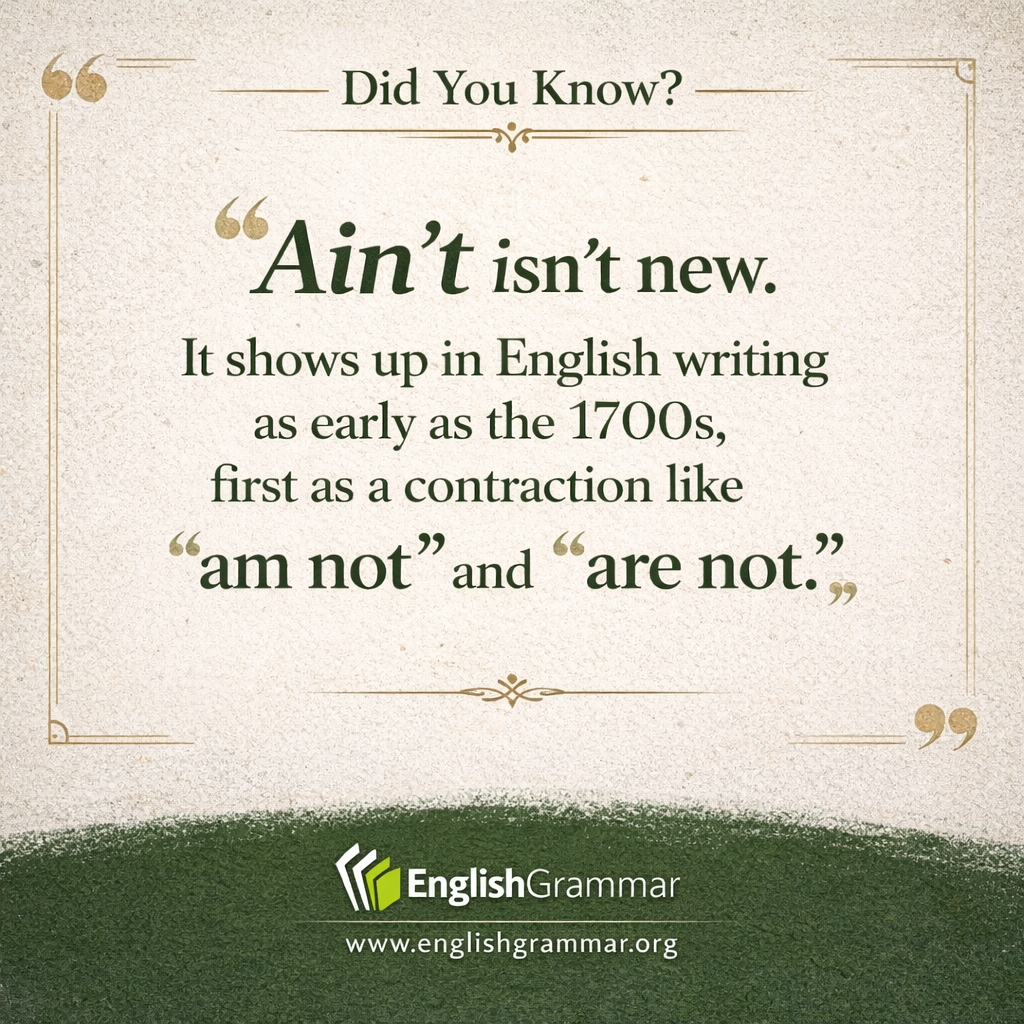
"Ain't" is older than many people think.

Ain’t feels modern to many readers, but it has a long paper trail. In English texts, it appears by the 1700s, and it likely grew from everyday speech where people regularly shortened common verb phrases.

Early on, ain’t could stand in for several negatives, especially forms related to be and have. It is often explained as developing from pronunciations and spellings connected to phrases like am not and are not, and it later spread to other patterns in speech.

What changed was not the word’s age, but its social meaning. Over time, style guides and school norms treated ain’t as nonstandard, so it became a marker of informal, regional, or working class speech in many settings. That is why it is common in dialogue and lyrics, but avoided in formal writing.

Examples and contrasts:

  • Informal: I ain’t ready yet.
  • More formal: I’m not ready yet.
  • Informal: They ain’t coming.
  • More formal: They aren’t coming.

If you want a safe rule, use ain’t intentionally for voice, character, or casual tone, and choose isn’t, aren’t, or haven’t in formal contexts.

  • Share
  • Post
  • Post
  • Reddit
  • Email
  • WhatsApp
NEW: Try Matches, our daily vocabulary challenge. Pick a topic and level and match words with definitions to boost your vocabulary.

Primary Sidebar

2,485,429 
761,532 
Improve Your English
  • Download 2026 Grammar Guide (PDF)
  • Free Weekly Exercises & Vocabulary
  • Join over 3 Million English Learners
We respect your privacy. Unsubscribe anytime.
Grammar Checker - Try Now

Latest Posts

  • Appointments Vocabulary Exercise October 12, 2026
  • 100 Best Synonyms for “Provoked” October 12, 2026
  • 100 Best Synonyms for “Stranded” October 12, 2026
  • The surprisingly old roots of “newfangled” October 12, 2026
  • 100 Best Synonyms for “Answer” October 12, 2026
  • 100 Best Synonyms for “Prove” October 12, 2026
  • 100 Best Synonyms for “Repressed” October 12, 2026
Home of English Grammar

Free English grammar exercises, rules and vocabulary lists, with new exercises every week. Join the leading English grammar site with over 3 million followers.

Upgrade to Pro

Learn

  • Exercises
  • Matches
  • Grammar rules
  • Vocabulary lists
  • Writing guides
  • Online tools

More

  • Top social media posts
  • Various posts
  • Free grammar guide (PDF)
  • Contact

Pro

  • What is Pro?
  • Pro account
  • Pro exercises

Copyright © 2026 EnglishGrammar.org

  • Disclaimer
  • Privacy policy
  • Refund policy
  • Terms
  • Sitemap
Improve Your English
  • Download 2026 Grammar Guide (PDF)
  • Free Weekly Exercises & Vocabulary
  • Join over 3 Million English Learners
We respect your privacy. Unsubscribe anytime.