
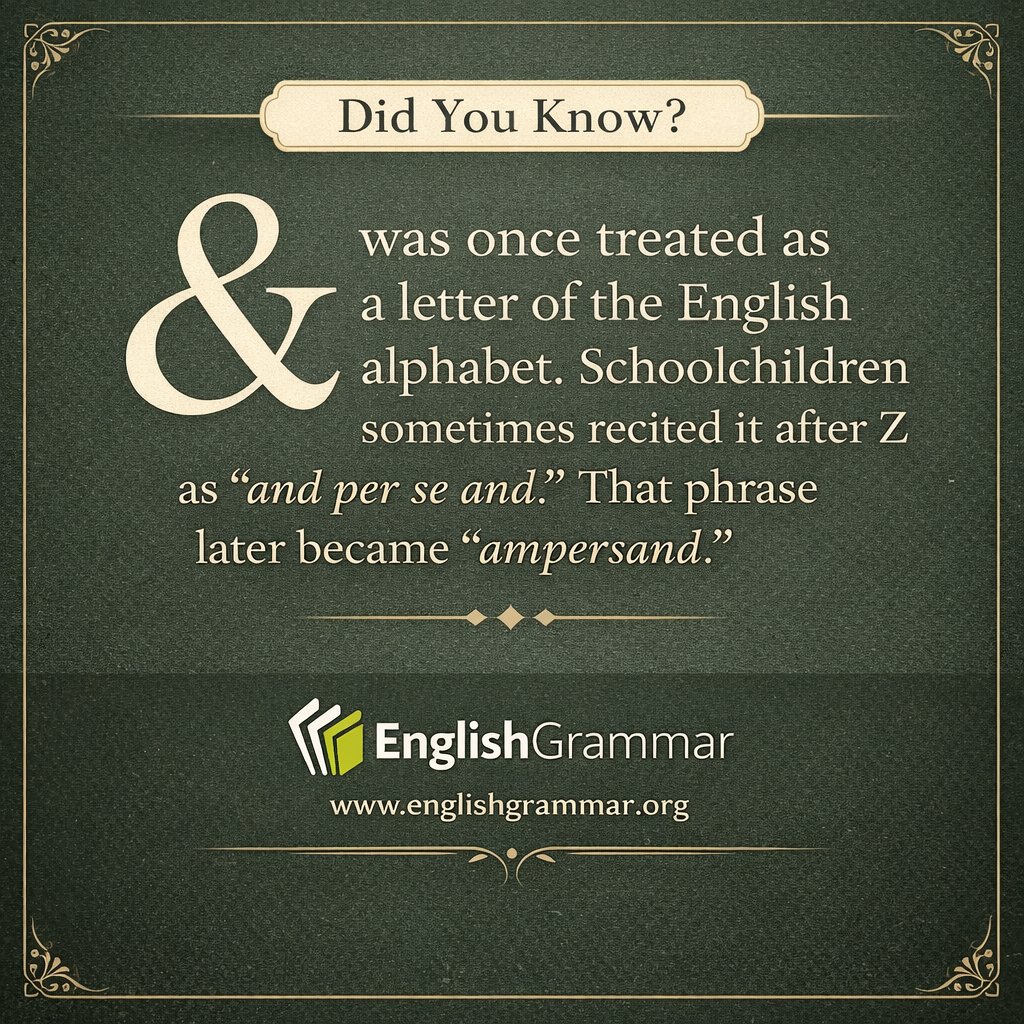
The symbol & has a surprisingly long history in English. In some schools and primers, it was treated as an extra letter and recited at the end of the alphabet. That practice was especially common in the 18th and 19th centuries, even though it was never as universally fixed as A to Z.
So where does the word ampersand come from? When children recited letters, they sometimes said “and per se and” to clarify that & meant the word and by itself (in Latin, per se means “by itself”). Over time, that phrase was slurred together in speech and became ampersand.
Today, & is not considered a letter in English. It is a symbol that usually stands in for and, especially in names and tight spaces.
- Common use in names: “Ben & Jerry’s” and “Smith & Sons.”
- In a sentence (more formal writing): “Bring paper and pencils.” (Many style guides prefer spelling out and in running text.)
- In a comparison: “Research and development” is often shortened to “R&D.”
This small mark carries a big reminder: punctuation and symbols can shift roles over time, from everyday letter lists to modern typography.
