
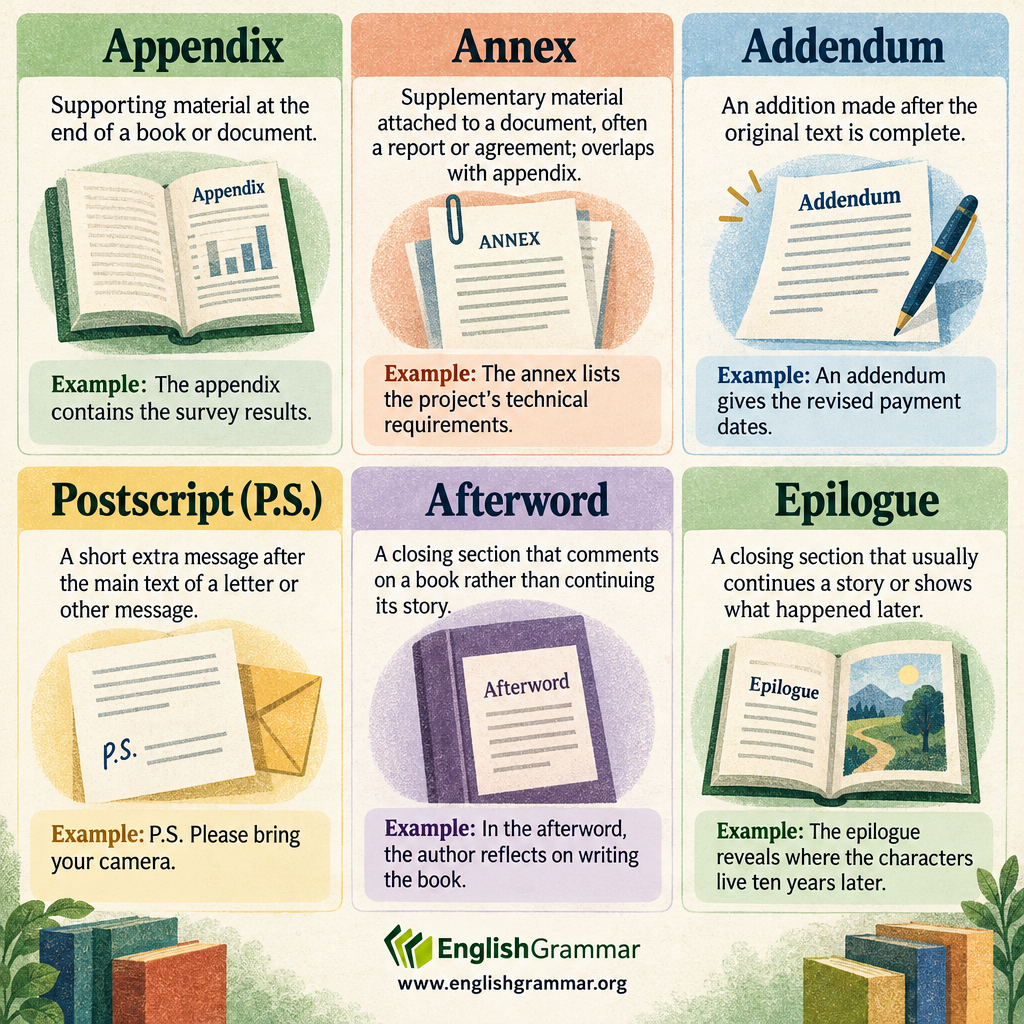
These six terms describe material added outside the main text, but they serve different purposes. Choose according to what the extra material does, not simply where it appears.
- Appendix: Supporting material at the end of a book or document, such as tables, questionnaires, or technical details. The appendix contains the full interview questions. It lets readers check details without interrupting the main discussion.
- Annex: Supplementary material attached to a document, often a report or agreement. The safety rules are attached as an annex to the contract. This overlaps with appendix, and organizations may use the terms differently. Follow the document’s existing naming convention.
- Addendum: An extra section or document added after the original text is complete. An addendum updates the delivery conditions. The emphasis is on a later addition, not necessarily reference material.
- Postscript (P.S.): A short extra message after a letter or other message, usually after the signature when there is one. P.S. I loved the photos you sent. It can be a deliberate final thought, not just something forgotten.
- Afterword: A closing section that comments on a book, often discussing its creation, background, or significance. The translator’s afterword explains several difficult choices. The writer steps back to discuss the work.
- Epilogue: A closing section that usually continues a story or tells what happened later. The epilogue follows the family after their move abroad. Unlike an afterword, it generally remains part of the narrative.