
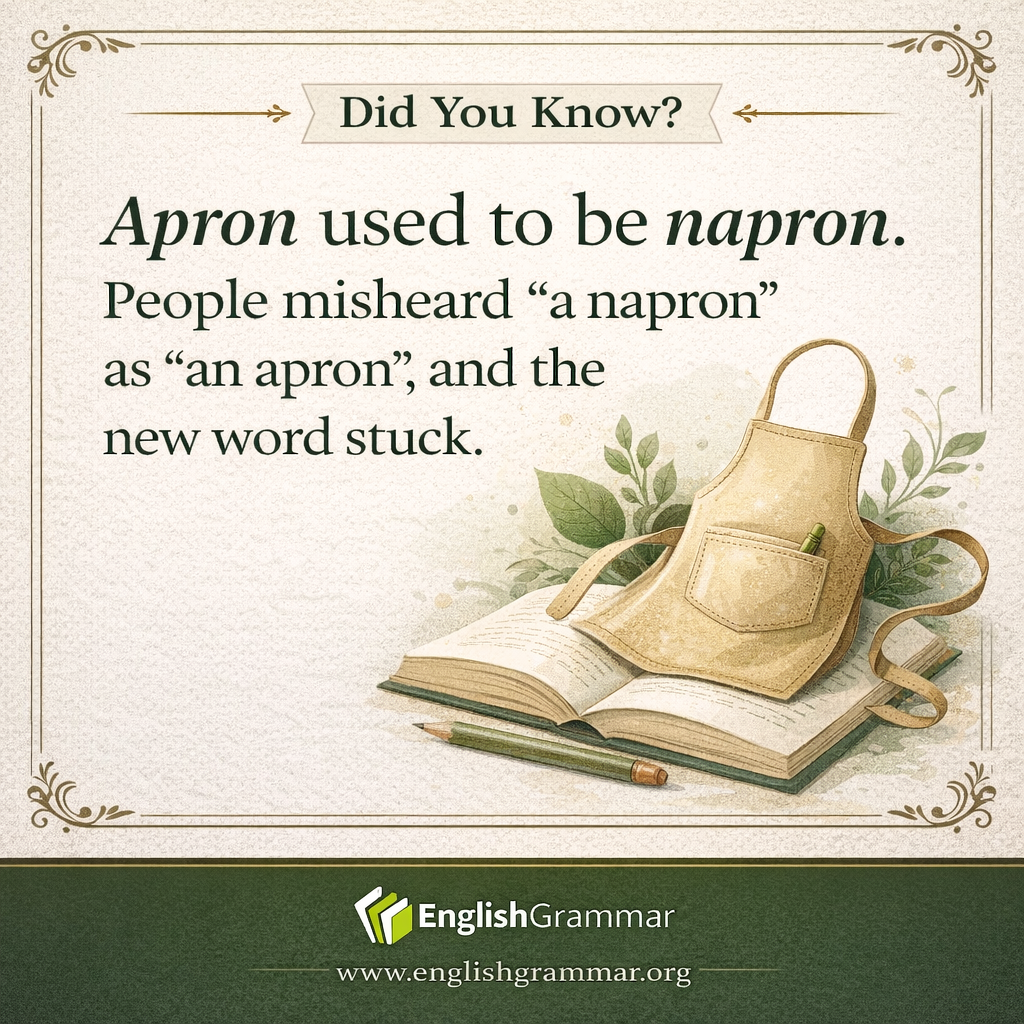
Apron looks ordinary today, but it is the result of a classic listening slip called rebracketing (also known as misdivision). That is when speakers move a boundary between words, often around a and an, because the sounds run together in everyday speech.
Historically, English had napron (from Old French), meaning a cloth worn in front. Over time, people began to interpret the phrase a napron as an apron. Once enough speakers adopted the new split, apron became the standard form and napron faded from common use.
You can hear why this happens. In quick speech, “a napron” can sound very close to “an apron”, especially when the initial n is lightly pronounced.
Example: “She tied on an apron before cooking.” In earlier English you could have found wording closer to: “She tied on a napron before cooking.”
This same pattern shows up in other words. A well known contrast is nickname, which came from an ekename being reheard as a nickname.
- Key idea: the sounds did not change much, but the word boundary did.
- Result: the reanalyzed form becomes normal once it spreads through a speech community.
