
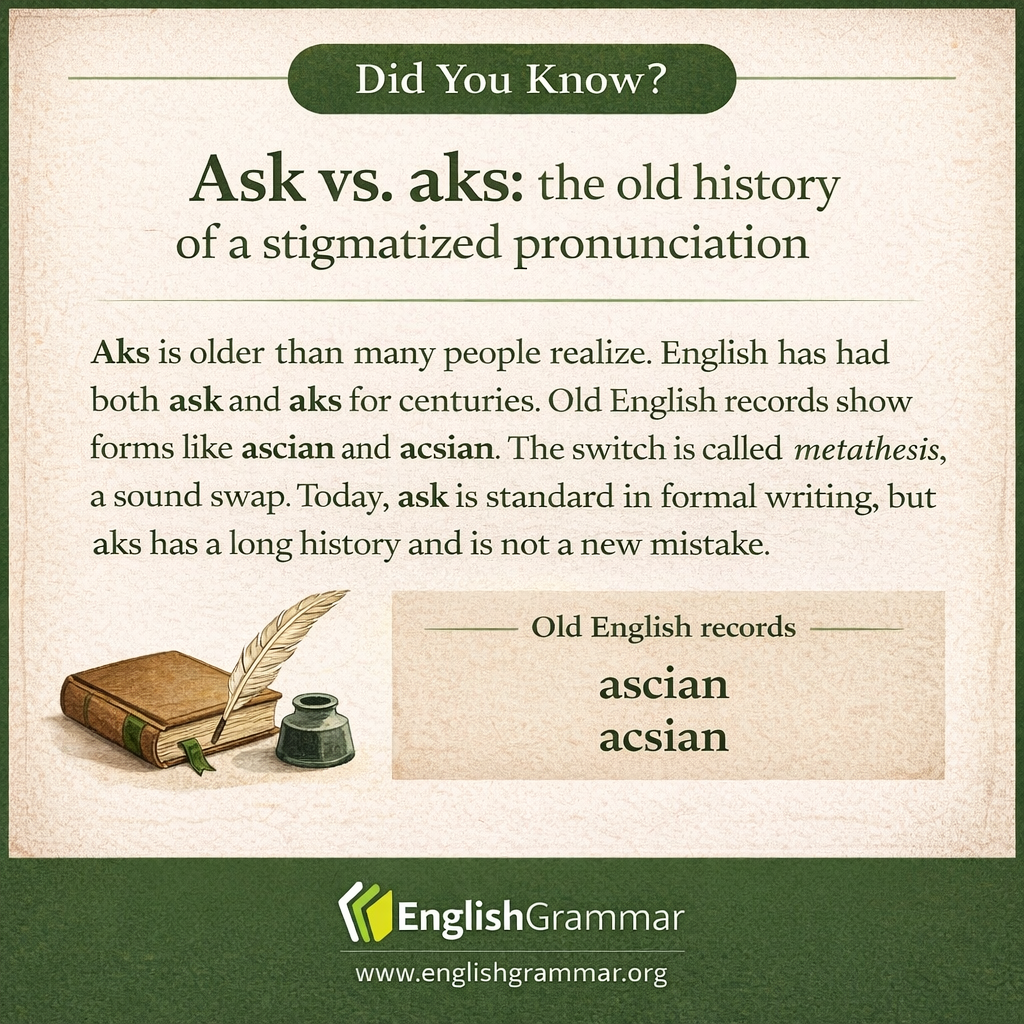
Many people assume aks is a recent error, but it is actually an old pronunciation with deep roots in English. For centuries, English has had forms that match both ask and aks. In Old English, records include forms such as ascian and acsian.
This kind of change is called metathesis, which means two sounds switch places. English has many examples of sound swapping over time. In this case, the s and k sounds changed order in speech, giving us both ask and aks.
Over time, ask became the standard spelling and the usual form in formal writing. But that does not mean aks appeared recently or has no history. It has been used in different regions and communities for a very long time.
- Standard written form: Ask your teacher a question.
- Historical spoken variant: I was going to aks you something.
So the modern status difference is real, but the history matters too. Ask is the standard form today, while aks is an old and well documented pronunciation, not a brand new mistake.