Home of English Grammar

Grammar Guide
  • Home
  • Exercises
  • Matches
  • Rules
  • Tools
    • Grammar Checker
    • Very Replacer
    • Word Counter
  • Top Social Media Posts
  • Various Posts
  • Vocabulary
  • Writing Guides
  • Contact

What “a bee in your bonnet” really means

May 8, 2026 - pdf

The origin of "a bee in your bonnet"

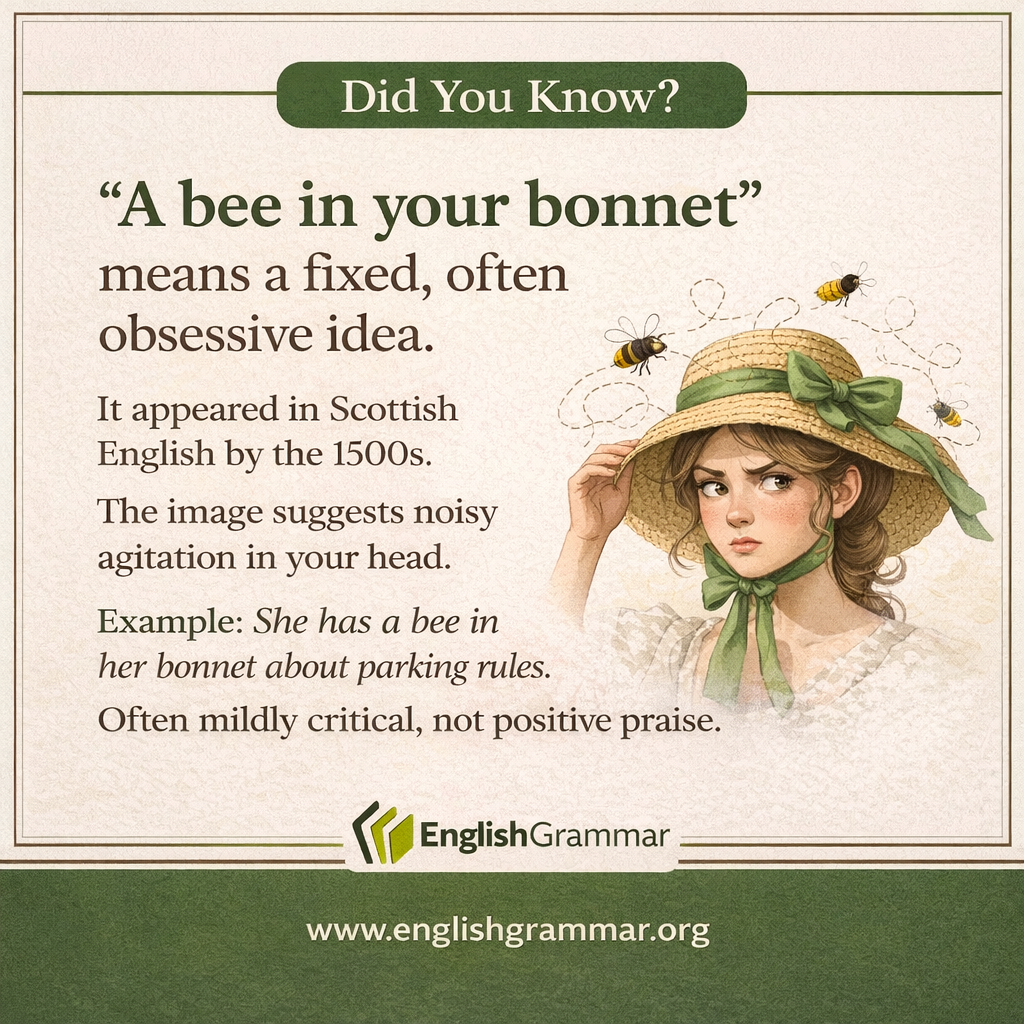
“A bee in your bonnet” is an idiom for having one particular idea stuck in your mind, often so strongly that you keep returning to it in conversation. It usually suggests irritation, obsession, or unnecessary intensity, not simple interest.

The phrase is old and is linked to Scottish English, where it was recorded centuries ago. The picture is easy to imagine: if a bee were trapped under your hat or bonnet, you would be distracted, agitated, and unable to think about much else. That image helped the expression come to mean a mind buzzing with one fixed concern.

Today, the idiom is often mildly critical. It suggests that someone is too focused on one issue.

  • Example: “He has a bee in his bonnet about office temperature.”
  • Contrast: “She is interested in local history” sounds neutral. “She has a bee in her bonnet about local history” suggests stronger, repeated focus.

People usually use it for topics, complaints, or causes that someone brings up again and again. It can be playful, but it often implies that the person’s focus is excessive.

  • Share
  • Post
  • Post
  • Email
NEW: Try Matches, our daily vocabulary challenge. Pick a topic and level and match words with definitions to boost your vocabulary.
2,485,429 
761,532 
Improve Your Grammar
  • Download 2026 Grammar Guide (PDF)
  • Free Weekly Exercises & Vocabulary
  • Join over 3 Million English Learners
We respect your privacy. Unsubscribe anytime.

Grammar Checker

GrammarCheck.net - Try online
Hint → Bookmark GrammarCheck for future use.

Latest Posts

  • What “a bee in your bonnet” really means May 8, 2026
  • 100 Best Synonyms for “Robust” May 8, 2026
  • 100 Best Synonyms for “Idleness” May 8, 2026
  • 100 Examples of Past Simple Sentences May 8, 2026
  • 100 Other Words for “Direct” May 8, 2026
  • Why we say “mad as a hatter” May 8, 2026
  • What Is an Oxymoron? May 8, 2026

Copyright © 2026 · EnglishGrammar.org
Disclaimer · Privacy Policy · Sitemap · Terms

Improve Your Grammar
  • Download 2026 Grammar Guide (PDF)
  • Free Weekly Exercises & Vocabulary
  • Join over 3 Million English Learners
We respect your privacy. Unsubscribe anytime.