
• Skip to primary navigation
  • Skip to main content
  • Skip to primary sidebar
Home of English Grammar
  • Home
  • Course
  • Exercises
  • Grammar Rules
  • Matches
  • Posts
  • Tools
    • Grammar Checker
    • Very Replacer
    • Word Counter
  • Vocabulary Lists
  • Archives
    • Social Media Posts
    • Writing Guides
  • Sign in
  • Join free

Canon vs. cannon: what is the difference?

May 19, 2026

Canon vs. Cannon

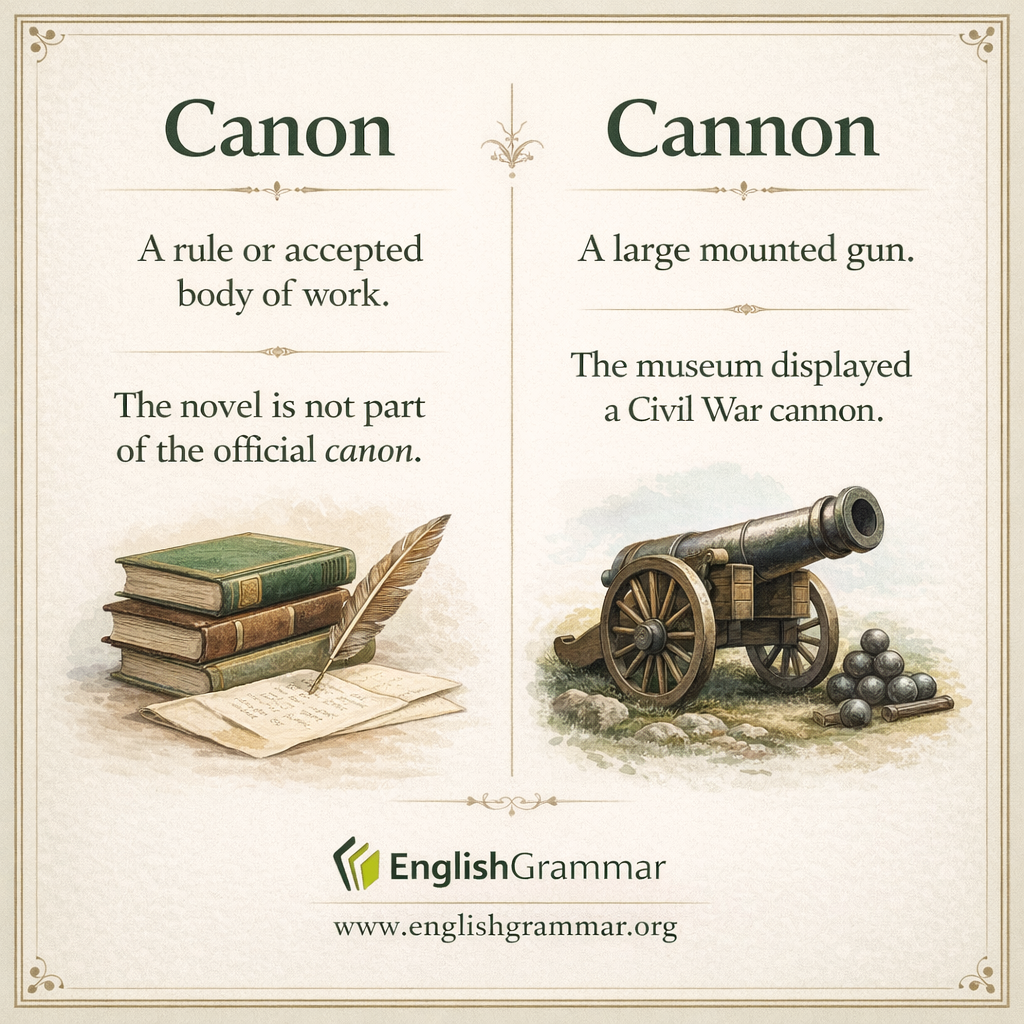
Canon and cannon sound the same, but they mean very different things.

Canon usually refers to a rule, a standard, or a group of works accepted as authentic or important. You will often see it in writing about religion, literature, film, and art. For example, you might say, This poem is part of the literary canon. In fan discussions, people also use it to mean something officially true in a story world.

Cannon is a noun for a large gun, usually mounted and used in warfare. For example, The fort still has an old cannon by the gate.

A quick way to remember the difference is this: cannon has an extra n, and it refers to something big and heavy. Canon is the spelling for authority, standards, and accepted works.

  • Use canon for rules, standards, and official works.
  • Use cannon for the weapon.
  • Example: The sequel is not canon, but the castle still has a cannon on display.

If you are writing about books, beliefs, or official story details, choose canon. If you mean artillery, choose cannon.

Improve your English grammar, vocabulary and writing

We take you step by step from beginner to advanced, even if you struggled with English at school or have always had trouble remembering the rules.

  • 10 modules, 112 lessons and 730 questions
  • Just log in and learn anytime and anywhere
  • Your progress is saved in your account
  • Download the 2027 Grammar Guide (PDF)
Join free

Already have an account? Sign in

See what’s in the course

Primary Sidebar

2.4M760.9K165.9K

Free 2027 Grammar Guide

  • Download Grammar Guide (PDF)
  • Online grammar course, A1 to C2
  • Weekly exercises and vocabulary
  • Join over 3 million English learners

We respect your privacy. Unsubscribe anytime.

Already have an account? Sign in

Grammar Checker - Try Now

Latest Posts

  • Ample vs. plentiful vs. abundant vs. bountiful vs. copious vs. profuse November 2, 2026
  • 100 Best Synonyms for “Respectfully” November 2, 2026
  • Creepy, spooky, eerie, sinister, macabre, and bloodcurdling: What’s the difference? November 2, 2026
  • 100 Best Synonyms for “Improvement” November 2, 2026
  • 100 Best Synonyms for “Understood” November 2, 2026
  • Perspicacious vs. perspicuous: understanding the difference November 2, 2026
  • 100 Best Synonyms for “Resent” November 2, 2026
  • 100 Best Synonyms for “Heavenly” November 2, 2026
  • 100 Best Synonyms for “Underpinned” November 2, 2026
  • 100 Best Synonyms for “Improved” November 2, 2026
Home of English Grammar

Free English grammar exercises, rules and vocabulary lists, with new exercises every week. Join the leading English grammar site with over 3 million followers.

Join free

Learn

  • Exercises
  • Matches
  • Grammar rules
  • Vocabulary lists
  • Writing guides
  • Online tools

More

  • Top social media posts
  • Various posts
  • Contact

Account

  • Join free
  • Grammar Course
  • Free grammar guide (PDF)

Copyright © 2026 EnglishGrammar.org

  • Disclaimer
  • Privacy policy
  • Terms
  • Sitemap