
• Skip to primary navigation
  • Skip to main content
  • Skip to primary sidebar
Home of English Grammar
  • Home
  • Course
  • Exercises
  • Grammar Rules
  • Vocabulary Matches
  • Posts
  • Tools
    • Grammar Checker
    • Very Replacer
    • Word Counter
  • Vocabulary Lists
  • Archives
    • Social Media Posts
    • Writing Guides
  • Sign in
  • Join free

What “cat’s paw” means and where it comes from

May 12, 2026

The origin of "cat’s paw"

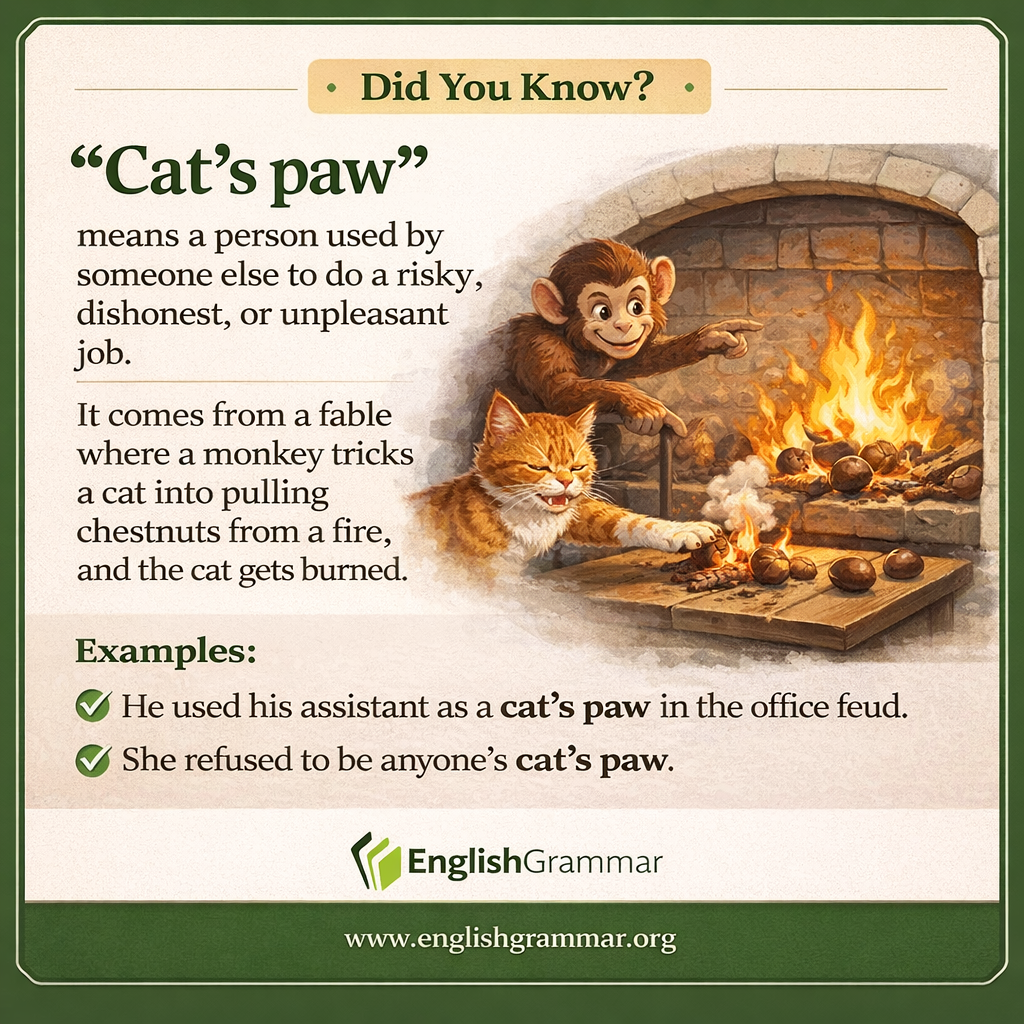
Cat’s paw means a person who is used by someone else to carry out a risky, unpleasant, or dishonest action. The key idea is manipulation. One person takes the danger or blame, while another person hopes to benefit.

The expression comes from an old fable. In the story, a monkey wants chestnuts roasting in a fire but does not want to burn himself. He flatters a cat and gets the cat to pull out the chestnuts. The cat burns its paw, and the monkey gets the food. That is why the modern meaning involves being used for someone else’s gain.

This phrase is often used in politics, business, workplace conflicts, or personal disputes. It suggests that the person being used may not fully understand how they are being manipulated, or may understand too late.

  • He used his assistant as a cat’s paw in the office feud.
  • She refused to be anyone’s cat’s paw during the argument.
  • The article suggested that the group was acting as a cat’s paw for a larger organization.

In modern English, the phrase is usually negative. If you call someone a cat’s paw, you mean they are being exploited, not simply helping.

Improve your English grammar, vocabulary and writing

We take you step by step from beginner to advanced, even if you struggled with English at school or have always had trouble remembering the rules.

  • 10 modules, 112 lessons and 730 questions
  • Just log in and learn anytime and anywhere
  • Your progress is saved in your account
  • Download the 2027 Grammar Guide (PDF)
Join free

Already have an account? Sign in

See what’s in the course

Primary Sidebar

2.4M760.9K165.9K

Free 2027 Grammar Guide

  • Download Grammar Guide (PDF)
  • Online grammar course, A1 to C2
  • Weekly exercises and vocabulary
  • Join over 3 million English learners

We respect your privacy. Unsubscribe anytime.

Already have an account? Sign in

Grammar Checker - Try Now

Latest Posts

  • 100 Best Synonyms for “Retributive” November 3, 2026
  • 100 Best Synonyms for “Vary” November 3, 2026
  • 100 Best Synonyms for “Individuals” November 3, 2026
  • Temporary vs. passing vs. fleeting vs. transient vs. ephemeral vs. evanescent November 3, 2026
  • 100 Best Synonyms for “Restless” November 3, 2026
  • Hard, firm, solid, rigid, stiff and unyielding: How to choose November 3, 2026
  • The origin of “out of the blue” November 3, 2026
  • 100 Best Synonyms for “Individualised” November 3, 2026
  • 100 Best Synonyms for “Varied” November 3, 2026
  • Fewer vs. less: counting things and measuring amounts November 3, 2026
Home of English Grammar

Free English grammar exercises, rules and vocabulary lists, with new exercises every week. Join the leading English grammar site with over 3 million followers.

Join free

Learn

  • Exercises
  • Matches
  • Grammar rules
  • Vocabulary lists
  • Writing guides
  • Online tools

More

  • Top social media posts
  • Various posts
  • Contact

Account

  • Join free
  • Grammar Course
  • Free grammar guide (PDF)

Copyright © 2026 EnglishGrammar.org

  • Disclaimer
  • Privacy policy
  • Terms
  • Sitemap