
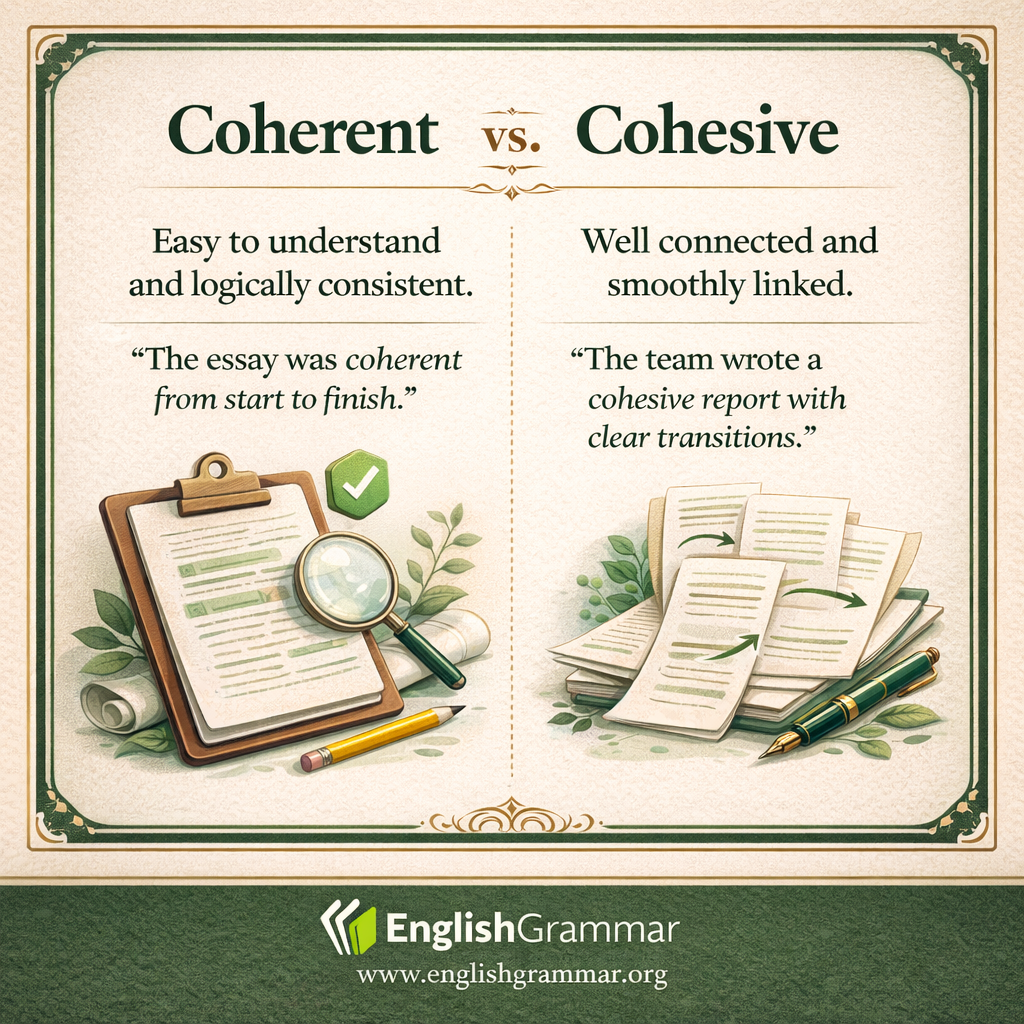
Coherent and cohesive are related, but they describe different strengths in writing, speech, and ideas.
Use coherent when something makes sense overall. The parts fit into a clear, logical whole, so the reader or listener can follow it easily. For example: The presentation was coherent from beginning to end.
Use cohesive when the parts are well connected to each other. This often refers to smooth transitions, strong links between sentences, or a group that works well together. For example: The report felt cohesive because each section connected naturally to the next.
A useful shortcut is this: coherent focuses on clarity and logic, while cohesive focuses on connection and unity.
- If the main question is, “Does it make sense?” choose coherent.
- If the main question is, “Do the parts hold together well?” choose cohesive.
Something can be cohesive without being fully coherent, and coherent without feeling especially cohesive. Strong writing usually aims for both.