
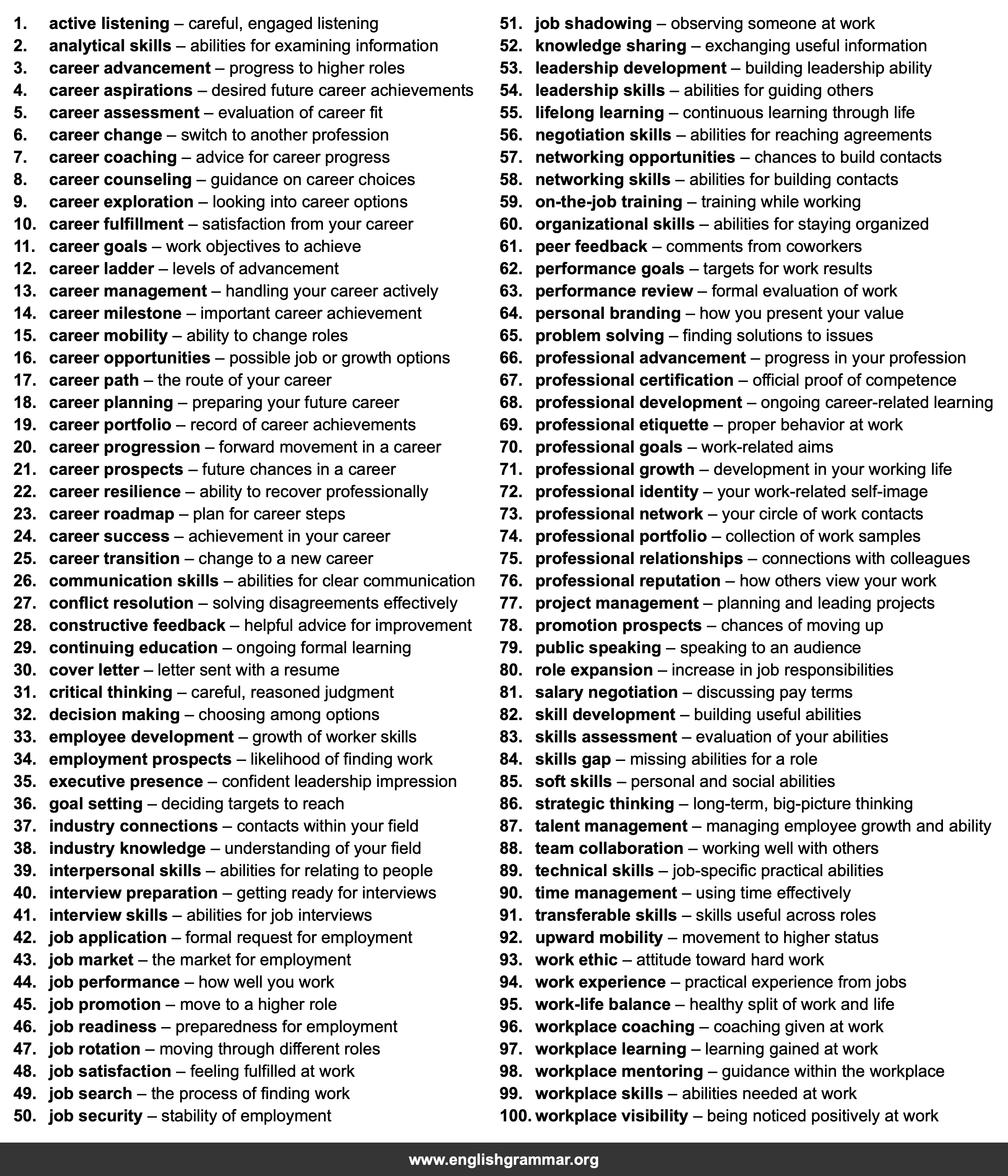
| No. | Item | Definition |
|---|---|---|
| 1. | active listening | careful, engaged listening |
| 2. | analytical skills | abilities for examining information |
| 3. | career advancement | progress to higher roles |
| 4. | career aspirations | desired future career achievements |
| 5. | career assessment | evaluation of career fit |
| 6. | career change | switch to another profession |
| 7. | career coaching | advice for career progress |
| 8. | career counseling | guidance on career choices |
| 9. | career exploration | looking into career options |
| 10. | career fulfillment | satisfaction from your career |
| 11. | career goals | work objectives to achieve |
| 12. | career ladder | levels of advancement |
| 13. | career management | handling your career actively |
| 14. | career milestone | important career achievement |
| 15. | career mobility | ability to change roles |
| 16. | career opportunities | possible job or growth options |
| 17. | career path | the route of your career |
| 18. | career planning | preparing your future career |
| 19. | career portfolio | record of career achievements |
| 20. | career progression | forward movement in a career |
| 21. | career prospects | future chances in a career |
| 22. | career resilience | ability to recover professionally |
| 23. | career roadmap | plan for career steps |
| 24. | career success | achievement in your career |
| 25. | career transition | change to a new career |
| 26. | communication skills | abilities for clear communication |
| 27. | conflict resolution | solving disagreements effectively |
| 28. | constructive feedback | helpful advice for improvement |
| 29. | continuing education | ongoing formal learning |
| 30. | cover letter | letter sent with a resume |
| 31. | critical thinking | careful, reasoned judgment |
| 32. | decision making | choosing among options |
| 33. | employee development | growth of worker skills |
| 34. | employment prospects | likelihood of finding work |
| 35. | executive presence | confident leadership impression |
| 36. | goal setting | deciding targets to reach |
| 37. | industry connections | contacts within your field |
| 38. | industry knowledge | understanding of your field |
| 39. | interpersonal skills | abilities for relating to people |
| 40. | interview preparation | getting ready for interviews |
| 41. | interview skills | abilities for job interviews |
| 42. | job application | formal request for employment |
| 43. | job market | the market for employment |
| 44. | job performance | how well you work |
| 45. | job promotion | move to a higher role |
| 46. | job readiness | preparedness for employment |
| 47. | job rotation | moving through different roles |
| 48. | job satisfaction | feeling fulfilled at work |
| 49. | job search | the process of finding work |
| 50. | job security | stability of employment |
| 51. | job shadowing | observing someone at work |
| 52. | knowledge sharing | exchanging useful information |
| 53. | leadership development | building leadership ability |
| 54. | leadership skills | abilities for guiding others |
| 55. | lifelong learning | continuous learning through life |
| 56. | negotiation skills | abilities for reaching agreements |
| 57. | networking opportunities | chances to build contacts |
| 58. | networking skills | abilities for building contacts |
| 59. | on-the-job training | training while working |
| 60. | organizational skills | abilities for staying organized |
| 61. | peer feedback | comments from coworkers |
| 62. | performance goals | targets for work results |
| 63. | performance review | formal evaluation of work |
| 64. | personal branding | how you present your value |
| 65. | problem solving | finding solutions to issues |
| 66. | professional advancement | progress in your profession |
| 67. | professional certification | official proof of competence |
| 68. | professional development | ongoing career-related learning |
| 69. | professional etiquette | proper behavior at work |
| 70. | professional goals | work-related aims |
| 71. | professional growth | development in your working life |
| 72. | professional identity | your work-related self-image |
| 73. | professional network | your circle of work contacts |
| 74. | professional portfolio | collection of work samples |
| 75. | professional relationships | connections with colleagues |
| 76. | professional reputation | how others view your work |
| 77. | project management | planning and leading projects |
| 78. | promotion prospects | chances of moving up |
| 79. | public speaking | speaking to an audience |
| 80. | role expansion | increase in job responsibilities |
| 81. | salary negotiation | discussing pay terms |
| 82. | skill development | building useful abilities |
| 83. | skills assessment | evaluation of your abilities |
| 84. | skills gap | missing abilities for a role |
| 85. | soft skills | personal and social abilities |
| 86. | strategic thinking | long-term, big-picture thinking |
| 87. | talent management | managing employee growth and ability |
| 88. | team collaboration | working well with others |
| 89. | technical skills | job-specific practical abilities |
| 90. | time management | using time effectively |
| 91. | transferable skills | skills useful across roles |
| 92. | upward mobility | movement to higher status |
| 93. | work ethic | attitude toward hard work |
| 94. | work experience | practical experience from jobs |
| 95. | work-life balance | healthy split of work and life |
| 96. | workplace coaching | coaching given at work |
| 97. | workplace learning | learning gained at work |
| 98. | workplace mentoring | guidance within the workplace |
| 99. | workplace skills | abilities needed at work |
| 100. | workplace visibility | being noticed positively at work |