
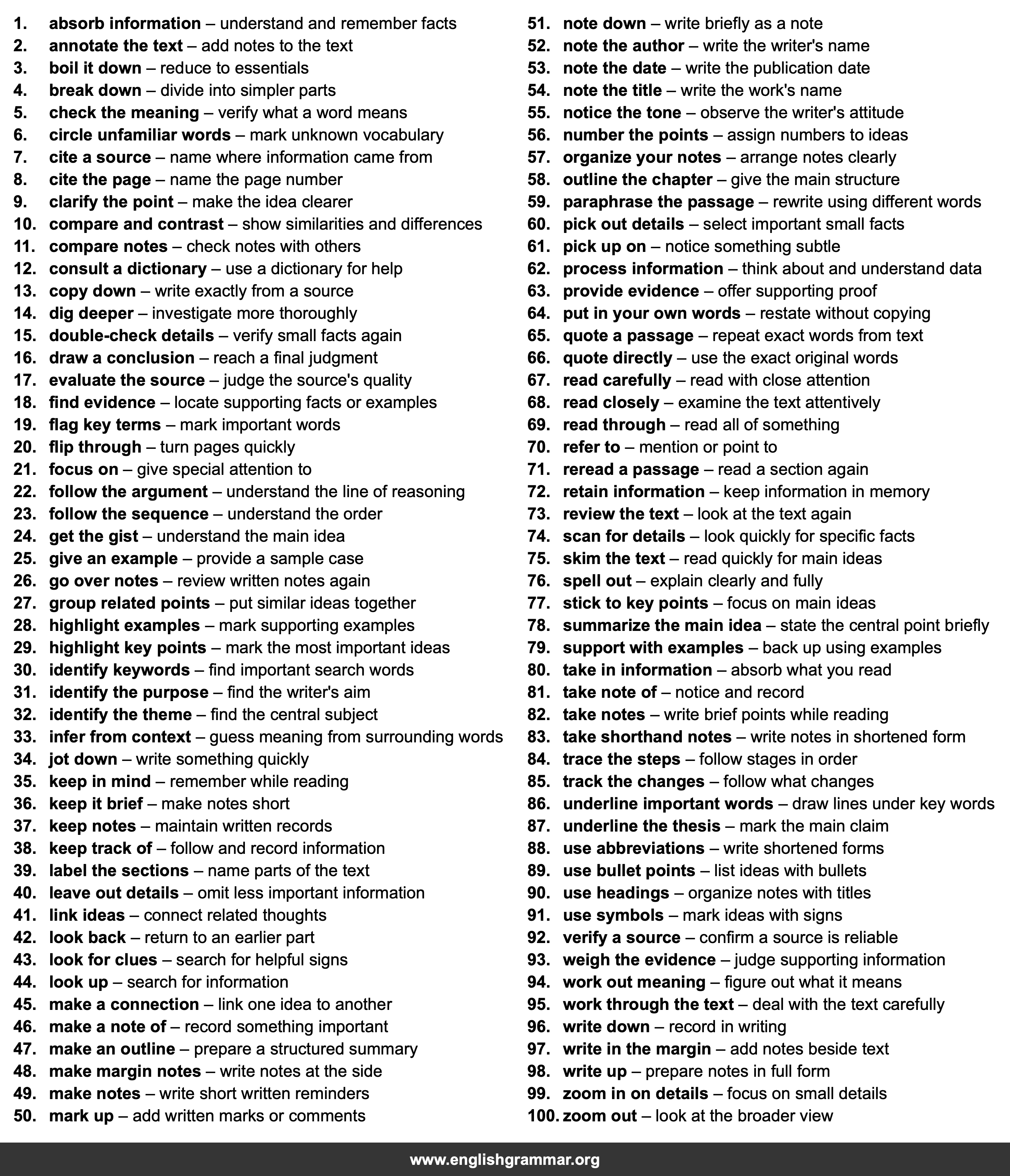
| No. | Item | Definition |
|---|---|---|
| 1. | absorb information | understand and remember facts |
| 2. | annotate the text | add notes to the text |
| 3. | boil it down | reduce to essentials |
| 4. | break down | divide into simpler parts |
| 5. | check the meaning | verify what a word means |
| 6. | circle unfamiliar words | mark unknown vocabulary |
| 7. | cite a source | name where information came from |
| 8. | cite the page | name the page number |
| 9. | clarify the point | make the idea clearer |
| 10. | compare and contrast | show similarities and differences |
| 11. | compare notes | check notes with others |
| 12. | consult a dictionary | use a dictionary for help |
| 13. | copy down | write exactly from a source |
| 14. | dig deeper | investigate more thoroughly |
| 15. | double-check details | verify small facts again |
| 16. | draw a conclusion | reach a final judgment |
| 17. | evaluate the source | judge the source’s quality |
| 18. | find evidence | locate supporting facts or examples |
| 19. | flag key terms | mark important words |
| 20. | flip through | turn pages quickly |
| 21. | focus on | give special attention to |
| 22. | follow the argument | understand the line of reasoning |
| 23. | follow the sequence | understand the order |
| 24. | get the gist | understand the main idea |
| 25. | give an example | provide a sample case |
| 26. | go over notes | review written notes again |
| 27. | group related points | put similar ideas together |
| 28. | highlight examples | mark supporting examples |
| 29. | highlight key points | mark the most important ideas |
| 30. | identify keywords | find important search words |
| 31. | identify the purpose | find the writer’s aim |
| 32. | identify the theme | find the central subject |
| 33. | infer from context | guess meaning from surrounding words |
| 34. | jot down | write something quickly |
| 35. | keep in mind | remember while reading |
| 36. | keep it brief | make notes short |
| 37. | keep notes | maintain written records |
| 38. | keep track of | follow and record information |
| 39. | label the sections | name parts of the text |
| 40. | leave out details | omit less important information |
| 41. | link ideas | connect related thoughts |
| 42. | look back | return to an earlier part |
| 43. | look for clues | search for helpful signs |
| 44. | look up | search for information |
| 45. | make a connection | link one idea to another |
| 46. | make a note of | record something important |
| 47. | make an outline | prepare a structured summary |
| 48. | make margin notes | write notes at the side |
| 49. | make notes | write short written reminders |
| 50. | mark up | add written marks or comments |
| 51. | note down | write briefly as a note |
| 52. | note the author | write the writer’s name |
| 53. | note the date | write the publication date |
| 54. | note the title | write the work’s name |
| 55. | notice the tone | observe the writer’s attitude |
| 56. | number the points | assign numbers to ideas |
| 57. | organize your notes | arrange notes clearly |
| 58. | outline the chapter | give the main structure |
| 59. | paraphrase the passage | rewrite using different words |
| 60. | pick out details | select important small facts |
| 61. | pick up on | notice something subtle |
| 62. | process information | think about and understand data |
| 63. | provide evidence | offer supporting proof |
| 64. | put in your own words | restate without copying |
| 65. | quote a passage | repeat exact words from text |
| 66. | quote directly | use the exact original words |
| 67. | read carefully | read with close attention |
| 68. | read closely | examine the text attentively |
| 69. | read through | read all of something |
| 70. | refer to | mention or point to |
| 71. | reread a passage | read a section again |
| 72. | retain information | keep information in memory |
| 73. | review the text | look at the text again |
| 74. | scan for details | look quickly for specific facts |
| 75. | skim the text | read quickly for main ideas |
| 76. | spell out | explain clearly and fully |
| 77. | stick to key points | focus on main ideas |
| 78. | summarize the main idea | state the central point briefly |
| 79. | support with examples | back up using examples |
| 80. | take in information | absorb what you read |
| 81. | take note of | notice and record |
| 82. | take notes | write brief points while reading |
| 83. | take shorthand notes | write notes in shortened form |
| 84. | trace the steps | follow stages in order |
| 85. | track the changes | follow what changes |
| 86. | underline important words | draw lines under key words |
| 87. | underline the thesis | mark the main claim |
| 88. | use abbreviations | write shortened forms |
| 89. | use bullet points | list ideas with bullets |
| 90. | use headings | organize notes with titles |
| 91. | use symbols | mark ideas with signs |
| 92. | verify a source | confirm a source is reliable |
| 93. | weigh the evidence | judge supporting information |
| 94. | work out meaning | figure out what it means |
| 95. | work through the text | deal with the text carefully |
| 96. | write down | record in writing |
| 97. | write in the margin | add notes beside text |
| 98. | write up | prepare notes in full form |
| 99. | zoom in on details | focus on small details |
| 100. | zoom out | look at the broader view |