
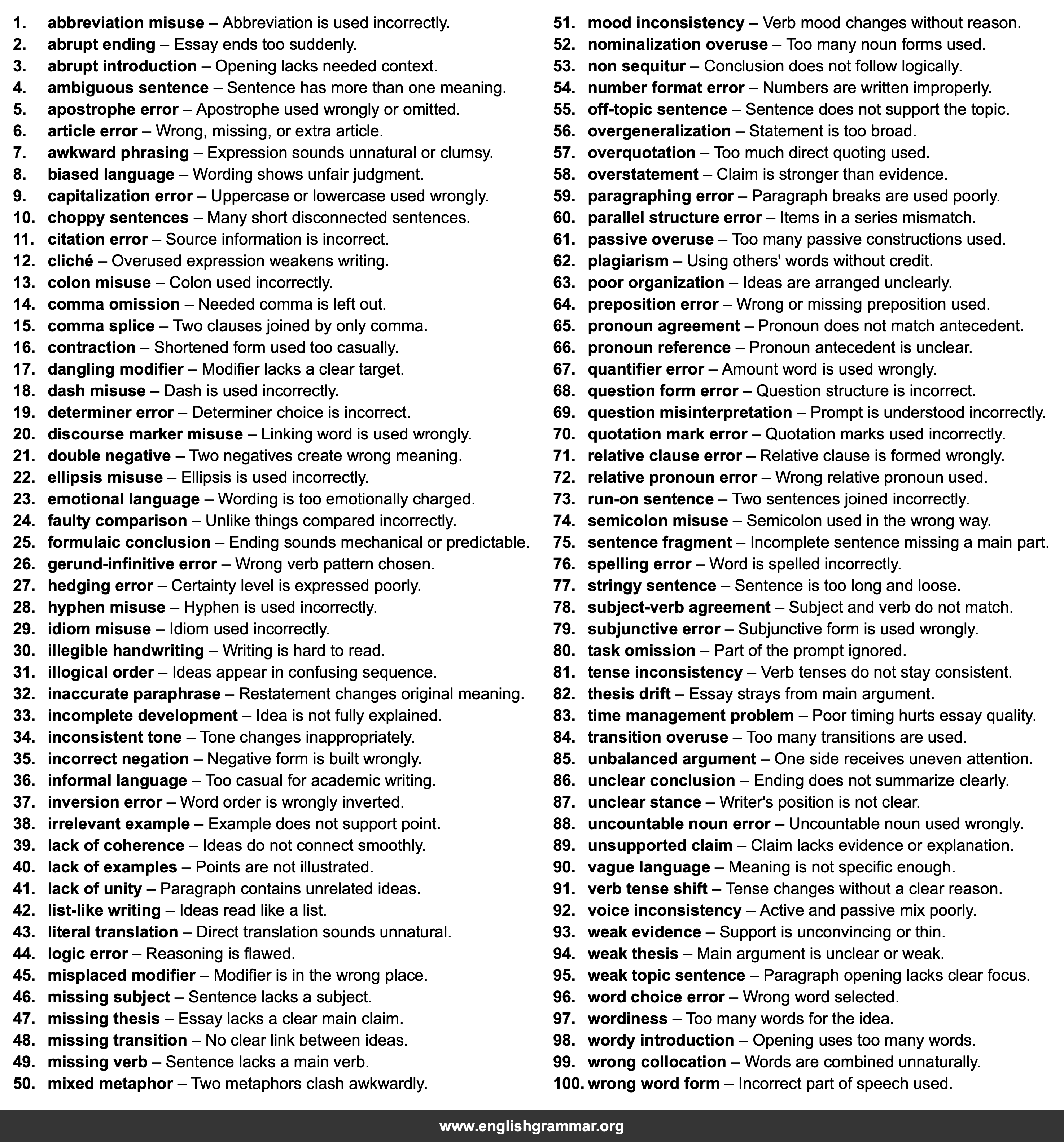
| No. | Item | Definition |
|---|---|---|
| 1. | abbreviation misuse | Abbreviation is used incorrectly. |
| 2. | abrupt ending | Essay ends too suddenly. |
| 3. | abrupt introduction | Opening lacks needed context. |
| 4. | ambiguous sentence | Sentence has more than one meaning. |
| 5. | apostrophe error | Apostrophe used wrongly or omitted. |
| 6. | article error | Wrong, missing, or extra article. |
| 7. | awkward phrasing | Expression sounds unnatural or clumsy. |
| 8. | biased language | Wording shows unfair judgment. |
| 9. | capitalization error | Uppercase or lowercase used wrongly. |
| 10. | choppy sentences | Many short disconnected sentences. |
| 11. | citation error | Source information is incorrect. |
| 12. | cliché | Overused expression weakens writing. |
| 13. | colon misuse | Colon used incorrectly. |
| 14. | comma omission | Needed comma is left out. |
| 15. | comma splice | Two clauses joined by only comma. |
| 16. | contraction | Shortened form used too casually. |
| 17. | dangling modifier | Modifier lacks a clear target. |
| 18. | dash misuse | Dash is used incorrectly. |
| 19. | determiner error | Determiner choice is incorrect. |
| 20. | discourse marker misuse | Linking word is used wrongly. |
| 21. | double negative | Two negatives create wrong meaning. |
| 22. | ellipsis misuse | Ellipsis is used incorrectly. |
| 23. | emotional language | Wording is too emotionally charged. |
| 24. | faulty comparison | Unlike things compared incorrectly. |
| 25. | formulaic conclusion | Ending sounds mechanical or predictable. |
| 26. | gerund-infinitive error | Wrong verb pattern chosen. |
| 27. | hedging error | Certainty level is expressed poorly. |
| 28. | hyphen misuse | Hyphen is used incorrectly. |
| 29. | idiom misuse | Idiom used incorrectly. |
| 30. | illegible handwriting | Writing is hard to read. |
| 31. | illogical order | Ideas appear in confusing sequence. |
| 32. | inaccurate paraphrase | Restatement changes original meaning. |
| 33. | incomplete development | Idea is not fully explained. |
| 34. | inconsistent tone | Tone changes inappropriately. |
| 35. | incorrect negation | Negative form is built wrongly. |
| 36. | informal language | Too casual for academic writing. |
| 37. | inversion error | Word order is wrongly inverted. |
| 38. | irrelevant example | Example does not support point. |
| 39. | lack of coherence | Ideas do not connect smoothly. |
| 40. | lack of examples | Points are not illustrated. |
| 41. | lack of unity | Paragraph contains unrelated ideas. |
| 42. | list-like writing | Ideas read like a list. |
| 43. | literal translation | Direct translation sounds unnatural. |
| 44. | logic error | Reasoning is flawed. |
| 45. | misplaced modifier | Modifier is in the wrong place. |
| 46. | missing subject | Sentence lacks a subject. |
| 47. | missing thesis | Essay lacks a clear main claim. |
| 48. | missing transition | No clear link between ideas. |
| 49. | missing verb | Sentence lacks a main verb. |
| 50. | mixed metaphor | Two metaphors clash awkwardly. |
| 51. | mood inconsistency | Verb mood changes without reason. |
| 52. | nominalization overuse | Too many noun forms used. |
| 53. | non sequitur | Conclusion does not follow logically. |
| 54. | number format error | Numbers are written improperly. |
| 55. | off-topic sentence | Sentence does not support the topic. |
| 56. | overgeneralization | Statement is too broad. |
| 57. | overquotation | Too much direct quoting used. |
| 58. | overstatement | Claim is stronger than evidence. |
| 59. | paragraphing error | Paragraph breaks are used poorly. |
| 60. | parallel structure error | Items in a series mismatch. |
| 61. | passive overuse | Too many passive constructions used. |
| 62. | plagiarism | Using others’ words without credit. |
| 63. | poor organization | Ideas are arranged unclearly. |
| 64. | preposition error | Wrong or missing preposition used. |
| 65. | pronoun agreement | Pronoun does not match antecedent. |
| 66. | pronoun reference | Pronoun antecedent is unclear. |
| 67. | quantifier error | Amount word is used wrongly. |
| 68. | question form error | Question structure is incorrect. |
| 69. | question misinterpretation | Prompt is understood incorrectly. |
| 70. | quotation mark error | Quotation marks used incorrectly. |
| 71. | relative clause error | Relative clause is formed wrongly. |
| 72. | relative pronoun error | Wrong relative pronoun used. |
| 73. | run-on sentence | Two sentences joined incorrectly. |
| 74. | semicolon misuse | Semicolon used in the wrong way. |
| 75. | sentence fragment | Incomplete sentence missing a main part. |
| 76. | spelling error | Word is spelled incorrectly. |
| 77. | stringy sentence | Sentence is too long and loose. |
| 78. | subject-verb agreement | Subject and verb do not match. |
| 79. | subjunctive error | Subjunctive form is used wrongly. |
| 80. | task omission | Part of the prompt ignored. |
| 81. | tense inconsistency | Verb tenses do not stay consistent. |
| 82. | thesis drift | Essay strays from main argument. |
| 83. | time management problem | Poor timing hurts essay quality. |
| 84. | transition overuse | Too many transitions are used. |
| 85. | unbalanced argument | One side receives uneven attention. |
| 86. | unclear conclusion | Ending does not summarize clearly. |
| 87. | unclear stance | Writer’s position is not clear. |
| 88. | uncountable noun error | Uncountable noun used wrongly. |
| 89. | unsupported claim | Claim lacks evidence or explanation. |
| 90. | vague language | Meaning is not specific enough. |
| 91. | verb tense shift | Tense changes without a clear reason. |
| 92. | voice inconsistency | Active and passive mix poorly. |
| 93. | weak evidence | Support is unconvincing or thin. |
| 94. | weak thesis | Main argument is unclear or weak. |
| 95. | weak topic sentence | Paragraph opening lacks clear focus. |
| 96. | word choice error | Wrong word selected. |
| 97. | wordiness | Too many words for the idea. |
| 98. | wordy introduction | Opening uses too many words. |
| 99. | wrong collocation | Words are combined unnaturally. |
| 100. | wrong word form | Incorrect part of speech used. |