
• Skip to primary navigation
  • Skip to main content
  • Skip to primary sidebar
Home of English Grammar
  • Home
  • Course
  • Exercises
  • Grammar Rules
  • Matches
  • Posts
  • Tools
    • Grammar Checker
    • Very Replacer
    • Word Counter
  • Vocabulary Lists
  • Archives
    • Social Media Posts
    • Writing Guides
  • Sign in
  • Join free

What “dog in the manger” means, and where it comes from

May 25, 2026

The origin of "dog in the manger"

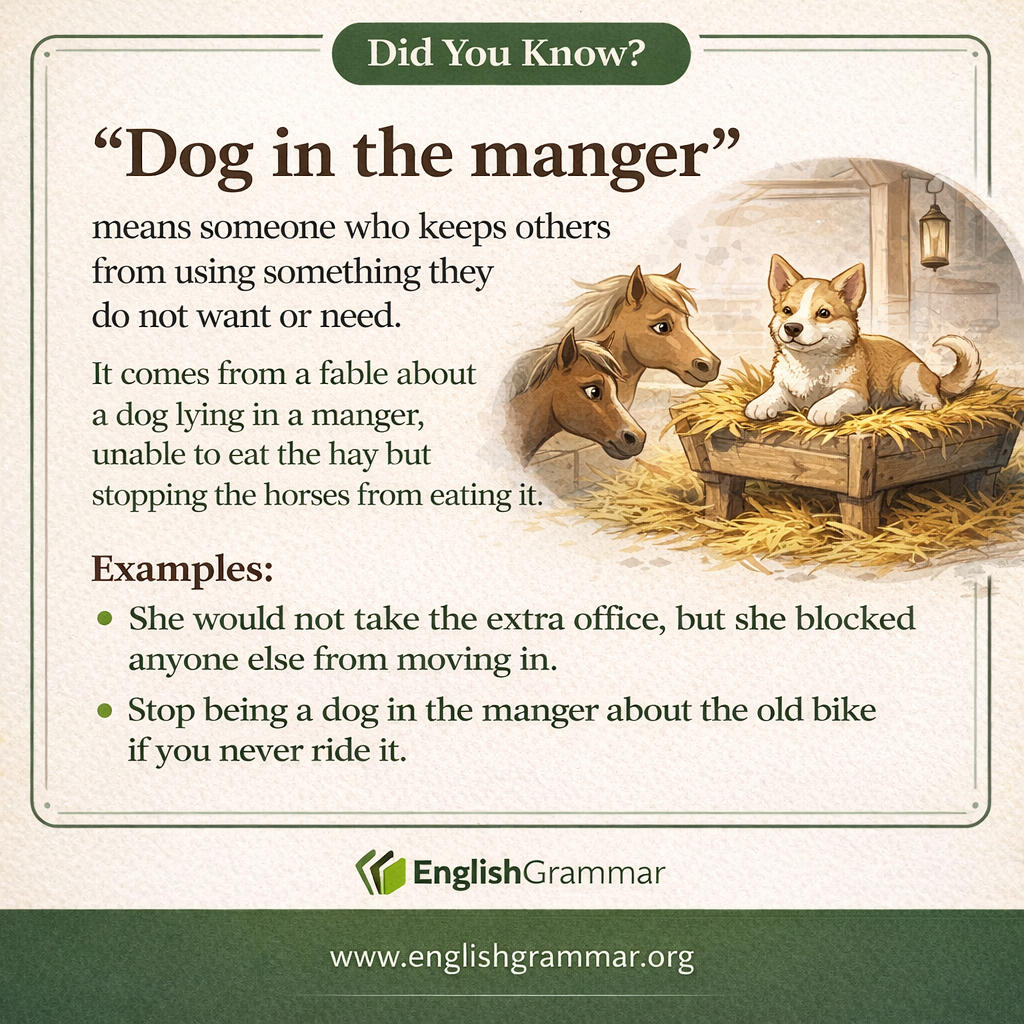
Dog in the manger is an idiom for a person who keeps others from having or using something, even though that person has no use for it. The idea is selfish obstruction, not simple ownership.

The expression comes from an old fable. A dog lies in a manger, which is a feeding trough or rack holding hay for horses or cattle. The dog cannot eat the hay, but it snarls and stops the animals from eating it. That image led to the modern meaning: blocking others from something you do not even want for yourself.

This idiom is often used when someone refuses to share, delays access, or prevents progress for no good reason.

  • She never uses the garden plot, but she will not let anyone else plant there. That is a dog in the manger attitude.
  • He did not want the project lead role, yet he objected whenever someone else was suggested.

People usually use the phrase critically. It suggests pettiness or spite, not fairness. If someone is simply protecting their own property for a clear reason, this idiom may be too harsh. Use it when the real problem is stopping others for the sake of stopping them.

Improve your English grammar, vocabulary and writing

We take you step by step from beginner to advanced, even if you struggled with English at school or have always had trouble remembering the rules.

  • 10 modules, 112 lessons and 730 questions
  • Just log in and learn anytime and anywhere
  • Your progress is saved in your account
  • Download the 2027 Grammar Guide (PDF)
Join free

Already have an account? Sign in

See what’s in the course

Primary Sidebar

2.4M760.9K165.9K

Free 2027 Grammar Guide

  • Download Grammar Guide (PDF)
  • Online grammar course, A1 to C2
  • Weekly exercises and vocabulary
  • Join over 3 million English learners

We respect your privacy. Unsubscribe anytime.

Already have an account? Sign in

Grammar Checker - Try Now

Latest Posts

  • 100 Best Synonyms for “Unbelievable” November 1, 2026
  • 100 Best Synonyms for “Reparations” November 1, 2026
  • The difference between an acronym and an initialism November 1, 2026
  • Differ vs. vary: how to choose the right verb November 1, 2026
  • 100 Best Synonyms for “Immersive” November 1, 2026
  • 100 Words Every Foley Artist Should Know November 1, 2026
  • 100 Best Synonyms for “Remnants” November 1, 2026
  • 100 Best Synonyms for “Table” November 1, 2026
  • 100 Email Subject Lines for Requests for Approval November 1, 2026
  • 100 Best Synonyms for “Ultimate” November 1, 2026
Home of English Grammar

Free English grammar exercises, rules and vocabulary lists, with new exercises every week. Join the leading English grammar site with over 3 million followers.

Join free

Learn

  • Exercises
  • Matches
  • Grammar rules
  • Vocabulary lists
  • Writing guides
  • Online tools

More

  • Top social media posts
  • Various posts
  • Contact

Account

  • Join free
  • Grammar Course
  • Free grammar guide (PDF)

Copyright © 2026 EnglishGrammar.org

  • Disclaimer
  • Privacy policy
  • Terms
  • Sitemap