
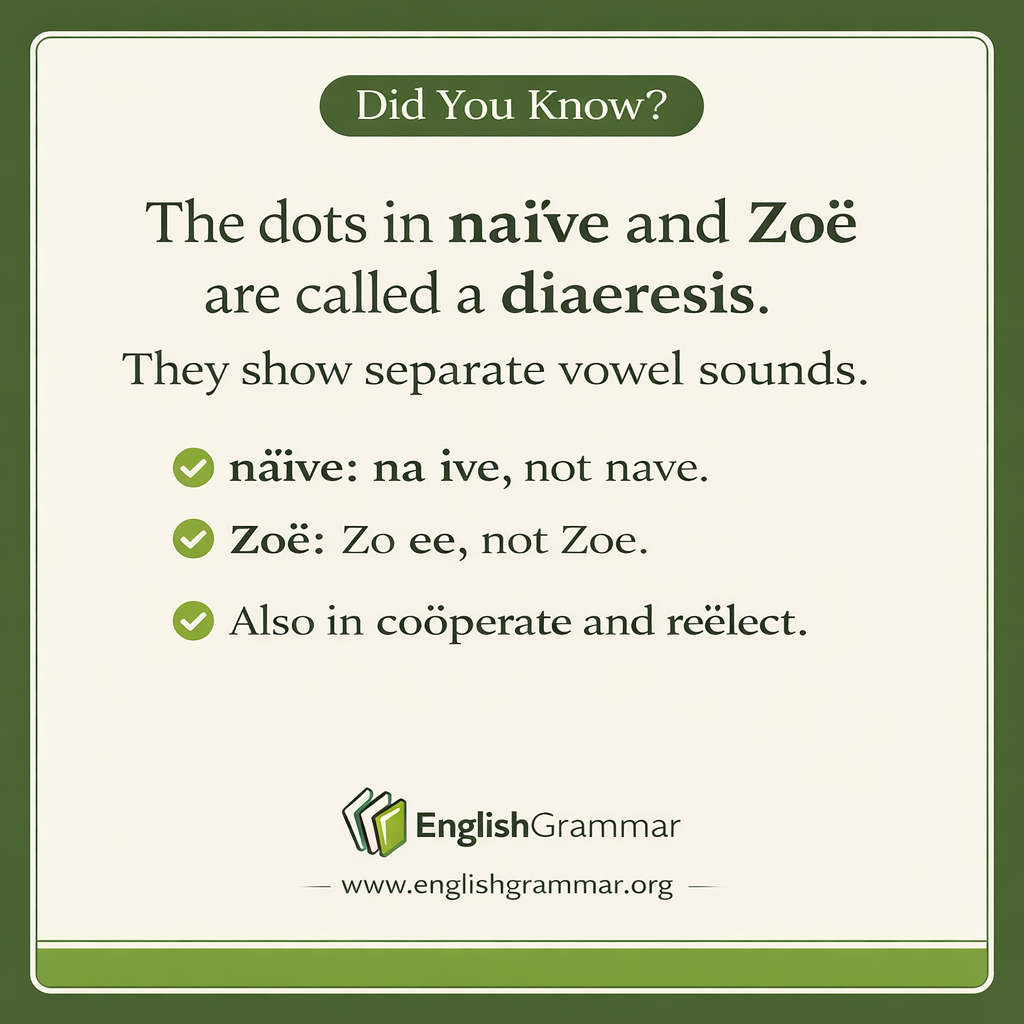
The two dots in naïve and Zoë are called a diaeresis. This mark tells the reader that two nearby vowels should be pronounced in separate syllables, rather than blended together.
For example, naïve is pronounced with two vowel sounds in the middle, roughly like “na ive,” not like nave. Likewise, Zoë is pronounced “Zo ee,” not as a single syllable that rhymes with toe.
You may also see a diaeresis in words such as coöperate and reëlect. In those spellings, the mark signals that the second vowel begins a new syllable.
- naïve: the a and i are pronounced separately
- Zoë: the o and e are pronounced separately
- coöperate: the o vowels are not merged
Not every publisher uses this mark regularly today, so you will often see plain spellings like naive or Zoe. Even when the dots are omitted, the pronunciation often stays the same.
