
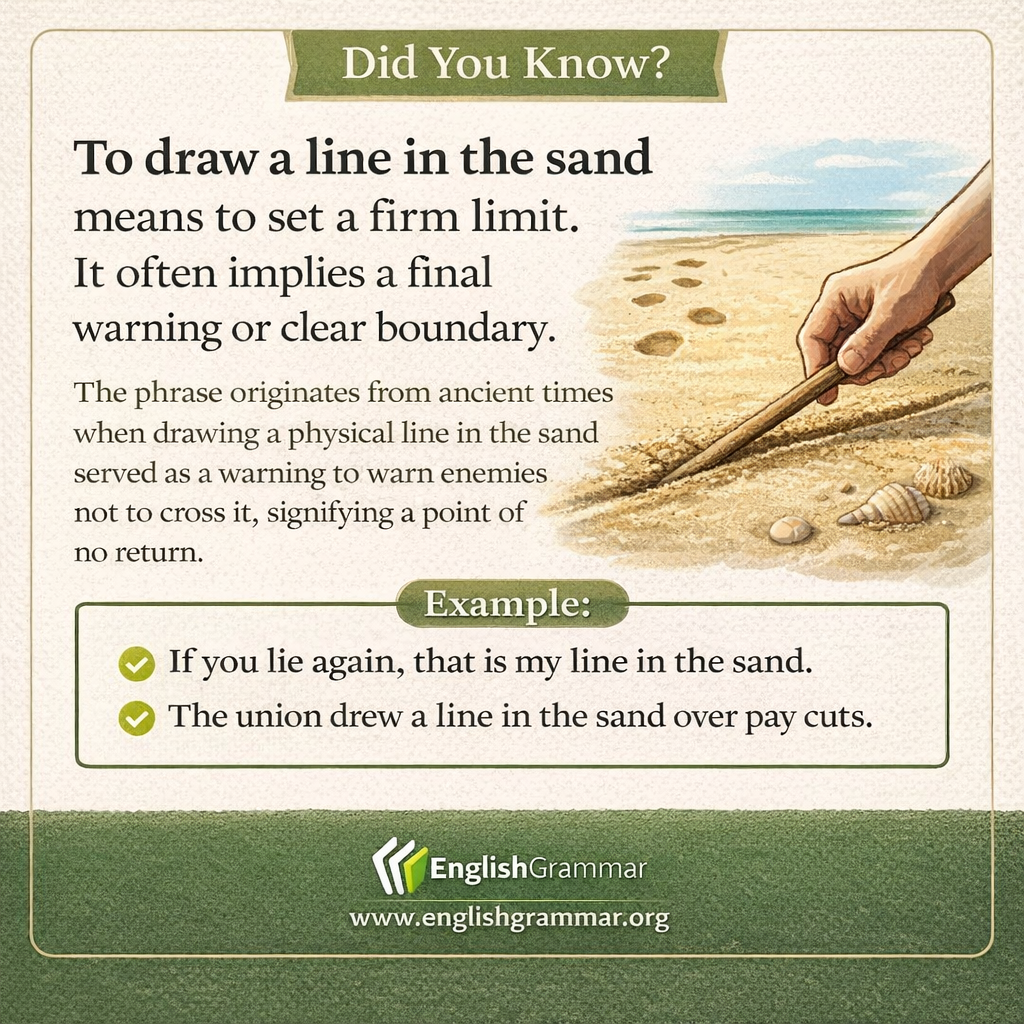
Draw a line in the sand means to set a firm boundary and make it clear that something will not be accepted beyond that point. In everyday English, it often suggests a final limit, a warning, or a non negotiable position.
People use it in personal, social, and political situations. For example, someone might say, If you borrow my car again without asking, that is my line in the sand. A company might draw a line in the sand on budget overspending. A government might use the phrase for a policy it refuses to change.
The exact origin is not perfectly certain, but the image is old and easy to understand: a visible line marks the point that should not be crossed. One famous historical story involves a Roman envoy, Gaius Popillius Laenas, who reportedly drew a circle in the sand around King Antiochus IV and demanded an answer before he stepped out of it. That story is not the modern phrase itself, but it helps explain why sand became a powerful image for a clear boundary.
- Personal use: setting a limit in a relationship.
- Workplace use: refusing a cut, delay, or policy.
- Public use: declaring a firm political position.
The phrase is figurative most of the time. It is really about boundaries, not beaches.
