
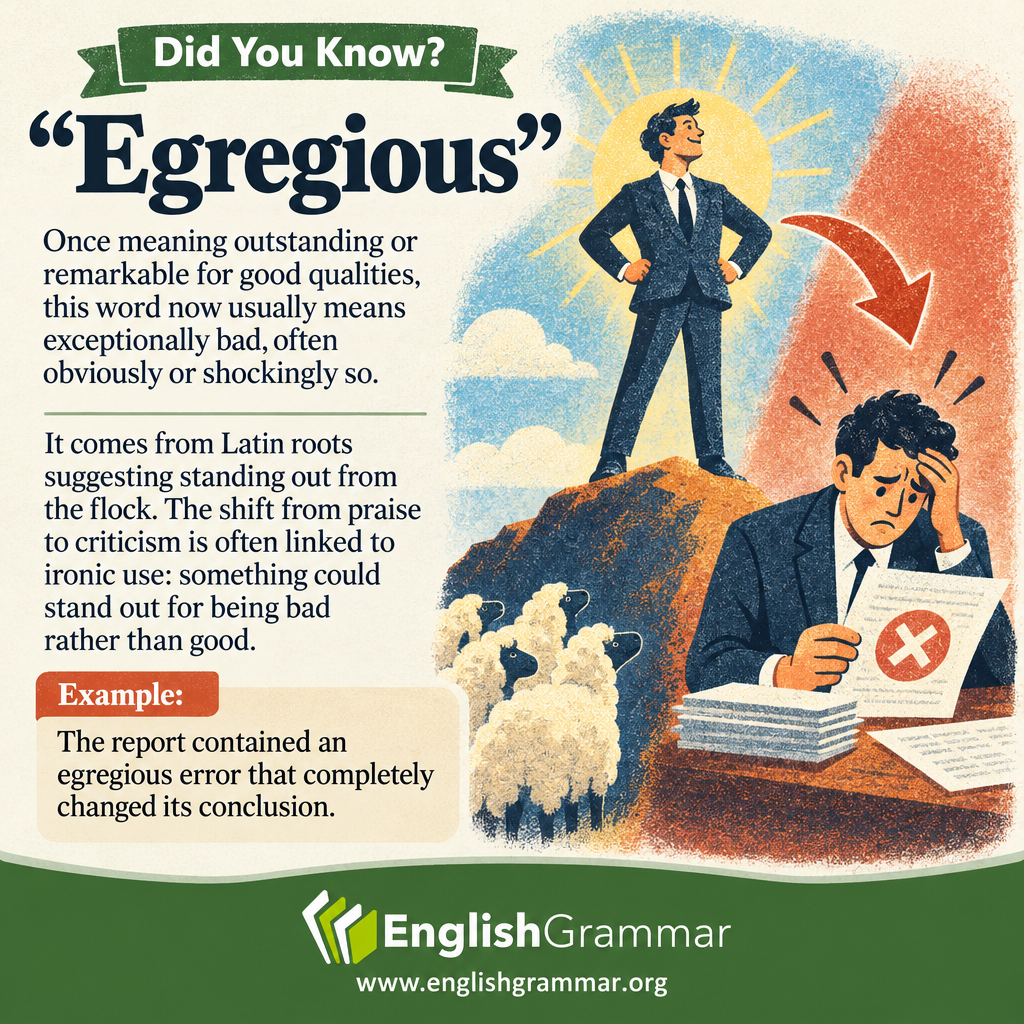
“Egregious” once meant outstanding in a good way. It could describe someone or something remarkable for excellent qualities. Today, however, it usually means exceptionally bad, often in a way that is obvious or shocking.
The word comes from Latin egregius, meaning distinguished or outstanding. Its roots convey the idea of standing out from the flock: Latin grex means flock. The original image was of something set apart from the ordinary, making it suitable for praise.
How did praise become criticism? The change is often linked to ironic use. A word meaning remarkably good can be used sarcastically to suggest the opposite. Over time, the negative meaning became the normal one. The idea of standing out remained, but the reason for standing out changed.
In modern English, use it for something seriously bad, not merely imperfect. It commonly describes errors, misconduct, or failures of judgment. It is stronger than bad and sounds fairly formal.
- “The company made an egregious mistake by publishing customers’ private details.” The mistake was serious, not a minor slip.
- “The referee ignored an egregious foul.” The foul was particularly bad or obvious.
For a small everyday problem, a milder word is usually more natural. Forgetting a comma might be a simple error; changing a quotation so that it reverses someone’s meaning could be an egregious error. The choice depends on how serious the problem is.