
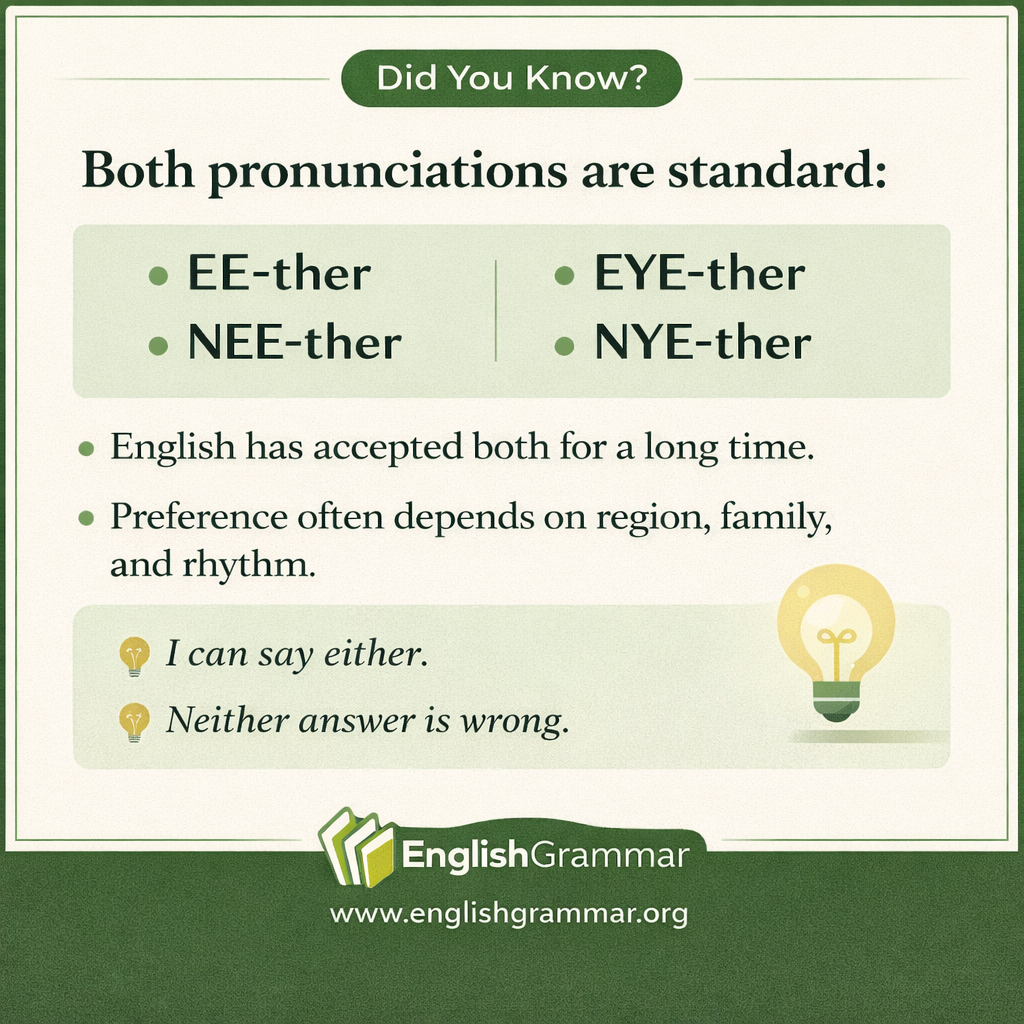
Both common pronunciations of either and neither are standard in modern English. You can say EE-ther or EYE-ther, and you can say NEE-ther or NYE-ther. Neither choice is more correct in general English.
Why do both forms exist? English pronunciation often keeps older variation instead of choosing only one sound. Over time, different regions and families prefer different versions, and speakers may also choose the one that fits the rhythm of a sentence better.
For example, you might hear:
- Either route is fine.
- Neither answer is correct.
Some speakers use one pronunciation consistently. Others switch naturally. A person might say EE-ther way in one sentence and EYE-ther one in another, especially when a certain rhythm feels smoother.
The key point is simple: these are accepted pronunciation variants, not mistakes. In careful speech, conversation, broadcasting, and teaching, all four forms are widely recognized and understood.