
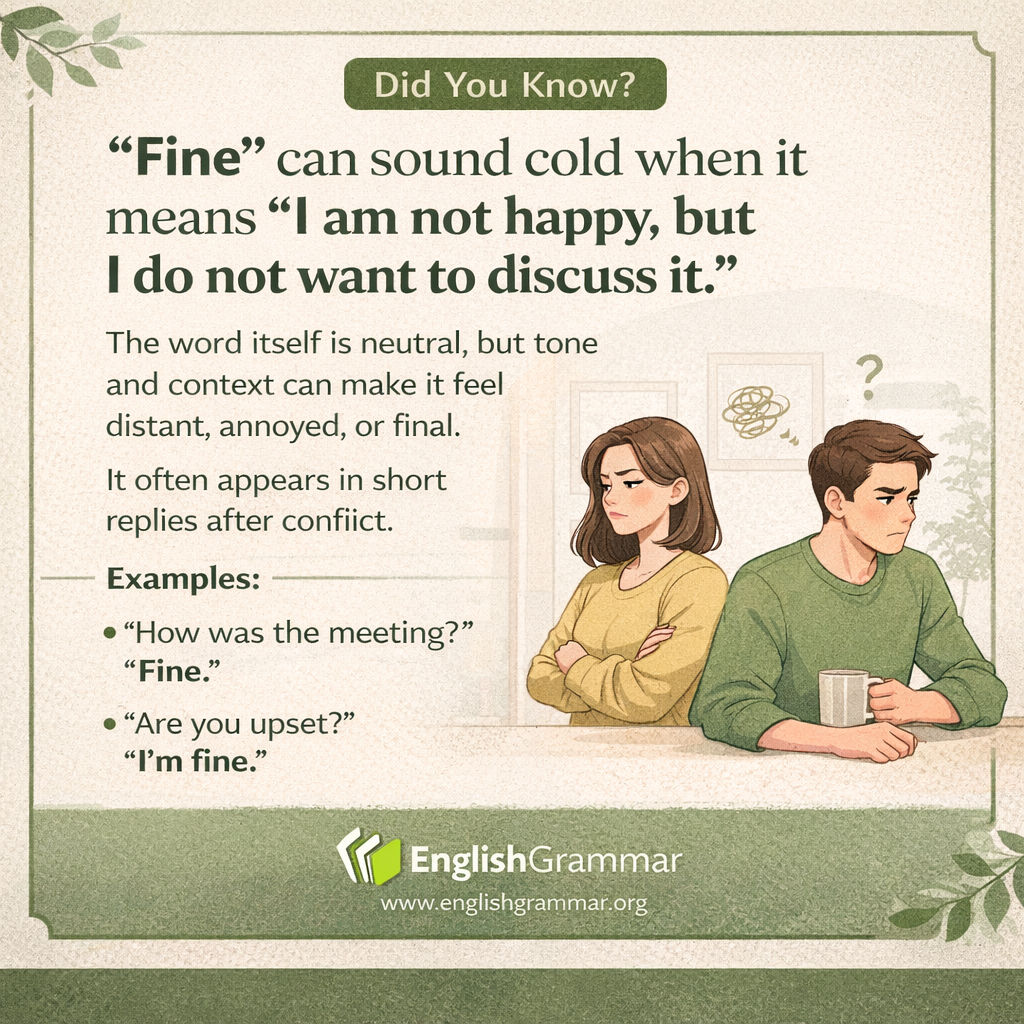
Fine usually means acceptable, okay, or good enough. In a dictionary, it is not a cold word at all. But in everyday English, people often hear much more than the literal meaning.
When someone answers with a short, flat Fine., the tone can suggest distance, irritation, or a wish to end the conversation. That is why the word can feel colder than more openly negative words. It may hide emotion instead of expressing it clearly.
This happens especially after tension or conflict. A longer answer such as I am a little upset, but I will be okay invites discussion. A clipped Fine often does the opposite.
- Neutral use: “The hotel was fine, nothing special.”
- Cold use: “Are you angry?” “I’m fine.”
- Closing use: “If that is what you want, fine.”
So the key lesson is simple: the meaning of fine depends heavily on tone, context, and length. On paper it may look harmless. In conversation, it can be one of the clearest signs that someone is not actually okay.
