
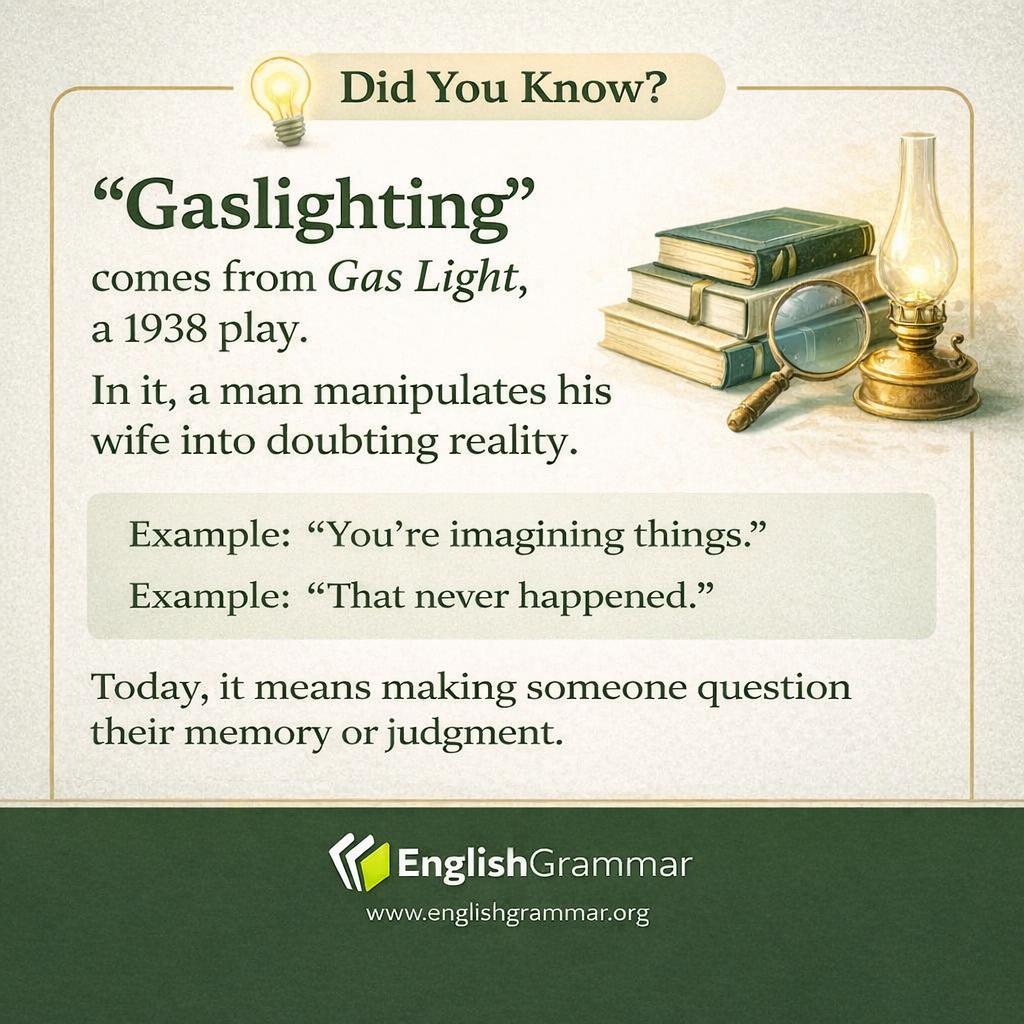
Gaslighting comes from Gas Light, a 1938 British play by Patrick Hamilton. In the story, a husband tries to make his wife doubt her own perceptions, memory, and sanity. One of his tactics involves the household gas lights, which dim slightly while he insists nothing has changed.
Because of that plot, gaslighting later became a general term for a form of psychological manipulation. It describes behavior that pushes someone to question what they clearly saw, heard, or remembered.
- Example: “You already agreed to that.”
- Example: “I never said that, you must be confused.”
- Example: “You are overreacting, that did not happen.”
Today, the word is often used in everyday conversation, therapy, and journalism. It usually refers to repeated attempts to distort another person’s sense of reality, not just a single disagreement or ordinary forgetting. That distinction matters, because the core idea is sustained manipulation, not a simple mistake.