
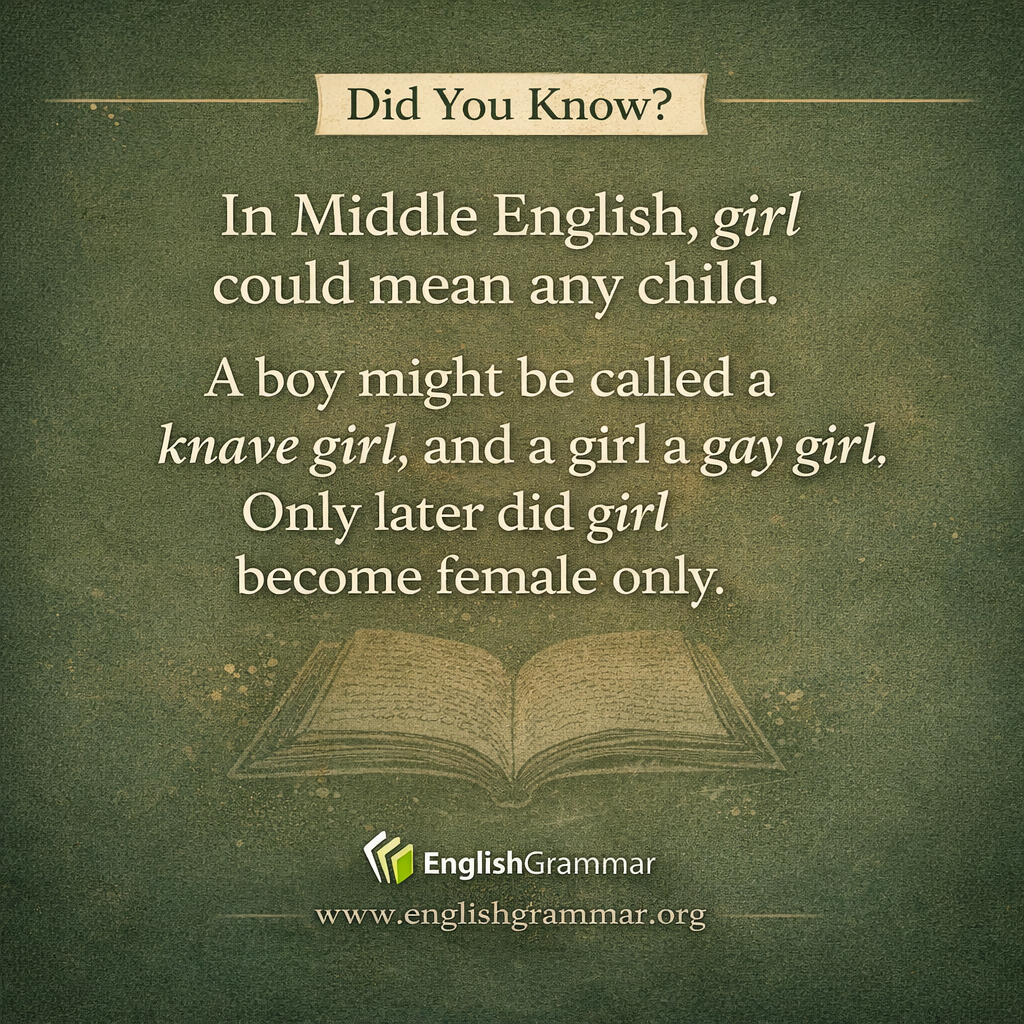
Girl has not always meant “female child.” In parts of Middle English, girl could refer to a young person of either sex, closer to a general word like child or young person.
Because the base word could be gender neutral, writers sometimes added a clarifier. A boy might be called a knave girl, and a girl might be called a gay girl. Here, knave carried the sense of “boy” or “male servant,” and gay could mean “lighthearted” or “pleasant,” not the modern sexual orientation meaning.
Over time, English developed and standardized other options for a gender neutral child, especially child itself, while girl increasingly specialized to mean a female child. That kind of narrowing is common in language change, a word starts broad, then becomes more specific as usage patterns settle.
Contrast the older and modern senses:
- Earlier sense: “The girl ran into the yard,” meaning simply “the child ran into the yard.”
- Modern sense: “The girl ran into the yard,” meaning “the female child ran into the yard.”
This shift is a reminder that meanings are not fixed, they follow how communities use words across centuries.
