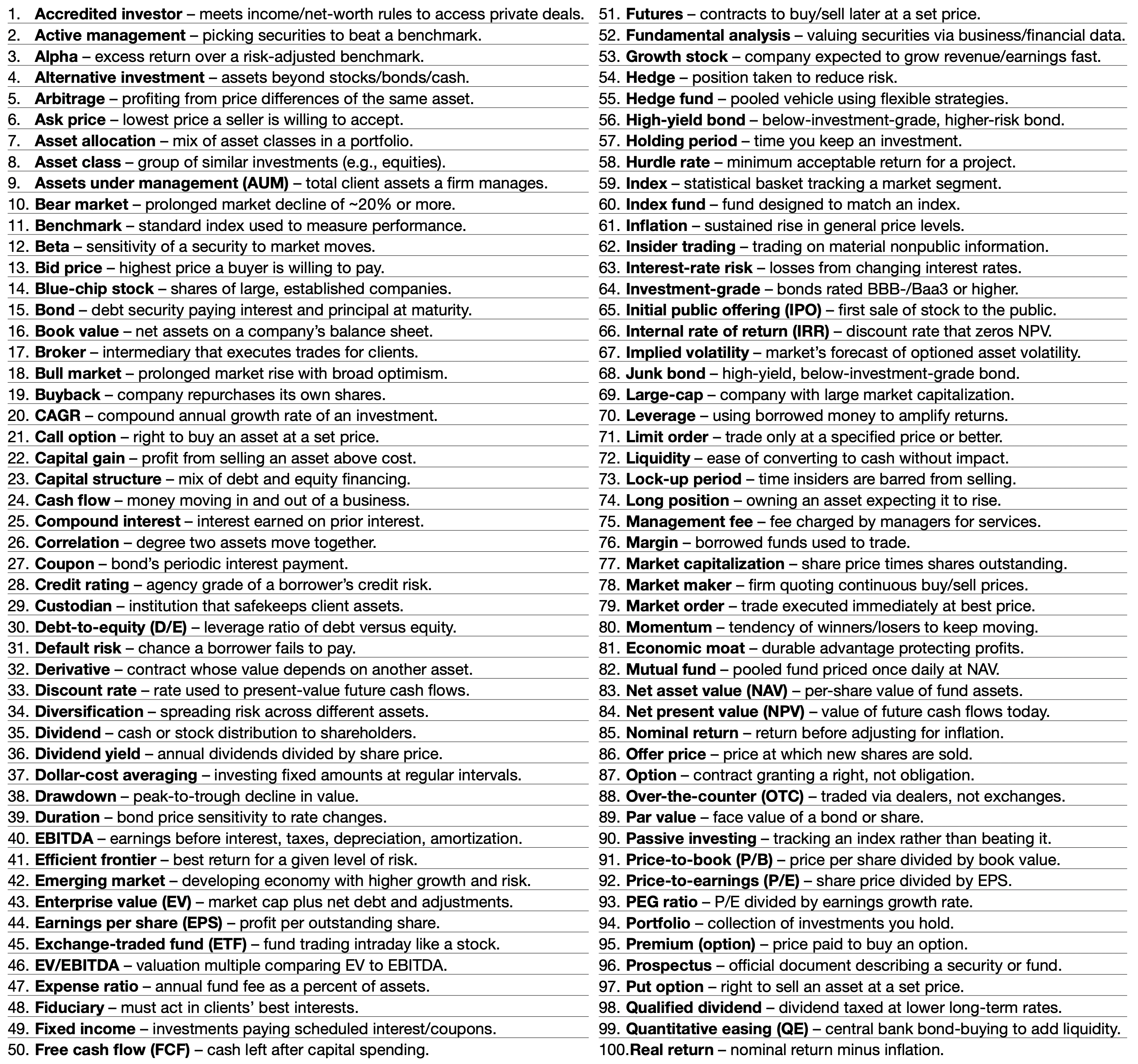
| No. | Term | Definition |
|---|---|---|
| 1. | Accredited investor | Meets income/net-worth rules to access private deals. |
| 2. | Active management | Picking securities to beat a benchmark. |
| 3. | Alpha | Excess return over a risk-adjusted benchmark. |
| 4. | Alternative investment | Assets beyond stocks, bonds, and cash. |
| 5. | Arbitrage | Profiting from price differences of the same asset. |
| 6. | Ask price | Lowest price a seller is willing to accept. |
| 7. | Asset allocation | Mix of asset classes in a portfolio. |
| 8. | Asset class | Group of similar investments (e.g., equities). |
| 9. | Assets under management (AUM) | Total client assets a firm manages. |
| 10. | Bear market | Prolonged market decline of ~20% or more. |
| 11. | Benchmark | Standard index used to measure performance. |
| 12. | Beta | Sensitivity of a security to market moves. |
| 13. | Bid price | Highest price a buyer is willing to pay. |
| 14. | Blue-chip stock | Shares of large, established companies. |
| 15. | Bond | Debt security paying interest and principal at maturity. |
| 16. | Book value | Net assets on a company’s balance sheet. |
| 17. | Broker | Intermediary that executes trades for clients. |
| 18. | Bull market | Prolonged market rise with broad optimism. |
| 19. | Buyback | Company repurchases its own shares. |
| 20. | CAGR | Compound annual growth rate of an investment. |
| 21. | Call option | Right to buy an asset at a set price. |
| 22. | Capital gain | Profit from selling an asset above cost. |
| 23. | Capital structure | Mix of debt and equity financing. |
| 24. | Cash flow | Money moving in and out of a business. |
| 25. | Compound interest | Interest earned on prior interest. |
| 26. | Correlation | Degree two assets move together. |
| 27. | Coupon | Bond’s periodic interest payment. |
| 28. | Credit rating | Agency grade of a borrower’s credit risk. |
| 29. | Custodian | Institution that safekeeps client assets. |
| 30. | Debt-to-equity (D/E) | Leverage ratio of debt versus equity. |
| 31. | Default risk | Chance a borrower fails to pay. |
| 32. | Derivative | Contract whose value depends on another asset. |
| 33. | Discount rate | Rate used to present-value future cash flows. |
| 34. | Diversification | Spreading risk across different assets. |
| 35. | Dividend | Cash or stock distribution to shareholders. |
| 36. | Dividend yield | Annual dividends divided by share price. |
| 37. | Dollar-cost averaging | Investing fixed amounts at regular intervals. |
| 38. | Drawdown | Peak-to-trough decline in value. |
| 39. | Duration | Bond price sensitivity to rate changes. |
| 40. | EBITDA | Earnings before interest, taxes, depreciation, amortization. |
| 41. | Efficient frontier | Best return for a given level of risk. |
| 42. | Emerging market | Developing economy with higher growth and risk. |
| 43. | Enterprise value (EV) | Market cap plus net debt and adjustments. |
| 44. | Earnings per share (EPS) | Profit per outstanding share. |
| 45. | Exchange-traded fund (ETF) | Fund trading intraday like a stock. |
| 46. | EV/EBITDA | Valuation multiple comparing EV to EBITDA. |
| 47. | Expense ratio | Annual fund fee as a percent of assets. |
| 48. | Fiduciary | Must act in clients’ best interests. |
| 49. | Fixed income | Investments paying scheduled interest/coupons. |
| 50. | Free cash flow (FCF) | Cash left after capital spending. |
| 51. | Futures | Contracts to buy/sell later at a set price. |
| 52. | Fundamental analysis | Valuing securities via business and financial data. |
| 53. | Growth stock | Company expected to grow revenue/earnings fast. |
| 54. | Hedge | Position taken to reduce risk. |
| 55. | Hedge fund | Pooled vehicle using flexible strategies. |
| 56. | High-yield bond | Below-investment-grade, higher-risk bond. |
| 57. | Holding period | Time you keep an investment. |
| 58. | Hurdle rate | Minimum acceptable return for a project. |
| 59. | Index | Statistical basket tracking a market segment. |
| 60. | Index fund | Fund designed to match an index. |
| 61. | Inflation | Sustained rise in general price levels. |
| 62. | Insider trading | Trading on material nonpublic information. |
| 63. | Interest-rate risk | Losses from changing interest rates. |
| 64. | Investment-grade | Bonds rated BBB-/Baa3 or higher. |
| 65. | Initial public offering (IPO) | First sale of stock to the public. |
| 66. | Internal rate of return (IRR) | Discount rate that zeros NPV. |
| 67. | Implied volatility | Market’s forecast of option volatility. |
| 68. | Junk bond | High-yield, below-investment-grade bond. |
| 69. | Large-cap | Company with large market capitalization. |
| 70. | Leverage | Using borrowed money to amplify returns. |
| 71. | Limit order | Trade only at a specified price or better. |
| 72. | Liquidity | Ease of converting to cash without impact. |
| 73. | Lock-up period | Time insiders are barred from selling. |
| 74. | Long position | Owning an asset expecting it to rise. |
| 75. | Management fee | Fee charged by managers for services. |
| 76. | Margin | Borrowed funds used to trade. |
| 77. | Market capitalization | Share price times shares outstanding. |
| 78. | Market maker | Firm quoting continuous buy/sell prices. |
| 79. | Market order | Trade executed immediately at best price. |
| 80. | Momentum | Tendency of winners/losers to keep moving. |
| 81. | Economic moat | Durable advantage protecting profits. |
| 82. | Mutual fund | Pooled fund priced once daily at NAV. |
| 83. | Net asset value (NAV) | Per-share value of fund assets. |
| 84. | Net present value (NPV) | Value of future cash flows today. |
| 85. | Nominal return | Return before adjusting for inflation. |
| 86. | Offer price | Price at which new shares are sold. |
| 87. | Option | Contract granting a right, not obligation. |
| 88. | Over-the-counter (OTC) | Traded via dealers, not exchanges. |
| 89. | Par value | Face value of a bond or share. |
| 90. | Passive investing | Tracking an index rather than beating it. |
| 91. | Price-to-book (P/B) | Price per share divided by book value. |
| 92. | Price-to-earnings (P/E) | Share price divided by EPS. |
| 93. | PEG ratio | P/E divided by earnings growth rate. |
| 94. | Portfolio | Collection of investments you hold. |
| 95. | Premium (option) | Price paid to buy an option. |
| 96. | Prospectus | Official document describing a security or fund. |
| 97. | Put option | Right to sell an asset at a set price. |
| 98. | Qualified dividend | Dividend taxed at lower long-term rates. |
| 99. | Quantitative easing (QE) | Central bank bond-buying to add liquidity. |
| 100. | Real return | Nominal return minus inflation. |
