
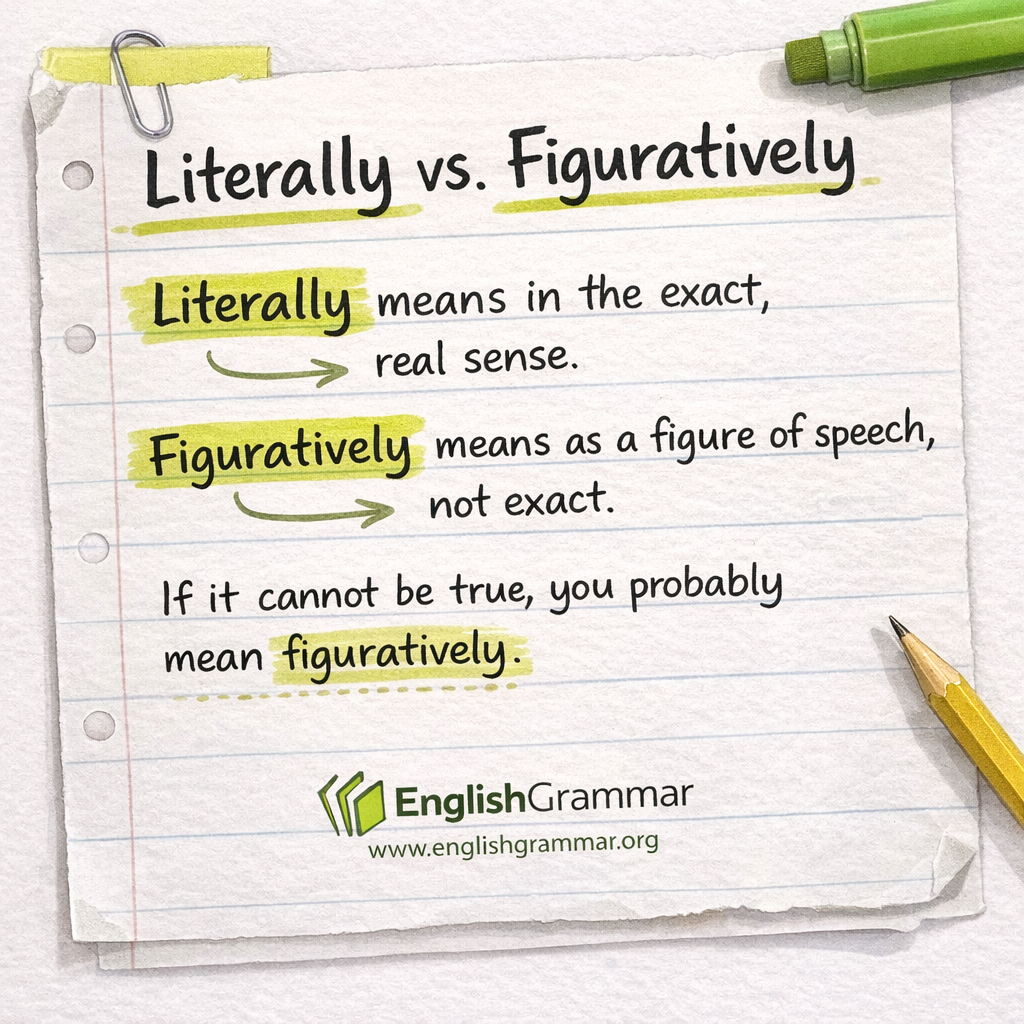
Literally means “in the exact, real sense.” It describes something that actually happened or is factually true. Figuratively means “as a figure of speech,” so the words are not meant in their strict, physical meaning.
A simple test helps: ask, Could this be true in real life exactly as stated? If the answer is yes, literally can fit. If the answer is no, you are probably speaking figuratively.
- Literal example: “I literally ran five miles.” This is a measurable claim that could be verified.
- Figurative example: “I was so embarrassed, I could have died.” The speaker did not actually die, it is an exaggeration to show intensity.
People sometimes use literally for emphasis even when the statement is not true, like “I literally exploded with laughter.” In careful writing, that usage can confuse readers because “explode” has a precise meaning. If you mean “laughed a lot,” you can write “I laughed so hard” or “I was laughing nonstop.”
When you choose between the two, focus on clarity. Use literally for facts and exact events, and figuratively when you are using imagery, idioms, or exaggeration to express a feeling.
