
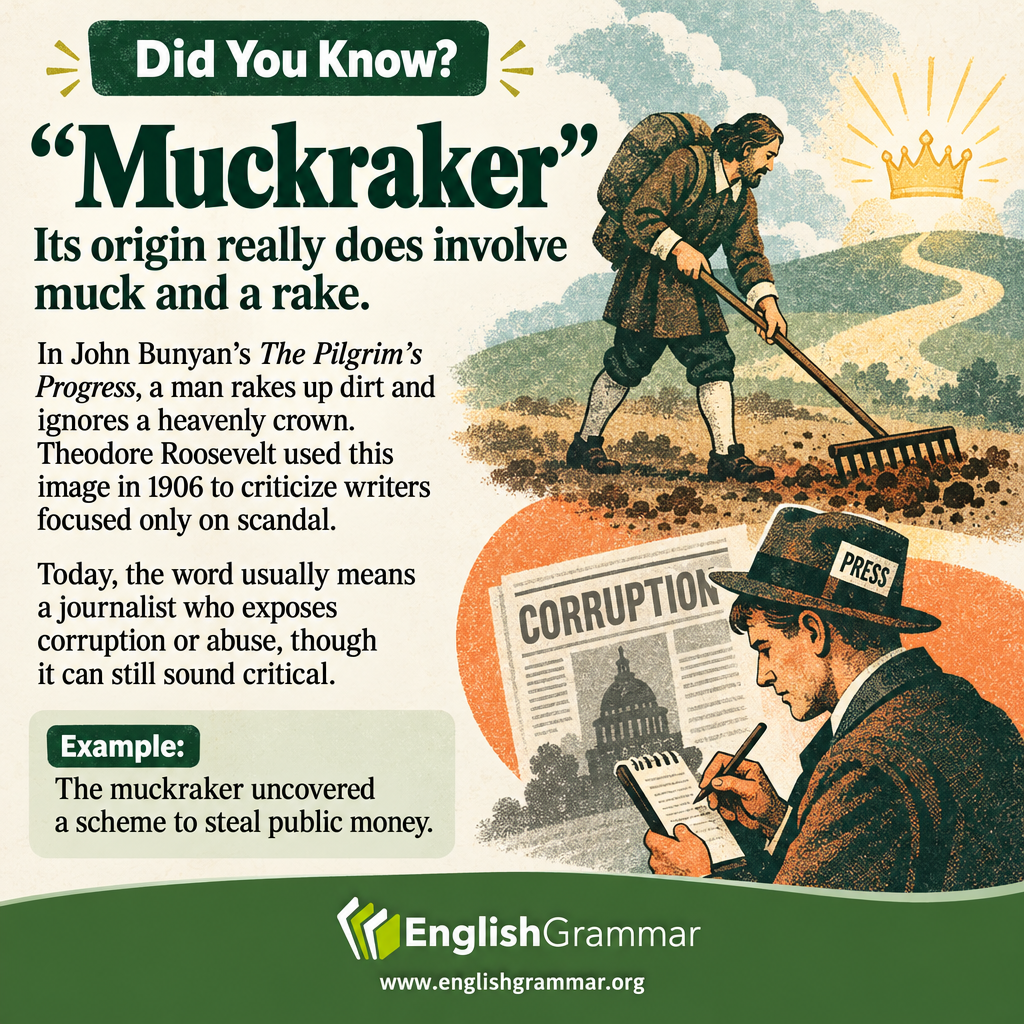
A muckraker is usually a journalist who investigates and exposes corruption, abuse, or other serious wrongdoing. The word is especially associated with American reporters who uncovered problems in politics and business in the early twentieth century.
But the claim that its origin had nothing to do with muck or rakes is misleading. Its backstory involves both—through a literary image rather than a reporting tool.
In John Bunyan’s The Pilgrim’s Progress, a man looks downward and uses a muck-rake to gather straw, sticks, and dust. He ignores a heavenly crown offered above him. The scene represents someone so attached to earthly things that he misses something more valuable.
In a 1906 speech, President Theodore Roosevelt applied that image to writers who concentrated on scandal and wrongdoing. He acknowledged that exposing corruption was necessary, but criticized those who focused only on the bad.
The label later became strongly associated with investigative reporting. Today, it can suggest either valuable public-interest work or an excessive search for scandal, depending on the context.
- Investigative use: “The muckraker uncovered a scheme to steal public money.”
- Critical use: “The mayor dismissed the reporter as a muckraker who cared only about scandal.”
In the second example, the label expresses the mayor’s criticism; it does not prove that the reporter’s work was unfair.
