
Home of English Grammar

Grammar Guide
  • Home
  • Exercises
  • Matches
  • Rules
  • Tools
    • Grammar Checker
    • Very Replacer
    • Word Counter
  • Top Social Media Posts
  • Various Posts
  • Vocabulary
  • Writing Guides
  • Contact

When Nice Meant Foolish

March 24, 2026 - pdf

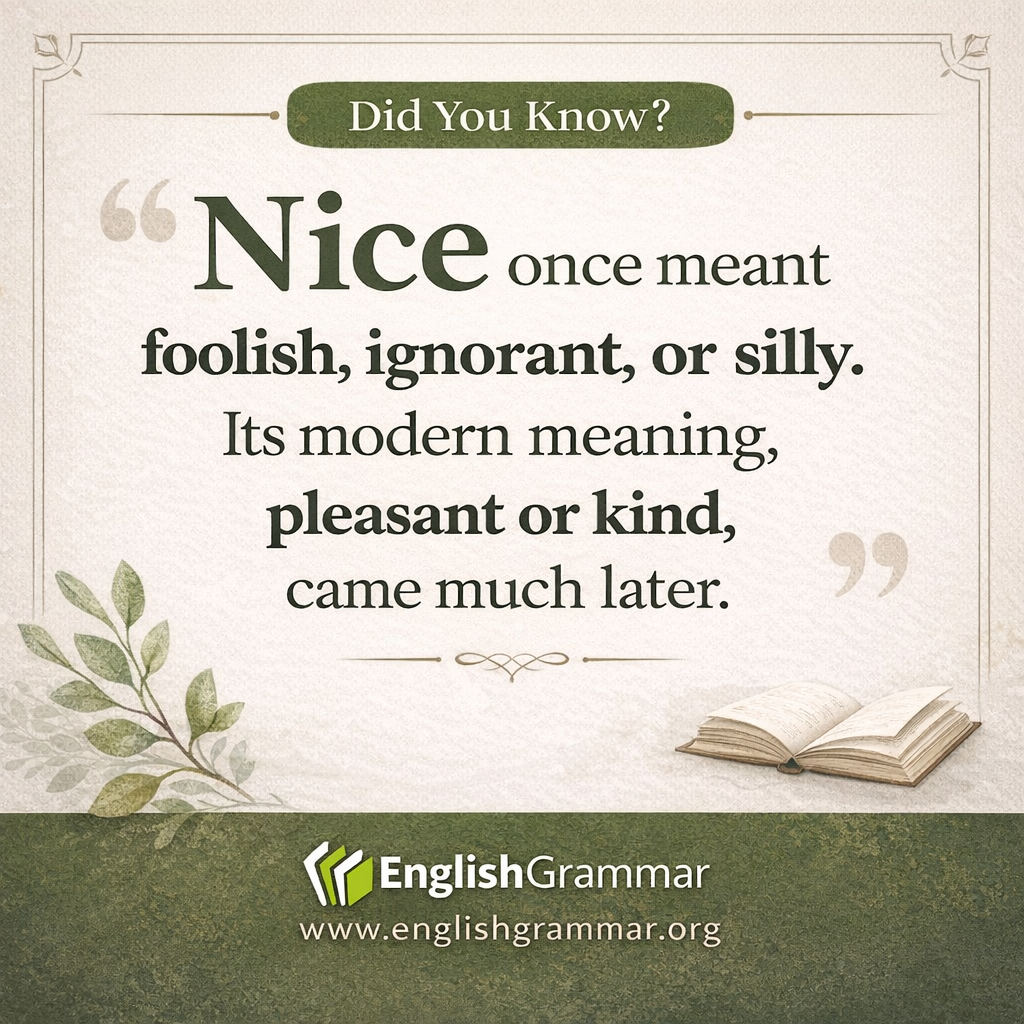
"Nice" once meant foolish.

Nice has not always been a compliment. In earlier English, it often meant foolish, ignorant, or silly. That older sense came through French and ultimately from Latin, where the word had negative meanings connected to not knowing or lacking good judgment.

Over time, the meaning of nice shifted again and again. It was also used to mean precise or fussy before settling into the modern sense of pleasant, kind, or agreeable. This kind of change is common in language. Words often soften, narrow, or broaden as people use them in new contexts.

The contrast is striking:

  • Older sense: He was thought too nice to manage his affairs, meaning foolish or lacking judgment.
  • Modern sense: She gave us a nice welcome, meaning pleasant and kind.

So when you call someone nice today, you are using a word with a surprisingly rough past. Its history is a good reminder that word meanings are not fixed. They change with time, culture, and everyday use.

  • Share
  • Post
  • Post
  • Email
NEW: Try Matches, our daily vocabulary challenge. Pick a topic and level and match words with definitions to boost your vocabulary.
2,485,429 
760,468 
Improve Your Grammar
  • Download 2026 Grammar Guide (PDF)
  • Free Weekly Exercises & Vocabulary
  • Join over 3 Million English Learners
We respect your privacy. Unsubscribe anytime.

Grammar Checker

GrammarCheck.net - Try online
Hint → Bookmark GrammarCheck for future use.

Latest Posts

  • Irregardless is real, but regardless is usually better April 13, 2026
  • 100 Best Synonyms for “Culture” April 13, 2026
  • 100 Other Words for “Learn” April 13, 2026
  • 100 Idioms About Rules and Responsibility April 13, 2026
  • Figure of speech: climax April 13, 2026
  • Present Continuous (Now vs. Temporary Actions) Exercise April 13, 2026
  • 100 Words to Use Instead of “Restless” April 13, 2026

Copyright © 2026 · EnglishGrammar.org
Disclaimer · Privacy Policy · Sitemap · Terms

Improve Your Grammar
  • Download 2026 Grammar Guide (PDF)
  • Free Weekly Exercises & Vocabulary
  • Join over 3 Million English Learners
We respect your privacy. Unsubscribe anytime.