
• Skip to primary navigation
  • Skip to main content
  • Skip to primary sidebar
Home of English Grammar
  • Home
  • Exercises
  • Matches
  • Posts
  • Rules
  • Social Media Archive
  • Tools
    • Grammar Checker
    • Very Replacer
    • Word Counter
  • Vocabulary
  • Writing Guides
  • Pro Course

Where “no dice” comes from and how to use it

October 13, 2026

The origin of "no dice"

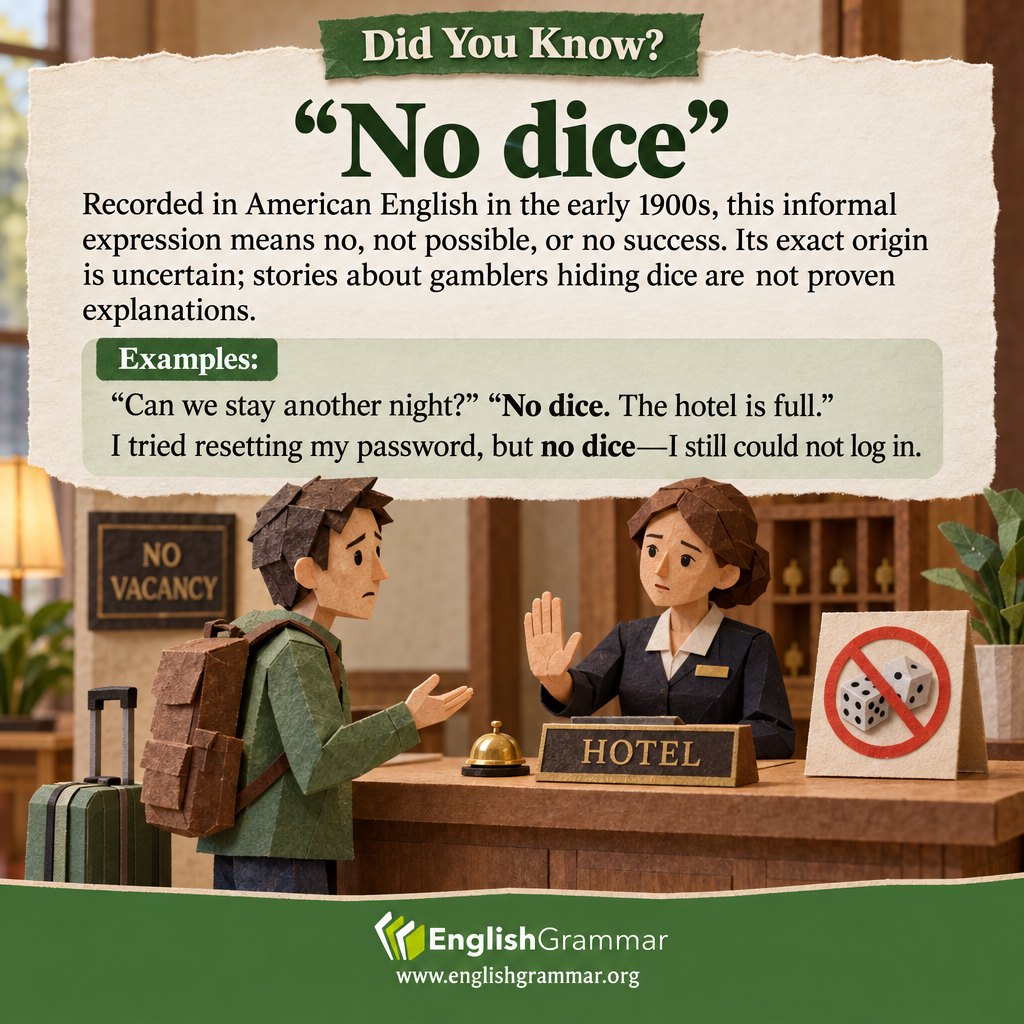
“No dice” is an informal expression meaning no, not possible, or no success. It appeared in American English in the early 1900s, but its exact origin is uncertain.

The expression is commonly associated with dice gambling. A popular origin story says that gamblers hid or swallowed their dice to avoid prosecution: without the dice, authorities supposedly had no evidence. However, that story is not a securely established explanation of how the expression developed. It is better to separate the uncertain backstory from the well-established modern meaning.

For a refusal, the expression gives a short, firm negative answer. It can sound blunt, so it fits casual conversation better than a polite business message.

  • “Can I borrow your car tonight?” “No dice. I need it myself.”

For an unsuccessful attempt, it tells the listener that someone tried something, but it did not work or produce the wanted result.

  • I asked the hotel for a late checkout, but no dice.
  • We tried restarting the printer, but no dice—it still would not print.

You do not need to be discussing gambling to use the expression today. The surrounding sentence usually makes its meaning clear: a request gets rejected, or an effort fails. In more formal writing, choose a direct alternative such as the request was declined or the attempt was unsuccessful.

  • Share
  • Post
  • Post
  • Reddit
  • Email
  • WhatsApp

Primary Sidebar

2,485,429 
761,532 
Improve Your English
  • Download 2026 Grammar Guide (PDF)
  • Free Weekly Exercises & Vocabulary
  • Join over 3 Million English Learners
We respect your privacy. Unsubscribe anytime.
Grammar Checker - Try Now

Latest posts

  • Where “no dice” comes from and how to use it October 13, 2026
  • Title vs. tittle: two spellings, different meanings October 13, 2026
  • Weekend Plans Language Exercise October 13, 2026
  • 100 Best Synonyms for “Patronized” October 13, 2026
  • 100 Best Synonyms for “Believing” October 13, 2026
  • 100 Best Synonyms for “Paradise” October 13, 2026
  • 100 Best Synonyms for “Received” October 13, 2026
  • 100 Best Synonyms for “Uncaring” October 13, 2026
  • 100 Best Synonyms for “Patriot” October 13, 2026
  • Brutalism vs. modernism vs. postmodernism in architecture October 13, 2026
Home of English Grammar

Free English grammar exercises, rules and vocabulary lists, with new exercises every week. Join the leading English grammar site with over 3 million followers.

Pro Course

Learn

  • Exercises
  • Matches
  • Grammar rules
  • Vocabulary lists
  • Writing guides
  • Online tools

More

  • Top social media posts
  • Various posts
  • Free grammar guide (PDF)
  • Contact

Pro

  • What is Pro?
  • Pro account
  • Pro exercises

Copyright © 2026 EnglishGrammar.org

  • Disclaimer
  • Privacy policy
  • Refund policy
  • Terms
  • Sitemap
Improve Your English
  • Download 2026 Grammar Guide (PDF)
  • Free Weekly Exercises & Vocabulary
  • Join over 3 Million English Learners
We respect your privacy. Unsubscribe anytime.