
• Skip to primary navigation
  • Skip to main content
  • Skip to primary sidebar
Home of English Grammar
  • Home
  • Course
  • Exercises
  • Grammar Rules
  • Matches
  • Posts
  • Tools
    • Grammar Checker
    • Very Replacer
    • Word Counter
  • Vocabulary Lists
  • Archives
    • Social Media Posts
    • Writing Guides
  • Join free

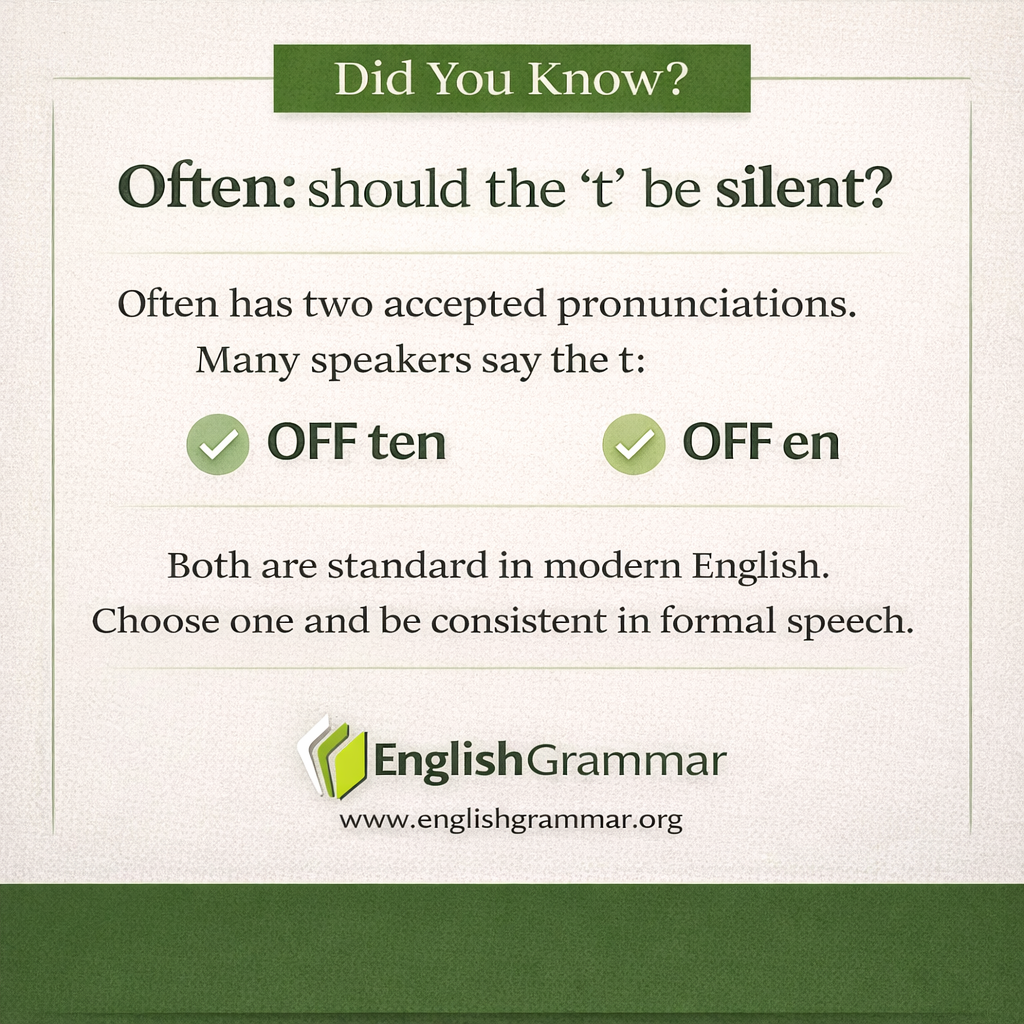
Often: should the t be silent?

July 7, 2026

Often: should the t be silent?

Often has two accepted pronunciations in modern English. Some speakers pronounce the t, saying OFF ten. Others leave it silent and say OFF en. Both forms are widely used, and both are considered standard.

This is why you may hear different teachers, broadcasters, or dictionaries give different versions. Pronunciation can vary by region, education, style, and personal habit. In careful speech, some people prefer to pronounce the t. In everyday speech, many speakers do not.

A simple way to think about it is this: neither pronunciation is wrong. What matters most is being clear and sounding natural.

  • With the t: I often read before bed.
  • Without the t: We often go there on Sundays.

If you are learning English, it is helpful to recognize both. You can choose the version you hear most often around you, or the one your teacher recommends. Just try to stay consistent, especially in formal speaking practice.

Improve your English grammar, vocabulary and writing

We take you step by step from beginner to advanced, even if you struggled with English at school or have always had trouble remembering the rules.

  • 10 modules, 112 lessons and 730 questions
  • Just log in and learn anytime and anywhere
  • Your progress is saved in your account
  • Download the 2027 Grammar Guide (PDF)

Related lesson in the course Advice and suggestions: should, ought to and had better Module 05: Modals & conditions · Lesson 4

Join free

Already have an account? Sign in

See what’s in the course

Primary Sidebar

2.4M761.4K165.8K

Free 2027 Grammar Guide

  • Download Grammar Guide (PDF)
  • Online grammar course, A1 to C2
  • Weekly exercises and vocabulary
  • Join over 3 million English learners

We respect your privacy. Unsubscribe anytime.

Already have an account? Sign in

Grammar Checker - Try Now

Latest Posts

  • 100 Best Synonyms for “Evocative” October 24, 2026
  • 100 Best Synonyms for “Compatible” October 24, 2026
  • Starting a Conversation Exercise October 23, 2026
  • Sentence Rewriting with Modals Exercise October 23, 2026
  • 100 Best Synonyms for “Empower” October 23, 2026
  • The origin of “not worth a tinker’s damn” October 23, 2026
  • 100 Best Synonyms for “Stark” October 23, 2026
  • Patterning Paraphrase Exercise October 23, 2026
  • 100 Best Synonyms for “Propositive” October 23, 2026
  • 100 Best Synonyms for “Emphasizing” October 23, 2026
Home of English Grammar

Free English grammar exercises, rules and vocabulary lists, with new exercises every week. Join the leading English grammar site with over 3 million followers.

Join free

Learn

  • Exercises
  • Matches
  • Grammar rules
  • Vocabulary lists
  • Writing guides
  • Online tools

More

  • Top social media posts
  • Various posts
  • Contact

Account

  • Join free
  • Grammar Course
  • Free grammar guide (PDF)

Copyright © 2026 EnglishGrammar.org

  • Disclaimer
  • Privacy policy
  • Terms
  • Sitemap