
• Skip to primary navigation
  • Skip to main content
  • Skip to primary sidebar
Home of English Grammar
  • Home
  • Course
  • Exercises
  • Grammar Rules
  • Matches
  • Posts
  • Tools
    • Grammar Checker
    • Very Replacer
    • Word Counter
  • Vocabulary Lists
  • Archives
    • Social Media Posts
    • Writing Guides
  • Sign in
  • Join free

The origin of “go the extra mile”

June 5, 2026

The origin of "go the extra mile"

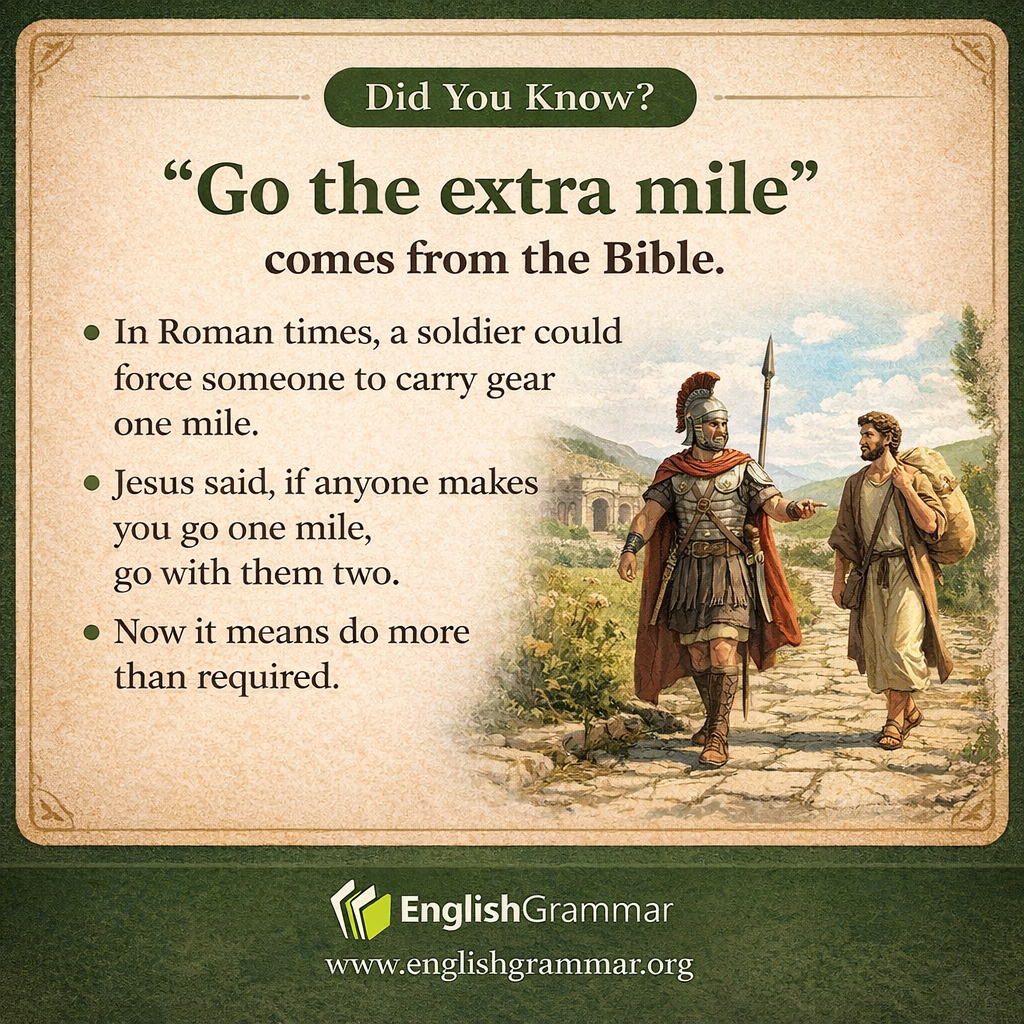
The phrase “go the extra mile” comes from the Bible, specifically Matthew 5:41. In that verse, Jesus says, “If anyone forces you to go one mile, go with them two miles.”

To people living under Roman rule, this was very concrete. Roman soldiers could legally force civilians to carry loads for a set distance, often understood as one mile. Jesus used that real situation to teach a broader lesson about responding with unexpected generosity rather than bare minimum obedience.

Over time, the expression moved from a literal meaning to a figurative one. Today, when someone goes the extra mile, they do more than required.

  • A teacher stays after class to help a student.
  • A business fixes a problem quickly and adds a refund.
  • A friend not only gives advice, but also helps you make a plan.

So the modern meaning is about extra effort, but the origin is historical and biblical. What began as a command about an actual mile became a common phrase for exceeding expectations.

Improve your English grammar, vocabulary and writing

We take you step by step from beginner to advanced, even if you struggled with English at school or have always had trouble remembering the rules.

  • 10 modules, 112 lessons and 730 questions
  • Just log in and learn anytime and anywhere
  • Your progress is saved in your account
  • Download the 2027 Grammar Guide (PDF)
Join free

Already have an account? Sign in

See what’s in the course

Primary Sidebar

2.4M760.9K165.9K

Free 2027 Grammar Guide

  • Download Grammar Guide (PDF)
  • Online grammar course, A1 to C2
  • Weekly exercises and vocabulary
  • Join over 3 million English learners

We respect your privacy. Unsubscribe anytime.

Already have an account? Sign in

Grammar Checker - Try Now

Latest Posts

  • 100 Best Synonyms for “Deceitful” October 30, 2026
  • 100 Best Synonyms for “Transparent” October 30, 2026
  • Useful, helpful, beneficial, advantageous, valuable and invaluable: how to choose October 30, 2026
  • 100 Commonly Misused Words Every Adult Should Know October 30, 2026
  • Abstruse vs. obtuse vs. obscure vs. esoteric vs. arcane vs. recondite October 30, 2026
  • The origin of “once in a blue moon” October 30, 2026
  • 100 Best Synonyms for “Harmful” October 30, 2026
  • Superlatives Exercise October 30, 2026
  • Six ways to talk about privacy and secrecy in English October 30, 2026
  • 100 Best Synonyms for “Training” October 30, 2026
Home of English Grammar

Free English grammar exercises, rules and vocabulary lists, with new exercises every week. Join the leading English grammar site with over 3 million followers.

Join free

Learn

  • Exercises
  • Matches
  • Grammar rules
  • Vocabulary lists
  • Writing guides
  • Online tools

More

  • Top social media posts
  • Various posts
  • Contact

Account

  • Join free
  • Grammar Course
  • Free grammar guide (PDF)

Copyright © 2026 EnglishGrammar.org

  • Disclaimer
  • Privacy policy
  • Terms
  • Sitemap