
• Skip to primary navigation
  • Skip to main content
  • Skip to primary sidebar
Home of English Grammar
  • Home
  • Course
  • Exercises
  • Grammar Rules
  • Matches
  • Posts
  • Tools
    • Grammar Checker
    • Very Replacer
    • Word Counter
  • Vocabulary Lists
  • Archives
    • Social Media Posts
    • Writing Guides
  • Sign in
  • Join free

The origin of “turn a blind eye”

May 16, 2026

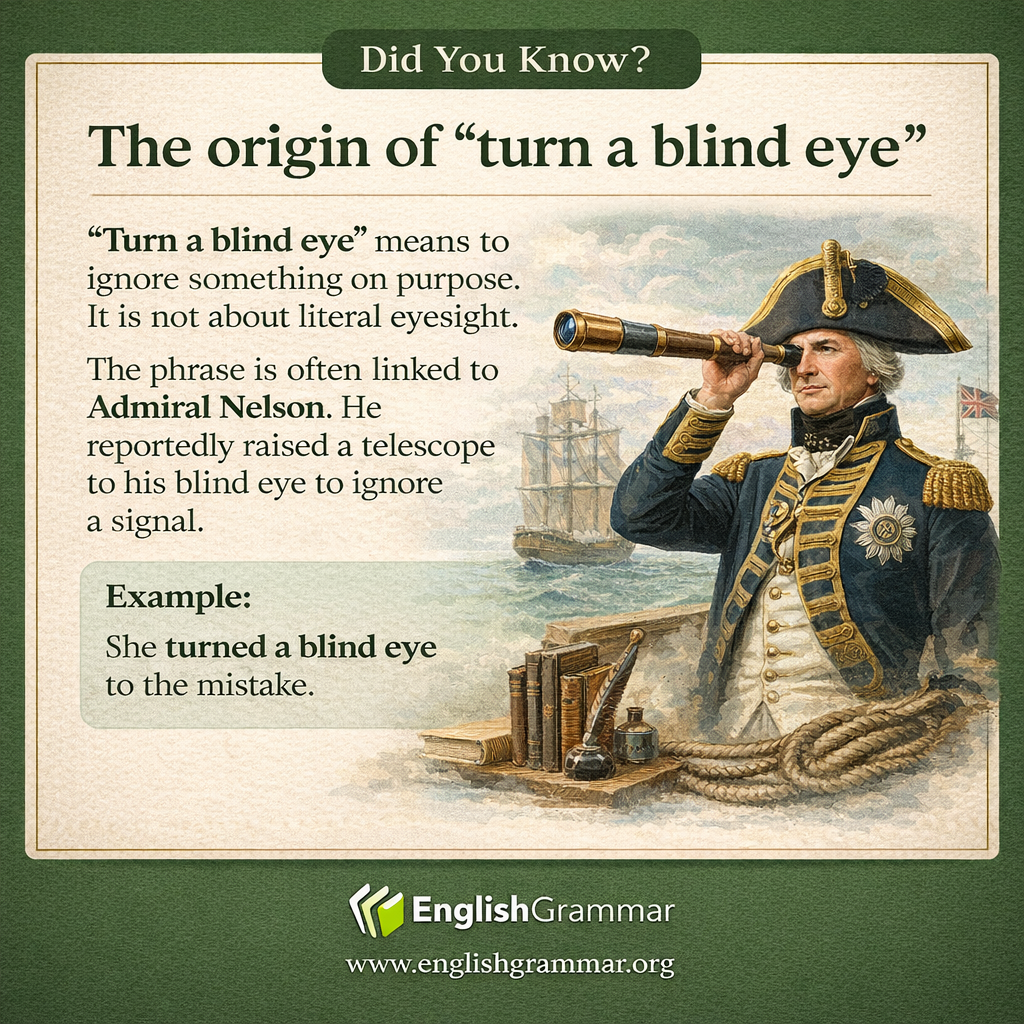
The origin of "turn a blind eye"

Turn a blind eye means to deliberately ignore something, especially when you know it is there. It does not refer to actual vision in normal use. Instead, it describes a choice not to notice or respond.

The expression is widely connected to Admiral Horatio Nelson. During the Battle of Copenhagen in 1801, Nelson was said to have put a telescope to his blind eye and claimed he could not see the signal ordering him to stop. He continued the attack. Whether every detail of the story is perfect or not, this is the famous explanation most people know.

Today, the phrase is used figuratively. For example, you might say, The manager turned a blind eye to repeated lateness. That means the manager knew about the problem but chose not to act.

  • Literal meaning: about actual eyesight
  • Idiomatic meaning: choosing to ignore something
  • Example: They turned a blind eye to the damage

This makes the phrase useful when you want to describe intentional inaction, not simple failure to notice.

Improve your English grammar, vocabulary and writing

We take you step by step from beginner to advanced, even if you struggled with English at school or have always had trouble remembering the rules.

  • 10 modules, 112 lessons and 730 questions
  • Just log in and learn anytime and anywhere
  • Your progress is saved in your account
  • Download the 2027 Grammar Guide (PDF)
Join free

Already have an account? Sign in

See what’s in the course

Primary Sidebar

2.4M760.9K165.9K

Free 2027 Grammar Guide

  • Download Grammar Guide (PDF)
  • Online grammar course, A1 to C2
  • Weekly exercises and vocabulary
  • Join over 3 million English learners

We respect your privacy. Unsubscribe anytime.

Already have an account? Sign in

Grammar Checker - Try Now

Latest Posts

  • The origin of “out of left field” November 2, 2026
  • Creepy, spooky, eerie, sinister, macabre, and bloodcurdling: What’s the difference? November 2, 2026
  • 100 Best Synonyms for “Improvement” November 2, 2026
  • 100 Best Synonyms for “Understood” November 2, 2026
  • Perspicacious vs. perspicuous: understanding the difference November 2, 2026
  • 100 Best Synonyms for “Resent” November 2, 2026
  • 100 Best Synonyms for “Heavenly” November 2, 2026
  • 100 Best Synonyms for “Underpinned” November 2, 2026
  • 100 Best Synonyms for “Improved” November 2, 2026
  • 100 Best Synonyms for “Redeem” November 2, 2026
Home of English Grammar

Free English grammar exercises, rules and vocabulary lists, with new exercises every week. Join the leading English grammar site with over 3 million followers.

Join free

Learn

  • Exercises
  • Matches
  • Grammar rules
  • Vocabulary lists
  • Writing guides
  • Online tools

More

  • Top social media posts
  • Various posts
  • Contact

Account

  • Join free
  • Grammar Course
  • Free grammar guide (PDF)

Copyright © 2026 EnglishGrammar.org

  • Disclaimer
  • Privacy policy
  • Terms
  • Sitemap