EnglishGrammar Pro is a step-by-step grammar course that helps you build more accurate, confident English from the foundations to advanced grammar and editing.
For serious learners only. Cancel anytime in a few clicks.
SOUND FAMILIAR?
Can you relate to this?
It is late in the evening. You are writing an important email in English, maybe to a client, a teacher or a company you want to work for.
You read one sentence again. “I have sent the file yesterday.” Or is it “I sent the file yesterday”? You change it. Then you change it back.
You open Google or Reddit, looking for one clear rule. What should have been a quick email is taking far longer than it should.
In the end, you click Send and hope you chose correctly.
Or you are in a meeting. You know exactly what you want to say, but you start checking the grammar in your head. Since or for? By the time you are ready, the conversation has moved on.
The difficulty comes when two versions both sound right. Without a clear rule, you have nothing to settle the question. You choose one, but the same doubt comes back the next time you write.
Try these five sentences. Each one tests a common mistake.
THE 5-QUESTION QUIZ
Do you make these five mistakes in English?
Choose your answers, then check your score and the reasons.
Scoring needs JavaScript. You can still try the questions and open every answer below.
1. Could you give me ____?
some advice / an advice / some advices
Show the answer and explanation
Answer: Could you give me some advice?
Why: Advice is uncountable in English, so it cannot follow a or an, and we do not say advices. Say some advice or a piece of advice.
2. I have lived here ____ 2021.
for / since
Show the answer and explanation
Answer: I have lived here since 2021.
Why: Since gives the starting point: since 2021. For gives the length of time: for five years.
3. We ____ at a conference in 2022.
have met / met
Show the answer and explanation
Answer: We met at a conference in 2022.
Why: In 2022 is a finished time, so use the past simple. The present perfect cannot go with a finished time such as yesterday, last week or in 2022.
4. We ____ the timetable.
discussed about / discussed on / discussed
Show the answer and explanation
Answer: We discussed the timetable.
Why: Discuss takes its object directly, with no preposition: you discuss something. About follows the noun: a discussion about the timetable.
5. You ____ attend the extra session. It is optional.
don’t have to / mustn’t
Show the answer and explanation
Answer: You don’t have to attend the extra session.
Why: Don’t have to means it is not necessary: you can choose. Mustn’t means it is not allowed.
A Pro lesson to start with
Then US$12.99/month. Cancel anytime.
This is a five-question sample, not a test of your overall English level.
A LOOK INSIDE PRO
See a real Pro lesson.
This screenshot is from “Past simple or present perfect?” — the lesson behind question 3.
Common mistakes, a worked example and a rule to remember.
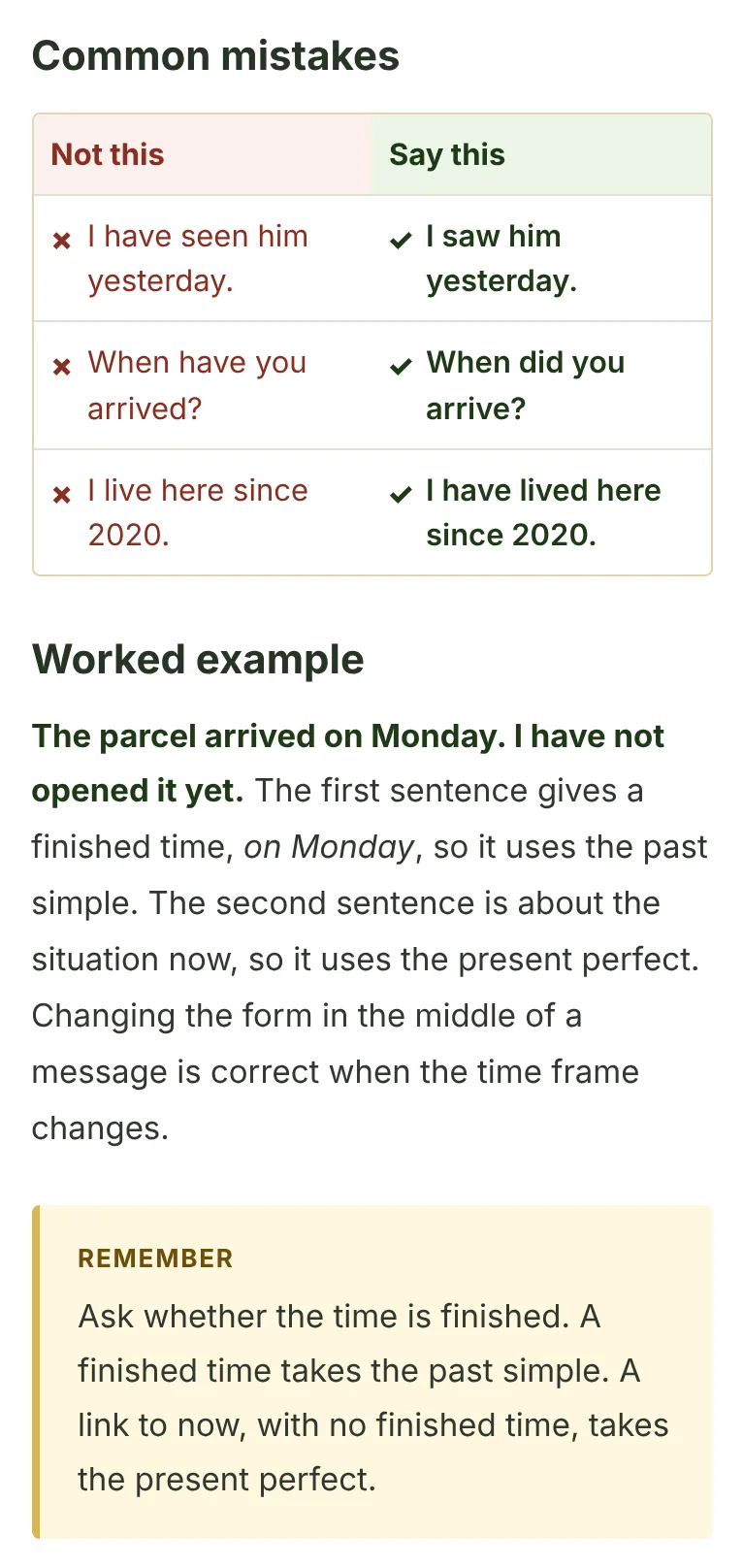
Read the screenshot as text
Common mistakes
Not this: I have seen him yesterday.
Say this: I saw him yesterday.
Not this: When have you arrived?
Say this: When did you arrive?
Not this: I live here since 2020.
Say this: I have lived here since 2020.
Worked example
The parcel arrived on Monday. I have not opened it yet. The first sentence gives a finished time, on Monday, so it uses the past simple. The second sentence is about the situation now, so it uses the present perfect. Changing the form in the middle of a message is correct when the time frame changes.
Remember
Ask whether the time is finished. A finished time takes the past simple. A link to now, with no finished time, takes the present perfect.
INTRODUCING ENGLISHGRAMMAR PRO
Go from “I think it is right” to “I know why it is right.”
EnglishGrammar Pro is a complete grammar course you can follow without planning anything. 105 short lessons in 10 modules, already in the right order. Open your Pro account, and your next lesson is waiting. You do not have to decide what to study or piece rules together from five different websites. You just follow the path, and every minute goes into learning a rule instead of searching for one.
Every lesson tells you why. First the rule, in plain English. Then the mistakes learners make most often. Then practice questions, each with the answer and the reason. That is what ends the doubt: the next time two sentences both sound right, you know which one is correct, and you know why.
Easy to follow, whatever your level. Short sentences, everyday examples and no grammar jargon. If you are still learning English, start with Module 01 and build up. If you already speak English well, even as a native speaker, the later modules on clauses, tone and editing will sharpen your writing.
15 minutes a day is enough. Most lessons take 10 to 15 minutes. Do one with your morning coffee or on the train home, and you can finish all 105 in about 15 weeks. There is no deadline. Go faster when you have time, and slower when you do not.
You are learning from a site that explains grammar to millions. Pro comes from EnglishGrammar.org, followed by more than 3 million people on Facebook and X, with a newsletter that goes to over 100,000 subscribers. The explanations are the same plain-English kind you may already know from our free exercises. Pro puts them in order and adds the reason behind every answer.
And you can try all of it free for 7 days. Open the lessons, try the questions, use the Pro exercises. Are you ready to take action?
A few things you will learn in Pro
Small rules that make a big difference. Each one is explained in a Pro lesson.
- Why “I look forward to hear from you” is wrong, and the small word that explains it Module 04, lesson 15
- One question that tells you when to write “I sent it” and when to write “I have sent it” Module 04, lesson 9
- How “I am boring in this class” turns a complaint into an insult against yourself Module 03, lesson 2
- Why “Please explain me the rule” is wrong, and the word it is missing Module 06, lesson 2
- “If I would have known…”: the mistake that slips into sentences about regret, and the simple fix Module 05, lesson 7
- Say or tell? One rule that tells you which one to use Module 08, lesson 5
- Why you take a photo but make a mistake, and why translating these verbs from your own language goes wrong Module 07, lesson 7
- Where to put only in a sentence, and how moving it one word changes what you mean Module 03, lesson 8
10 grammar modules. One clear path.
Start with the foundations, or go straight to the grammar you need. The modules are grouped into three stages.
Foundations
Modules 01–03
Make correct sentences, ask questions and use nouns, articles and describing words.
- 01Sentence Foundations: Build Accurate English
- 02Nouns, Articles and Pronouns
- 03Adjectives, Adverbs and Comparison
Intermediate
Modules 04–07
Choose the right tense, talk about possibility and use natural word partnerships.
- 04English Tenses and Verb Forms, Made Clear
- 05Modals, Conditions and Hypothetical Meaning
- 06Verb Patterns, Passives and Causatives
- 07Prepositions, Phrasal Verbs and Word Partnerships
Advanced
Modules 08–10
Connect ideas, report what people said, choose the right tone and edit your writing.
- 08Clauses, Questions and Reported Speech
- 09Build Clearer, More Natural English
- 10Advanced Grammar: Precision, Emphasis and Editing
105 step-by-step lessons with examples · 688 practice questions, each with the answer and the reason
See all 105 lesson titles
Sentence Foundations: Build Accurate English
- Words, phrases and the sentence core
- The verb be: am, is and are
- Be, have and do: main verbs and helpers
- Statements, negatives and agreement
- There is, there are and it is
- Yes/no questions and short answers
- Question words: who, what, where, when, why and how
- Question tags and polite indirect questions
- Instructions, requests and complete sentences
- Join ideas with and, but, or, so and because
- Foundation workshop: introduce, ask and explain
Nouns, Articles and Pronouns
- Singular and plural nouns
- Countable and uncountable nouns
- A, an and no article: introduce or generalize
- The: when your listener knows which one
- This, that, these and those
- Some, any, much, many and a lot of
- Few, little, each, every, all, both and neither
- Pronouns and possessives: I, me, my and mine
- Possessive ’s, reflexive pronouns and clear reference
- Noun-phrase workshop: describe without ambiguity
Adjectives, Adverbs and Comparison
- Adjectives: position and order
- Bored or boring? Adjectives with -ed and -ing
- Comparatives: bigger, more useful, better
- Superlatives and as ... as
- Adverbs: how something happens
- Always, usually, never: adverbs of frequency
- Too, enough, so and such
- Only, even and careful comparisons
- Description workshop: compare and evaluate
- Stage 1 checkpoint: check your foundations
English Tenses and Verb Forms, Made Clear
- Present simple: habits, facts and routines
- Present continuous: happening now and around now
- Present simple or present continuous?
- Past simple: finished actions
- Past simple and past continuous: tell a story
- Used to and would: past habits and states
- Present perfect: experience, change and news
- Irregular verbs: base form, past and past participle
- Past simple or present perfect?
- Present perfect simple or continuous?
- Past perfect: looking further back
- The future: will, going to and present continuous
- Future time clauses, future continuous and future perfect
- Modal verbs: how the forms work
- After another verb: to do, doing or do?
- Verb forms in if-sentences
- Put it together: a verb-choice workshop
Modals, Conditions and Hypothetical Meaning
- Ability, permission and requests: can, could and be able to
- Obligation and necessity: must, have to and don’t have to
- Advice and suggestions: should, ought to and had better
- Possibility and deduction: might, may, must and can’t
- Real conditions: zero and first conditionals
- Imagined situations: the second conditional
- Past and mixed conditions: third and mixed conditionals
- Wishes, preferences and alternatives to if
- Meaning workshop: rules, guesses and alternatives
Verb Patterns, Passives and Causatives
- What can follow a verb?
- Verbs with two objects: give, send, explain and suggest
- Patterns that change meaning: stop, remember, try
- The passive: is made, was built
- Passives in other tenses and with modals
- Reporting passives and advanced passive patterns
- Causatives: have, get, make, let and help
- Verb-structure workshop: explain a process
Prepositions, Phrasal Verbs and Word Partnerships
- Time: at, on and in
- For, since, during, by and until
- Place: at, on, in and where things are
- Movement: to, into, onto, across and through
- Prepositions after adjectives, nouns and verbs
- Phrasal verbs: meaning, objects and separation
- Make, do, have and take: common word partnerships
- Word partnerships and word families
- Partnership workshop: describe a plan naturally
- Stage 2 checkpoint: check your control
Clauses, Questions and Reported Speech
- Defining relative clauses: who, which, that, whose, where
- Non-defining relative clauses: extra information
- Participle clauses and reduced descriptions
- Noun clauses and embedded questions
- Reported statements: say, tell and backshift
- Reported questions, requests and instructions
- Reason, result and purpose: because, so, so that
- Contrast and time: although, despite, however, while
- Clause workshop: turn notes into a clear report
Build Clearer, More Natural English
- Build a clear sentence core
- Agreement and clear reference
- Articles, countability and quantity
- Prepositions and useful word partnerships
- Link ideas without losing the reader
- Punctuation that changes meaning: commas and apostrophes
- Add detail with relative and participle clauses
- Keep viewpoints clear when reporting speech
- Choose a tone that fits your reader
- Emphasis and parallel structure
- A practical editing workshop
Advanced Grammar: Precision, Emphasis and Editing
- Inversion and fronting for controlled emphasis
- Clefts, fronting and information flow
- Ellipsis and substitution without ambiguity
- The subjunctive and formal recommendations
- Hedging: say exactly how sure you are
- Nouns or verbs? Control density in formal writing
- Colons, semicolons and dashes
- Precision editing: agreement, parallel structure and register
- Mastery workshop: defend your grammar choices
- Stage 3 checkpoint: check your precision
New Pro exercises every week
Your membership includes every exercise marked Pro, and new ones are added every week. Here are some of the latest.
- Level B2Causative Have and Get
- Level B1Verb Patterns with Remember
- Level A2Electronics Shopping Vocabulary
- Level B1Future Forms
- Level A1Articles A and An
- Level A2Going To Future
- Level C1Nominalisation in Academic Writing
- Level B2Passive Voice in Formal Writing
- Level A1Lost Property Notices
- Level B1Used To
- Level A1There Is and There Are
- Level C2Argumentation and Evaluation Review
LEARNER FEEDBACK
“Everything made sense right away”
“Everything made sense right away because of how logically you break things down.”
“I haven’t come across another course that’s organized this well or explained this clearly.”
“I improved quickly and the explanations were spot on.”
YOUR FREE WEEK
Try it for 7 days. Keep it only if it helps.
It’s simple: You pay nothing today. If Pro is not for you, cancel online before the 7 days end, and you will NOT be charged.
EnglishGrammar Pro
7 days free
Then US$12.99/month
Instant access. Payment details required.
- TodayFull access to every lesson and Pro exercise.
- Days 1 to 7Cancel online in your account if it is not for you.
- After 7 daysYour monthly plan starts. You can still cancel anytime.
- 105 short lessons in 10 modules, from the basics to advanced English
- 688 practice questions, each with the answer and the reason
- 60 Pro exercises from A1 to C2, with new ones every week
- Your next lesson is always ready in your Pro account
Already have an EnglishGrammar.org account? Log in before subscribing.
Start in three simple steps
- Start your free trial. Complete checkout, then continue to the welcome page.
- Set up your Pro account. If you are new, choose your password on the welcome page. If you already have an account, your existing password stays the same.
- Open your first lesson. Your Pro account shows you where to start. Begin with Module 01 for the foundations, or go directly to the grammar you want to improve.

Questions before you begin?
Is Pro right for my level?
Pro starts with simple sentences and goes up to advanced grammar and editing. If you need the basics, start with Module 01. If not, go straight to the grammar you want to improve.
Everything is written in English. Here are two sentences from the first lesson: “In a normal English statement, the subject comes first and the verb comes next. You cannot leave the subject out.” The first lessons are all written like this. Later modules teach harder grammar, but the explanations stay in short, plain sentences. If these two sentences are too hard for now, you may need help from a teacher or a book in your own language first.
How much time do I need?
Plan about 10 to 15 minutes for most lessons: read the explanation, answer the questions, open the answers and reasons, then write a few sentences of your own. This is our estimate from the length of the lessons, so take longer when you need to. Workshops and checkpoints take a little longer. If you do one lesson a day, you can finish all 105 lessons in about 15 weeks.
There are no deadlines and no live classes. You can go faster or slower, and you can come back to any lesson while your membership is active.
What do I get beyond the free exercises?
Pro combines a step-by-step grammar program with the complete Pro exercise library. Your membership includes 10 grammar modules, 105 lessons and 688 practice questions with explained answers, plus new Pro exercises every week.
Mark each lesson as reviewed when you finish it. Your Pro account then shows your next lesson. You add these marks yourself. They are not test results.
Is this a complete English course?
No. Pro is a self-study grammar program. It is made to help you use English more correctly and with more confidence. It covers sentence structure, verb forms, word partnerships, clauses, tone and editing, from the foundations to advanced grammar.
It does not include conversation classes, listening or pronunciation training, teacher feedback, a certificate or an official language level. Speaking, listening and pronunciation need their own practice as well.
How do I study with Pro?
Open your next lesson. Read the short explanation and the common mistakes. Answer each practice question before you open its answer and reason. Then write a few sentences of your own, and use the Pro exercises for more practice.
You can follow the lessons in order or go straight to the topic you need. At the end of each stage, a checkpoint asks you 12 mixed questions, with links back to the relevant lessons.
Unlike the sample quiz above, Pro lessons and checkpoints are self-checked rather than automatically scored. Compare your answers with the explanations, then mark lessons as reviewed to track your progress. Your answers are not saved.
Do I need an account before I start the trial?
No. Use an email address you can access. For a new account, stay in the same browser after checkout. Once your checkout and access are confirmed, choose your first password on the welcome page to open your Pro account.
We also send you a secure setup link, so you can finish after leaving the page or on another device. You do not need a username or a registration form.
Already have an EnglishGrammar.org account? Log in before you start. Your password stays the same. If you complete checkout without logging in, use the email address of your account, then sign in with your usual password. An existing active subscription keeps its current terms; you do not need to subscribe again.
How do the free trial, billing and cancellation work?
You get seven days of full Pro access with no subscription charge. Payment details are required. After the trial, your subscription starts billing automatically at the monthly price confirmed at checkout, unless you cancel beforehand. The base price is US$12.99 per month. Paddle shows any applicable tax, local-currency amount and first-charge details before you subscribe. Billing then renews monthly until you cancel.
To cancel, open your Pro account, choose “Manage billing and subscription”, and complete the cancellation on Paddle’s secure page. Cancel before the trial-end time shown in your account to avoid the first charge. Check Paddle’s confirmation for when cancellation and the end of access take effect.
After a paid month begins, cancel before the next billing date to stop future renewals. With cancellation scheduled for the end of the paid period, access continues until that date. Canceling does not itself request a refund.
If you already have an active Pro subscription, it keeps its original price and billing schedule. Starting this offer does not add a trial to an existing subscription. You can see your plan details in your account.
How do refunds work?
There is no subscription payment to refund during the free trial. After a payment has been collected, refund requests follow the policies below. Cancellation stops future billing; it is not a refund request.
Payments are processed by Paddle, our merchant of record.
Refund requests follow our Refund Policy, Paddle’s policies and applicable consumer law. Use the support link in your receipt or contact us for help.
“Probably the fastest and easiest way to perfect English grammar.”
If you are serious about improving your English, online, anytime and from anywhere you like, then start your free week of Pro today. A week from now, you could already be writing and speaking with more confidence. What’s holding you back?
P.S. You pay nothing for the first 7 days, so the only thing you risk is 15 minutes. Open one lesson tonight and decide for yourself. Start your free week.