
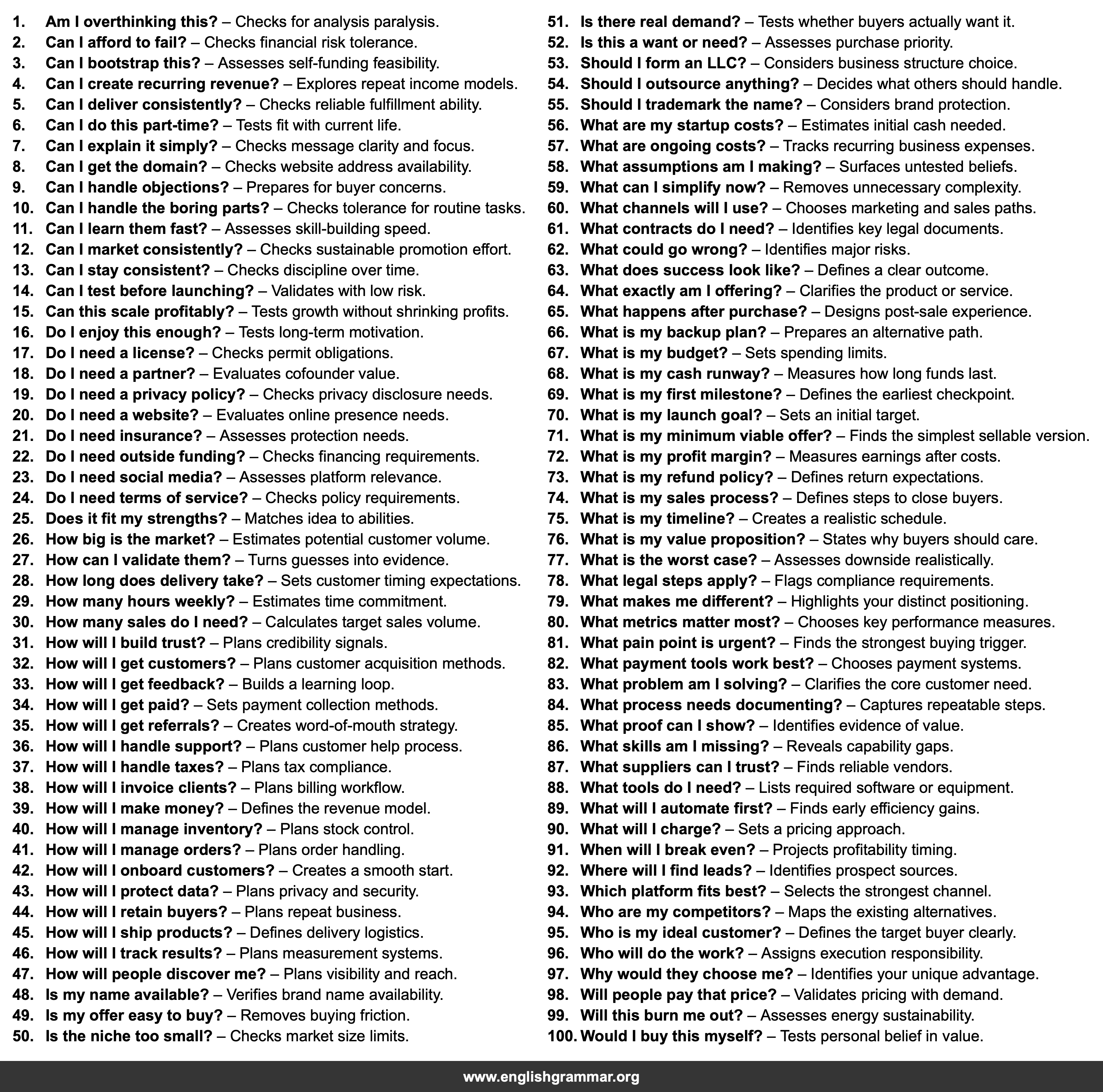
| No. | Item | Definition |
|---|---|---|
| 1. | Am I overthinking this? | Checks for analysis paralysis. |
| 2. | Can I afford to fail? | Checks financial risk tolerance. |
| 3. | Can I bootstrap this? | Assesses self-funding feasibility. |
| 4. | Can I create recurring revenue? | Explores repeat income models. |
| 5. | Can I deliver consistently? | Checks reliable fulfillment ability. |
| 6. | Can I do this part-time? | Tests fit with current life. |
| 7. | Can I explain it simply? | Checks message clarity and focus. |
| 8. | Can I get the domain? | Checks website address availability. |
| 9. | Can I handle objections? | Prepares for buyer concerns. |
| 10. | Can I handle the boring parts? | Checks tolerance for routine tasks. |
| 11. | Can I learn them fast? | Assesses skill-building speed. |
| 12. | Can I market consistently? | Checks sustainable promotion effort. |
| 13. | Can I stay consistent? | Checks discipline over time. |
| 14. | Can I test before launching? | Validates with low risk. |
| 15. | Can this scale profitably? | Tests growth without shrinking profits. |
| 16. | Do I enjoy this enough? | Tests long-term motivation. |
| 17. | Do I need a license? | Checks permit obligations. |
| 18. | Do I need a partner? | Evaluates cofounder value. |
| 19. | Do I need a privacy policy? | Checks privacy disclosure needs. |
| 20. | Do I need a website? | Evaluates online presence needs. |
| 21. | Do I need insurance? | Assesses protection needs. |
| 22. | Do I need outside funding? | Checks financing requirements. |
| 23. | Do I need social media? | Assesses platform relevance. |
| 24. | Do I need terms of service? | Checks policy requirements. |
| 25. | Does it fit my strengths? | Matches idea to abilities. |
| 26. | How big is the market? | Estimates potential customer volume. |
| 27. | How can I validate them? | Turns guesses into evidence. |
| 28. | How long does delivery take? | Sets customer timing expectations. |
| 29. | How many hours weekly? | Estimates time commitment. |
| 30. | How many sales do I need? | Calculates target sales volume. |
| 31. | How will I build trust? | Plans credibility signals. |
| 32. | How will I get customers? | Plans customer acquisition methods. |
| 33. | How will I get feedback? | Builds a learning loop. |
| 34. | How will I get paid? | Sets payment collection methods. |
| 35. | How will I get referrals? | Creates word-of-mouth strategy. |
| 36. | How will I handle support? | Plans customer help process. |
| 37. | How will I handle taxes? | Plans tax compliance. |
| 38. | How will I invoice clients? | Plans billing workflow. |
| 39. | How will I make money? | Defines the revenue model. |
| 40. | How will I manage inventory? | Plans stock control. |
| 41. | How will I manage orders? | Plans order handling. |
| 42. | How will I onboard customers? | Creates a smooth start. |
| 43. | How will I protect data? | Plans privacy and security. |
| 44. | How will I retain buyers? | Plans repeat business. |
| 45. | How will I ship products? | Defines delivery logistics. |
| 46. | How will I track results? | Plans measurement systems. |
| 47. | How will people discover me? | Plans visibility and reach. |
| 48. | Is my name available? | Verifies brand name availability. |
| 49. | Is my offer easy to buy? | Removes buying friction. |
| 50. | Is the niche too small? | Checks market size limits. |
| 51. | Is there real demand? | Tests whether buyers actually want it. |
| 52. | Is this a want or need? | Assesses purchase priority. |
| 53. | Should I form an LLC? | Considers business structure choice. |
| 54. | Should I outsource anything? | Decides what others should handle. |
| 55. | Should I trademark the name? | Considers brand protection. |
| 56. | What are my startup costs? | Estimates initial cash needed. |
| 57. | What are ongoing costs? | Tracks recurring business expenses. |
| 58. | What assumptions am I making? | Surfaces untested beliefs. |
| 59. | What can I simplify now? | Removes unnecessary complexity. |
| 60. | What channels will I use? | Chooses marketing and sales paths. |
| 61. | What contracts do I need? | Identifies key legal documents. |
| 62. | What could go wrong? | Identifies major risks. |
| 63. | What does success look like? | Defines a clear outcome. |
| 64. | What exactly am I offering? | Clarifies the product or service. |
| 65. | What happens after purchase? | Designs post-sale experience. |
| 66. | What is my backup plan? | Prepares an alternative path. |
| 67. | What is my budget? | Sets spending limits. |
| 68. | What is my cash runway? | Measures how long funds last. |
| 69. | What is my first milestone? | Defines the earliest checkpoint. |
| 70. | What is my launch goal? | Sets an initial target. |
| 71. | What is my minimum viable offer? | Finds the simplest sellable version. |
| 72. | What is my profit margin? | Measures earnings after costs. |
| 73. | What is my refund policy? | Defines return expectations. |
| 74. | What is my sales process? | Defines steps to close buyers. |
| 75. | What is my timeline? | Creates a realistic schedule. |
| 76. | What is my value proposition? | States why buyers should care. |
| 77. | What is the worst case? | Assesses downside realistically. |
| 78. | What legal steps apply? | Flags compliance requirements. |
| 79. | What makes me different? | Highlights your distinct positioning. |
| 80. | What metrics matter most? | Chooses key performance measures. |
| 81. | What pain point is urgent? | Finds the strongest buying trigger. |
| 82. | What payment tools work best? | Chooses payment systems. |
| 83. | What problem am I solving? | Clarifies the core customer need. |
| 84. | What process needs documenting? | Captures repeatable steps. |
| 85. | What proof can I show? | Identifies evidence of value. |
| 86. | What skills am I missing? | Reveals capability gaps. |
| 87. | What suppliers can I trust? | Finds reliable vendors. |
| 88. | What tools do I need? | Lists required software or equipment. |
| 89. | What will I automate first? | Finds early efficiency gains. |
| 90. | What will I charge? | Sets a pricing approach. |
| 91. | When will I break even? | Projects profitability timing. |
| 92. | Where will I find leads? | Identifies prospect sources. |
| 93. | Which platform fits best? | Selects the strongest channel. |
| 94. | Who are my competitors? | Maps the existing alternatives. |
| 95. | Who is my ideal customer? | Defines the target buyer clearly. |
| 96. | Who will do the work? | Assigns execution responsibility. |
| 97. | Why would they choose me? | Identifies your unique advantage. |
| 98. | Will people pay that price? | Validates pricing with demand. |
| 99. | Will this burn me out? | Assesses energy sustainability. |
| 100. | Would I buy this myself? | Tests personal belief in value. |