
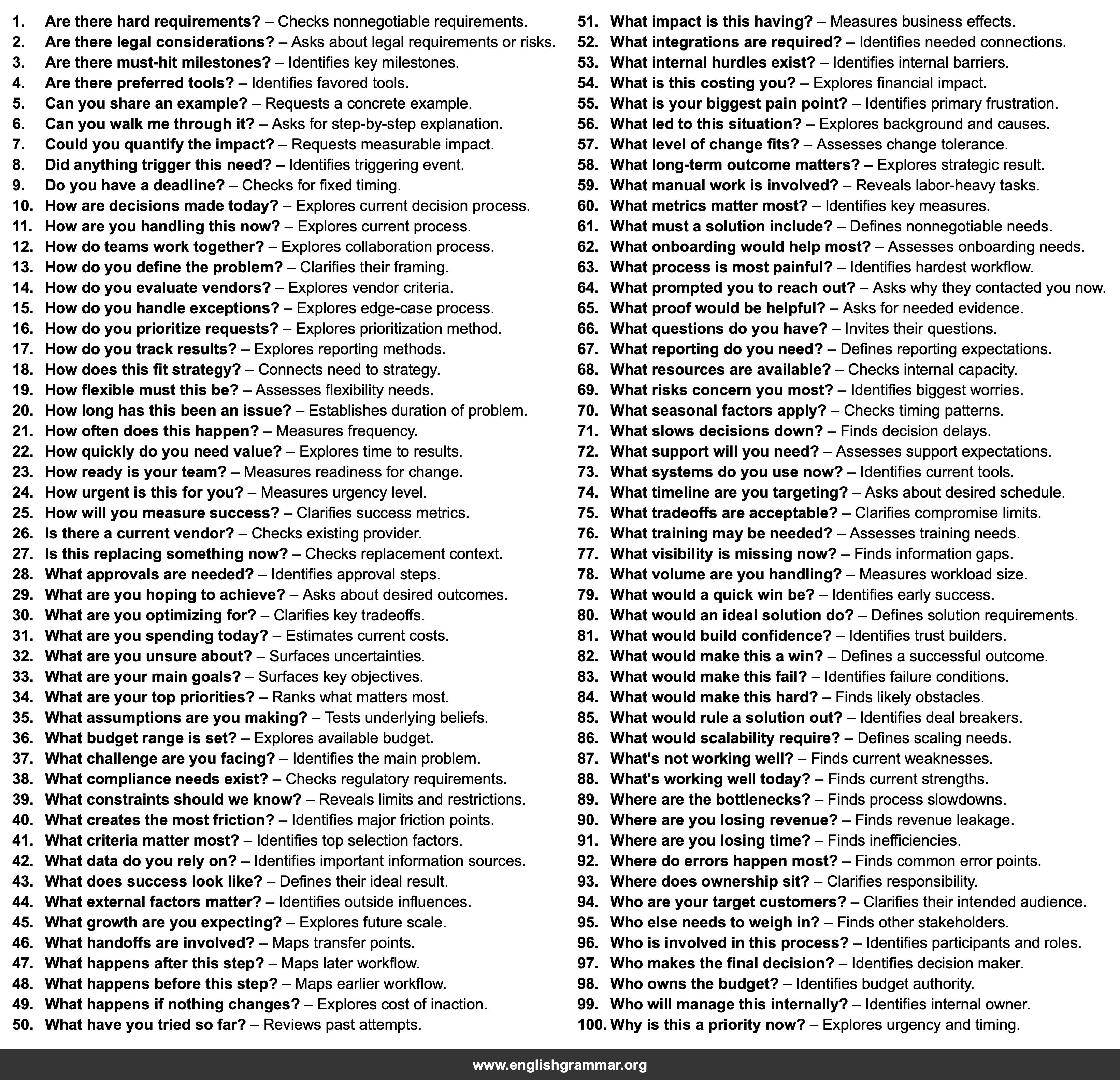
| No. | Item | Definition |
|---|---|---|
| 1. | Are there hard requirements? | Checks nonnegotiable requirements. |
| 2. | Are there legal considerations? | Asks about legal requirements or risks. |
| 3. | Are there must-hit milestones? | Identifies key milestones. |
| 4. | Are there preferred tools? | Identifies favored tools. |
| 5. | Can you share an example? | Requests a concrete example. |
| 6. | Can you walk me through it? | Asks for step-by-step explanation. |
| 7. | Could you quantify the impact? | Requests measurable impact. |
| 8. | Did anything trigger this need? | Identifies triggering event. |
| 9. | Do you have a deadline? | Checks for fixed timing. |
| 10. | How are decisions made today? | Explores current decision process. |
| 11. | How are you handling this now? | Explores current process. |
| 12. | How do teams work together? | Explores collaboration process. |
| 13. | How do you define the problem? | Clarifies their framing. |
| 14. | How do you evaluate vendors? | Explores vendor criteria. |
| 15. | How do you handle exceptions? | Explores edge-case process. |
| 16. | How do you prioritize requests? | Explores prioritization method. |
| 17. | How do you track results? | Explores reporting methods. |
| 18. | How does this fit strategy? | Connects need to strategy. |
| 19. | How flexible must this be? | Assesses flexibility needs. |
| 20. | How long has this been an issue? | Establishes duration of problem. |
| 21. | How often does this happen? | Measures frequency. |
| 22. | How quickly do you need value? | Explores time to results. |
| 23. | How ready is your team? | Measures readiness for change. |
| 24. | How urgent is this for you? | Measures urgency level. |
| 25. | How will you measure success? | Clarifies success metrics. |
| 26. | Is there a current vendor? | Checks existing provider. |
| 27. | Is this replacing something now? | Checks replacement context. |
| 28. | What approvals are needed? | Identifies approval steps. |
| 29. | What are you hoping to achieve? | Asks about desired outcomes. |
| 30. | What are you optimizing for? | Clarifies key tradeoffs. |
| 31. | What are you spending today? | Estimates current costs. |
| 32. | What are you unsure about? | Surfaces uncertainties. |
| 33. | What are your main goals? | Surfaces key objectives. |
| 34. | What are your top priorities? | Ranks what matters most. |
| 35. | What assumptions are you making? | Tests underlying beliefs. |
| 36. | What budget range is set? | Explores available budget. |
| 37. | What challenge are you facing? | Identifies the main problem. |
| 38. | What compliance needs exist? | Checks regulatory requirements. |
| 39. | What constraints should we know? | Reveals limits and restrictions. |
| 40. | What creates the most friction? | Identifies major friction points. |
| 41. | What criteria matter most? | Identifies top selection factors. |
| 42. | What data do you rely on? | Identifies important information sources. |
| 43. | What does success look like? | Defines their ideal result. |
| 44. | What external factors matter? | Identifies outside influences. |
| 45. | What growth are you expecting? | Explores future scale. |
| 46. | What handoffs are involved? | Maps transfer points. |
| 47. | What happens after this step? | Maps later workflow. |
| 48. | What happens before this step? | Maps earlier workflow. |
| 49. | What happens if nothing changes? | Explores cost of inaction. |
| 50. | What have you tried so far? | Reviews past attempts. |
| 51. | What impact is this having? | Measures business effects. |
| 52. | What integrations are required? | Identifies needed connections. |
| 53. | What internal hurdles exist? | Identifies internal barriers. |
| 54. | What is this costing you? | Explores financial impact. |
| 55. | What is your biggest pain point? | Identifies primary frustration. |
| 56. | What led to this situation? | Explores background and causes. |
| 57. | What level of change fits? | Assesses change tolerance. |
| 58. | What long-term outcome matters? | Explores strategic result. |
| 59. | What manual work is involved? | Reveals labor-heavy tasks. |
| 60. | What metrics matter most? | Identifies key measures. |
| 61. | What must a solution include? | Defines nonnegotiable needs. |
| 62. | What onboarding would help most? | Assesses onboarding needs. |
| 63. | What process is most painful? | Identifies hardest workflow. |
| 64. | What prompted you to reach out? | Asks why they contacted you now. |
| 65. | What proof would be helpful? | Asks for needed evidence. |
| 66. | What questions do you have? | Invites their questions. |
| 67. | What reporting do you need? | Defines reporting expectations. |
| 68. | What resources are available? | Checks internal capacity. |
| 69. | What risks concern you most? | Identifies biggest worries. |
| 70. | What seasonal factors apply? | Checks timing patterns. |
| 71. | What slows decisions down? | Finds decision delays. |
| 72. | What support will you need? | Assesses support expectations. |
| 73. | What systems do you use now? | Identifies current tools. |
| 74. | What timeline are you targeting? | Asks about desired schedule. |
| 75. | What tradeoffs are acceptable? | Clarifies compromise limits. |
| 76. | What training may be needed? | Assesses training needs. |
| 77. | What visibility is missing now? | Finds information gaps. |
| 78. | What volume are you handling? | Measures workload size. |
| 79. | What would a quick win be? | Identifies early success. |
| 80. | What would an ideal solution do? | Defines solution requirements. |
| 81. | What would build confidence? | Identifies trust builders. |
| 82. | What would make this a win? | Defines a successful outcome. |
| 83. | What would make this fail? | Identifies failure conditions. |
| 84. | What would make this hard? | Finds likely obstacles. |
| 85. | What would rule a solution out? | Identifies deal breakers. |
| 86. | What would scalability require? | Defines scaling needs. |
| 87. | What’s not working well? | Finds current weaknesses. |
| 88. | What’s working well today? | Finds current strengths. |
| 89. | Where are the bottlenecks? | Finds process slowdowns. |
| 90. | Where are you losing revenue? | Finds revenue leakage. |
| 91. | Where are you losing time? | Finds inefficiencies. |
| 92. | Where do errors happen most? | Finds common error points. |
| 93. | Where does ownership sit? | Clarifies responsibility. |
| 94. | Who are your target customers? | Clarifies their intended audience. |
| 95. | Who else needs to weigh in? | Finds other stakeholders. |
| 96. | Who is involved in this process? | Identifies participants and roles. |
| 97. | Who makes the final decision? | Identifies decision maker. |
| 98. | Who owns the budget? | Identifies budget authority. |
| 99. | Who will manage this internally? | Identifies internal owner. |
| 100. | Why is this a priority now? | Explores urgency and timing. |