Home of English Grammar

Grammar Guide
  • Home
  • Exercises
  • Matches
  • Rules
  • Tools
    • Grammar Checker
    • Very Replacer
    • Word Counter
  • Top Social Media Posts
  • Various Posts
  • Vocabulary
  • Writing Guides
  • Try Pro Free

Why we say “open a can of worms”

May 24, 2026 - pdf

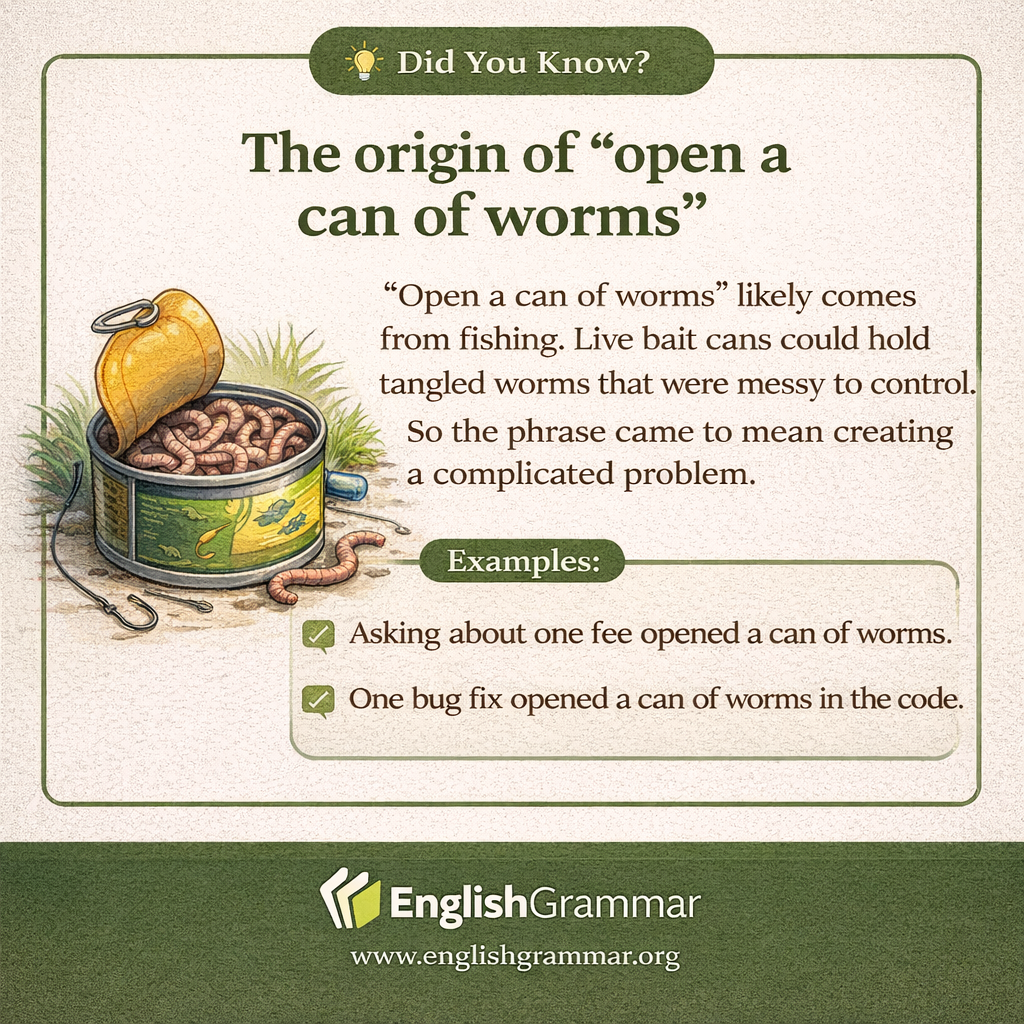
The origin of "open a can of worms"

“Open a can of worms” means to start a situation that becomes more complicated, messy, or difficult than expected. Today, people use it when one small question, change, or action leads to many new problems.

The phrase is likely connected to fishing. A container of live worms used as bait could be inconvenient and messy once opened, especially if the worms became tangled or hard to handle. That image helped the expression develop its modern meaning: once you begin, you may have more trouble than you expected.

People usually say it when a simple step creates a chain of complications. For example, asking why a bill seems high might reveal several billing mistakes. A small software fix might also expose deeper code problems.

  • Everyday use: “I just wanted to ask about one charge, but it opened a can of worms.”
  • Work use: “Updating that file opened a can of worms in the system.”

The exact historical path is not perfectly certain, but the fishing explanation is widely repeated because it matches the image so well: you open something small, and suddenly you have a much bigger mess to deal with.

  • Share
  • Post
  • Post
  • Reddit
  • Email
  • WhatsApp
NEW: Try Matches, our daily vocabulary challenge. Pick a topic and level and match words with definitions to boost your vocabulary.
2,485,429 
761,532 
Improve Your English
  • Download 2026 Grammar Guide (PDF)
  • Free Weekly Exercises & Vocabulary
  • Join over 3 Million English Learners
We respect your privacy. Unsubscribe anytime.
Grammar Checker - Try Now

Latest Posts

  • 100 Best Synonyms for “Paramount” October 7, 2026
  • Hedging Language Exercise October 7, 2026
  • 100 Best Synonyms for “Darker” October 7, 2026
  • How to choose improve on, with, at, in, and upon October 7, 2026
  • Spooky vs. creepy vs. eerie: choosing the right word October 7, 2026
  • 100 Best Synonyms for “Languid” October 7, 2026
  • Causative Have and Get Exercise October 7, 2026

Copyright © 2026 · EnglishGrammar.org
Contact · Disclaimer · Privacy Policy · Refund Policy · Sitemap · Terms

Improve Your English
  • Download 2026 Grammar Guide (PDF)
  • Free Weekly Exercises & Vocabulary
  • Join over 3 Million English Learners
We respect your privacy. Unsubscribe anytime.