
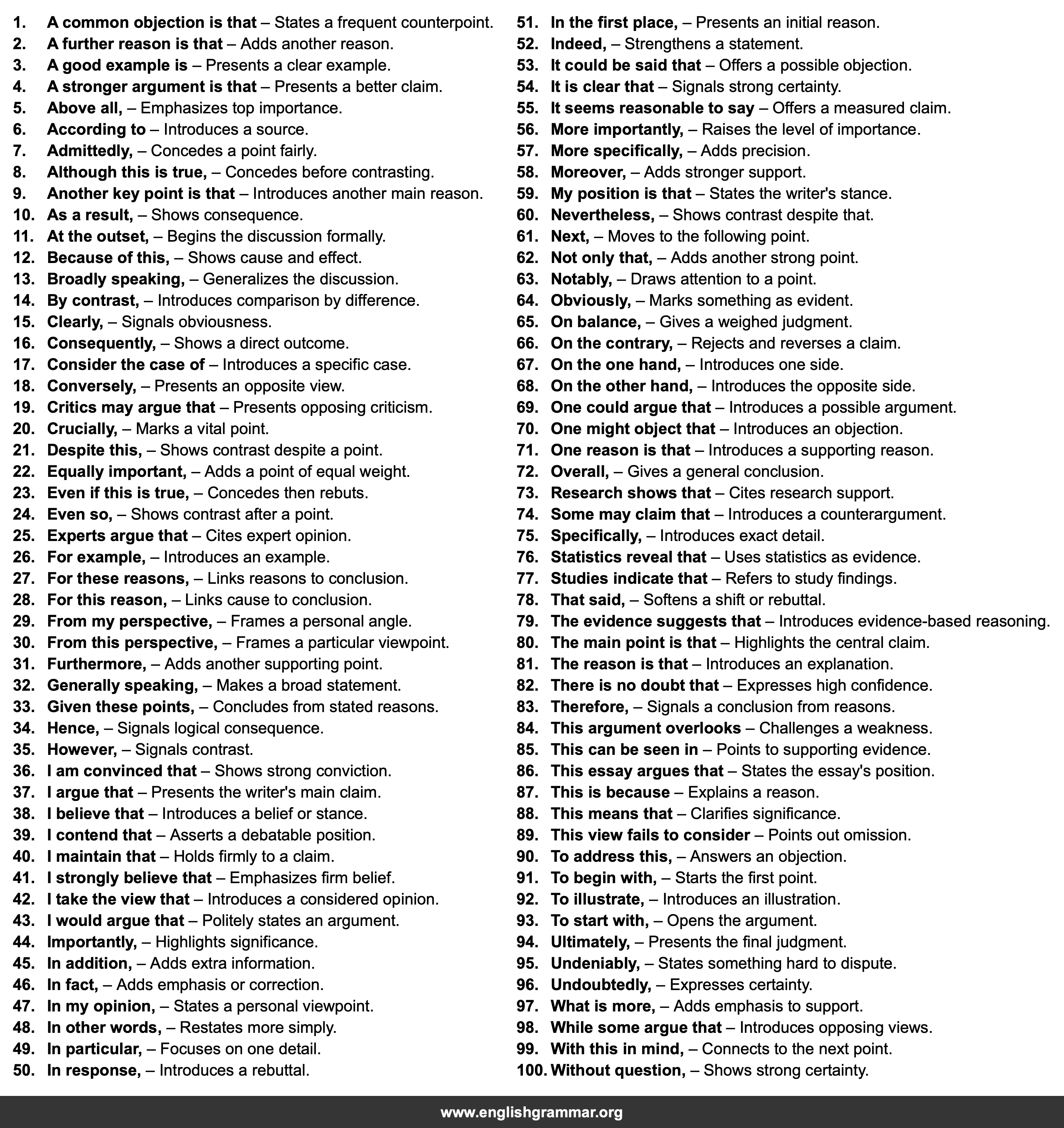
| No. | Item | Definition |
|---|---|---|
| 1. | A common objection is that | States a frequent counterpoint. |
| 2. | A further reason is that | Adds another reason. |
| 3. | A good example is | Presents a clear example. |
| 4. | A stronger argument is that | Presents a better claim. |
| 5. | Above all, | Emphasizes top importance. |
| 6. | According to | Introduces a source. |
| 7. | Admittedly, | Concedes a point fairly. |
| 8. | Although this is true, | Concedes before contrasting. |
| 9. | Another key point is that | Introduces another main reason. |
| 10. | As a result, | Shows consequence. |
| 11. | At the outset, | Begins the discussion formally. |
| 12. | Because of this, | Shows cause and effect. |
| 13. | Broadly speaking, | Generalizes the discussion. |
| 14. | By contrast, | Introduces comparison by difference. |
| 15. | Clearly, | Signals obviousness. |
| 16. | Consequently, | Shows a direct outcome. |
| 17. | Consider the case of | Introduces a specific case. |
| 18. | Conversely, | Presents an opposite view. |
| 19. | Critics may argue that | Presents opposing criticism. |
| 20. | Crucially, | Marks a vital point. |
| 21. | Despite this, | Shows contrast despite a point. |
| 22. | Equally important, | Adds a point of equal weight. |
| 23. | Even if this is true, | Concedes then rebuts. |
| 24. | Even so, | Shows contrast after a point. |
| 25. | Experts argue that | Cites expert opinion. |
| 26. | For example, | Introduces an example. |
| 27. | For these reasons, | Links reasons to conclusion. |
| 28. | For this reason, | Links cause to conclusion. |
| 29. | From my perspective, | Frames a personal angle. |
| 30. | From this perspective, | Frames a particular viewpoint. |
| 31. | Furthermore, | Adds another supporting point. |
| 32. | Generally speaking, | Makes a broad statement. |
| 33. | Given these points, | Concludes from stated reasons. |
| 34. | Hence, | Signals logical consequence. |
| 35. | However, | Signals contrast. |
| 36. | I am convinced that | Shows strong conviction. |
| 37. | I argue that | Presents the writer’s main claim. |
| 38. | I believe that | Introduces a belief or stance. |
| 39. | I contend that | Asserts a debatable position. |
| 40. | I maintain that | Holds firmly to a claim. |
| 41. | I strongly believe that | Emphasizes firm belief. |
| 42. | I take the view that | Introduces a considered opinion. |
| 43. | I would argue that | Politely states an argument. |
| 44. | Importantly, | Highlights significance. |
| 45. | In addition, | Adds extra information. |
| 46. | In fact, | Adds emphasis or correction. |
| 47. | In my opinion, | States a personal viewpoint. |
| 48. | In other words, | Restates more simply. |
| 49. | In particular, | Focuses on one detail. |
| 50. | In response, | Introduces a rebuttal. |
| 51. | In the first place, | Presents an initial reason. |
| 52. | Indeed, | Strengthens a statement. |
| 53. | It could be said that | Offers a possible objection. |
| 54. | It is clear that | Signals strong certainty. |
| 55. | It seems reasonable to say | Offers a measured claim. |
| 56. | More importantly, | Raises the level of importance. |
| 57. | More specifically, | Adds precision. |
| 58. | Moreover, | Adds stronger support. |
| 59. | My position is that | States the writer’s stance. |
| 60. | Nevertheless, | Shows contrast despite that. |
| 61. | Next, | Moves to the following point. |
| 62. | Not only that, | Adds another strong point. |
| 63. | Notably, | Draws attention to a point. |
| 64. | Obviously, | Marks something as evident. |
| 65. | On balance, | Gives a weighed judgment. |
| 66. | On the contrary, | Rejects and reverses a claim. |
| 67. | On the one hand, | Introduces one side. |
| 68. | On the other hand, | Introduces the opposite side. |
| 69. | One could argue that | Introduces a possible argument. |
| 70. | One might object that | Introduces an objection. |
| 71. | One reason is that | Introduces a supporting reason. |
| 72. | Overall, | Gives a general conclusion. |
| 73. | Research shows that | Cites research support. |
| 74. | Some may claim that | Introduces a counterargument. |
| 75. | Specifically, | Introduces exact detail. |
| 76. | Statistics reveal that | Uses statistics as evidence. |
| 77. | Studies indicate that | Refers to study findings. |
| 78. | That said, | Softens a shift or rebuttal. |
| 79. | The evidence suggests that | Introduces evidence-based reasoning. |
| 80. | The main point is that | Highlights the central claim. |
| 81. | The reason is that | Introduces an explanation. |
| 82. | There is no doubt that | Expresses high confidence. |
| 83. | Therefore, | Signals a conclusion from reasons. |
| 84. | This argument overlooks | Challenges a weakness. |
| 85. | This can be seen in | Points to supporting evidence. |
| 86. | This essay argues that | States the essay’s position. |
| 87. | This is because | Explains a reason. |
| 88. | This means that | Clarifies significance. |
| 89. | This view fails to consider | Points out omission. |
| 90. | To address this, | Answers an objection. |
| 91. | To begin with, | Starts the first point. |
| 92. | To illustrate, | Introduces an illustration. |
| 93. | To start with, | Opens the argument. |
| 94. | Ultimately, | Presents the final judgment. |
| 95. | Undeniably, | States something hard to dispute. |
| 96. | Undoubtedly, | Expresses certainty. |
| 97. | What is more, | Adds emphasis to support. |
| 98. | While some argue that | Introduces opposing views. |
| 99. | With this in mind, | Connects to the next point. |
| 100. | Without question, | Shows strong certainty. |