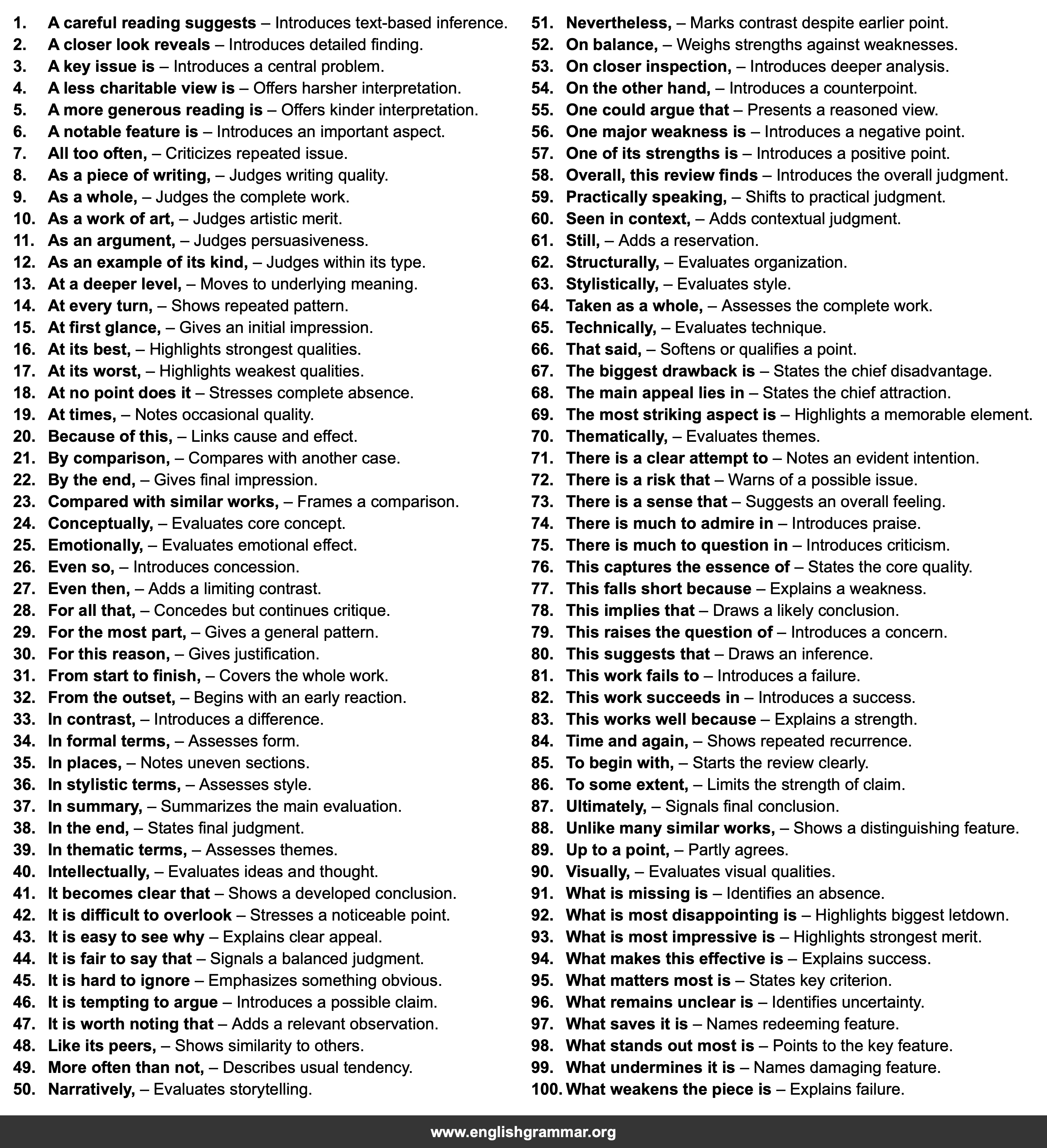
| No. | Item | Definition |
|---|---|---|
| 1. | A careful reading suggests | Introduces text-based inference. |
| 2. | A closer look reveals | Introduces detailed finding. |
| 3. | A key issue is | Introduces a central problem. |
| 4. | A less charitable view is | Offers harsher interpretation. |
| 5. | A more generous reading is | Offers kinder interpretation. |
| 6. | A notable feature is | Introduces an important aspect. |
| 7. | All too often, | Criticizes repeated issue. |
| 8. | As a piece of writing, | Judges writing quality. |
| 9. | As a whole, | Judges the complete work. |
| 10. | As a work of art, | Judges artistic merit. |
| 11. | As an argument, | Judges persuasiveness. |
| 12. | As an example of its kind, | Judges within its type. |
| 13. | At a deeper level, | Moves to underlying meaning. |
| 14. | At every turn, | Shows repeated pattern. |
| 15. | At first glance, | Gives an initial impression. |
| 16. | At its best, | Highlights strongest qualities. |
| 17. | At its worst, | Highlights weakest qualities. |
| 18. | At no point does it | Stresses complete absence. |
| 19. | At times, | Notes occasional quality. |
| 20. | Because of this, | Links cause and effect. |
| 21. | By comparison, | Compares with another case. |
| 22. | By the end, | Gives final impression. |
| 23. | Compared with similar works, | Frames a comparison. |
| 24. | Conceptually, | Evaluates core concept. |
| 25. | Emotionally, | Evaluates emotional effect. |
| 26. | Even so, | Introduces concession. |
| 27. | Even then, | Adds a limiting contrast. |
| 28. | For all that, | Concedes but continues critique. |
| 29. | For the most part, | Gives a general pattern. |
| 30. | For this reason, | Gives justification. |
| 31. | From start to finish, | Covers the whole work. |
| 32. | From the outset, | Begins with an early reaction. |
| 33. | In contrast, | Introduces a difference. |
| 34. | In formal terms, | Assesses form. |
| 35. | In places, | Notes uneven sections. |
| 36. | In stylistic terms, | Assesses style. |
| 37. | In summary, | Summarizes the main evaluation. |
| 38. | In the end, | States final judgment. |
| 39. | In thematic terms, | Assesses themes. |
| 40. | Intellectually, | Evaluates ideas and thought. |
| 41. | It becomes clear that | Shows a developed conclusion. |
| 42. | It is difficult to overlook | Stresses a noticeable point. |
| 43. | It is easy to see why | Explains clear appeal. |
| 44. | It is fair to say that | Signals a balanced judgment. |
| 45. | It is hard to ignore | Emphasizes something obvious. |
| 46. | It is tempting to argue | Introduces a possible claim. |
| 47. | It is worth noting that | Adds a relevant observation. |
| 48. | Like its peers, | Shows similarity to others. |
| 49. | More often than not, | Describes usual tendency. |
| 50. | Narratively, | Evaluates storytelling. |
| 51. | Nevertheless, | Marks contrast despite earlier point. |
| 52. | On balance, | Weighs strengths against weaknesses. |
| 53. | On closer inspection, | Introduces deeper analysis. |
| 54. | On the other hand, | Introduces a counterpoint. |
| 55. | One could argue that | Presents a reasoned view. |
| 56. | One major weakness is | Introduces a negative point. |
| 57. | One of its strengths is | Introduces a positive point. |
| 58. | Overall, this review finds | Introduces the overall judgment. |
| 59. | Practically speaking, | Shifts to practical judgment. |
| 60. | Seen in context, | Adds contextual judgment. |
| 61. | Still, | Adds a reservation. |
| 62. | Structurally, | Evaluates organization. |
| 63. | Stylistically, | Evaluates style. |
| 64. | Taken as a whole, | Assesses the complete work. |
| 65. | Technically, | Evaluates technique. |
| 66. | That said, | Softens or qualifies a point. |
| 67. | The biggest drawback is | States the chief disadvantage. |
| 68. | The main appeal lies in | States the chief attraction. |
| 69. | The most striking aspect is | Highlights a memorable element. |
| 70. | Thematically, | Evaluates themes. |
| 71. | There is a clear attempt to | Notes an evident intention. |
| 72. | There is a risk that | Warns of a possible issue. |
| 73. | There is a sense that | Suggests an overall feeling. |
| 74. | There is much to admire in | Introduces praise. |
| 75. | There is much to question in | Introduces criticism. |
| 76. | This captures the essence of | States the core quality. |
| 77. | This falls short because | Explains a weakness. |
| 78. | This implies that | Draws a likely conclusion. |
| 79. | This raises the question of | Introduces a concern. |
| 80. | This suggests that | Draws an inference. |
| 81. | This work fails to | Introduces a failure. |
| 82. | This work succeeds in | Introduces a success. |
| 83. | This works well because | Explains a strength. |
| 84. | Time and again, | Shows repeated recurrence. |
| 85. | To begin with, | Starts the review clearly. |
| 86. | To some extent, | Limits the strength of claim. |
| 87. | Ultimately, | Signals final conclusion. |
| 88. | Unlike many similar works, | Shows a distinguishing feature. |
| 89. | Up to a point, | Partly agrees. |
| 90. | Visually, | Evaluates visual qualities. |
| 91. | What is missing is | Identifies an absence. |
| 92. | What is most disappointing is | Highlights biggest letdown. |
| 93. | What is most impressive is | Highlights strongest merit. |
| 94. | What makes this effective is | Explains success. |
| 95. | What matters most is | States key criterion. |
| 96. | What remains unclear is | Identifies uncertainty. |
| 97. | What saves it is | Names redeeming feature. |
| 98. | What stands out most is | Points to the key feature. |
| 99. | What undermines it is | Names damaging feature. |
| 100. | What weakens the piece is | Explains failure. |
