
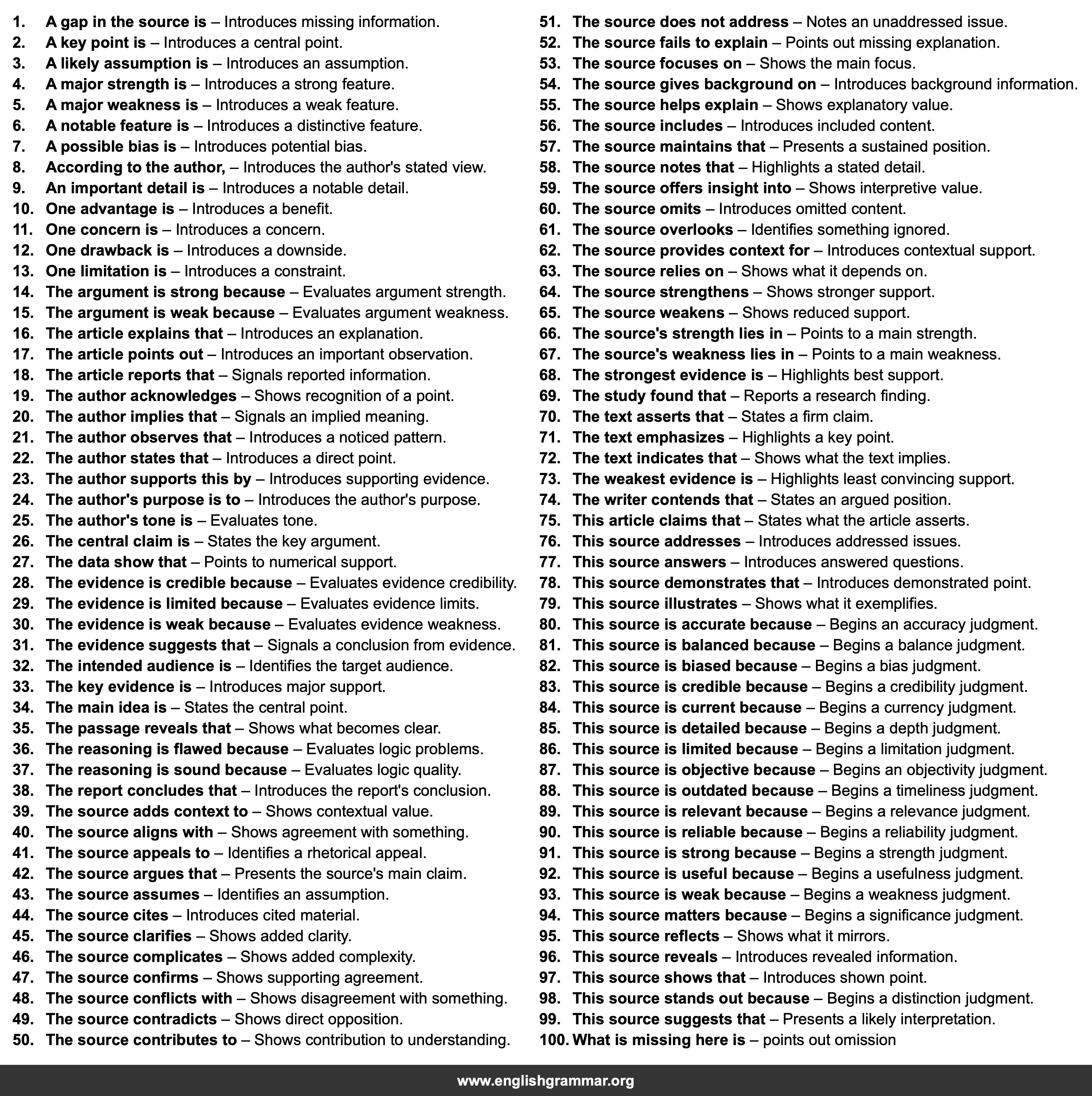
| No. | Item | Definition |
|---|---|---|
| 1. | A gap in the source is | Introduces missing information. |
| 2. | A key point is | Introduces a central point. |
| 3. | A likely assumption is | Introduces an assumption. |
| 4. | A major strength is | Introduces a strong feature. |
| 5. | A major weakness is | Introduces a weak feature. |
| 6. | A notable feature is | Introduces a distinctive feature. |
| 7. | A possible bias is | Introduces potential bias. |
| 8. | According to the author, | Introduces the author’s stated view. |
| 9. | An important detail is | Introduces a notable detail. |
| 10. | One advantage is | Introduces a benefit. |
| 11. | One concern is | Introduces a concern. |
| 12. | One drawback is | Introduces a downside. |
| 13. | One limitation is | Introduces a constraint. |
| 14. | The argument is strong because | Evaluates argument strength. |
| 15. | The argument is weak because | Evaluates argument weakness. |
| 16. | The article explains that | Introduces an explanation. |
| 17. | The article points out | Introduces an important observation. |
| 18. | The article reports that | Signals reported information. |
| 19. | The author acknowledges | Shows recognition of a point. |
| 20. | The author implies that | Signals an implied meaning. |
| 21. | The author observes that | Introduces a noticed pattern. |
| 22. | The author states that | Introduces a direct point. |
| 23. | The author supports this by | Introduces supporting evidence. |
| 24. | The author’s purpose is to | Introduces the author’s purpose. |
| 25. | The author’s tone is | Evaluates tone. |
| 26. | The central claim is | States the key argument. |
| 27. | The data show that | Points to numerical support. |
| 28. | The evidence is credible because | Evaluates evidence credibility. |
| 29. | The evidence is limited because | Evaluates evidence limits. |
| 30. | The evidence is weak because | Evaluates evidence weakness. |
| 31. | The evidence suggests that | Signals a conclusion from evidence. |
| 32. | The intended audience is | Identifies the target audience. |
| 33. | The key evidence is | Introduces major support. |
| 34. | The main idea is | States the central point. |
| 35. | The passage reveals that | Shows what becomes clear. |
| 36. | The reasoning is flawed because | Evaluates logic problems. |
| 37. | The reasoning is sound because | Evaluates logic quality. |
| 38. | The report concludes that | Introduces the report’s conclusion. |
| 39. | The source adds context to | Shows contextual value. |
| 40. | The source aligns with | Shows agreement with something. |
| 41. | The source appeals to | Identifies a rhetorical appeal. |
| 42. | The source argues that | Presents the source’s main claim. |
| 43. | The source assumes | Identifies an assumption. |
| 44. | The source cites | Introduces cited material. |
| 45. | The source clarifies | Shows added clarity. |
| 46. | The source complicates | Shows added complexity. |
| 47. | The source confirms | Shows supporting agreement. |
| 48. | The source conflicts with | Shows disagreement with something. |
| 49. | The source contradicts | Shows direct opposition. |
| 50. | The source contributes to | Shows contribution to understanding. |
| 51. | The source does not address | Notes an unaddressed issue. |
| 52. | The source fails to explain | Points out missing explanation. |
| 53. | The source focuses on | Shows the main focus. |
| 54. | The source gives background on | Introduces background information. |
| 55. | The source helps explain | Shows explanatory value. |
| 56. | The source includes | Introduces included content. |
| 57. | The source maintains that | Presents a sustained position. |
| 58. | The source notes that | Highlights a stated detail. |
| 59. | The source offers insight into | Shows interpretive value. |
| 60. | The source omits | Introduces omitted content. |
| 61. | The source overlooks | Identifies something ignored. |
| 62. | The source provides context for | Introduces contextual support. |
| 63. | The source relies on | Shows what it depends on. |
| 64. | The source strengthens | Shows stronger support. |
| 65. | The source weakens | Shows reduced support. |
| 66. | The source’s strength lies in | Points to a main strength. |
| 67. | The source’s weakness lies in | Points to a main weakness. |
| 68. | The strongest evidence is | Highlights best support. |
| 69. | The study found that | Reports a research finding. |
| 70. | The text asserts that | States a firm claim. |
| 71. | The text emphasizes | Highlights a key point. |
| 72. | The text indicates that | Shows what the text implies. |
| 73. | The weakest evidence is | Highlights least convincing support. |
| 74. | The writer contends that | States an argued position. |
| 75. | This article claims that | States what the article asserts. |
| 76. | This source addresses | Introduces addressed issues. |
| 77. | This source answers | Introduces answered questions. |
| 78. | This source demonstrates that | Introduces demonstrated point. |
| 79. | This source illustrates | Shows what it exemplifies. |
| 80. | This source is accurate because | Begins an accuracy judgment. |
| 81. | This source is balanced because | Begins a balance judgment. |
| 82. | This source is biased because | Begins a bias judgment. |
| 83. | This source is credible because | Begins a credibility judgment. |
| 84. | This source is current because | Begins a currency judgment. |
| 85. | This source is detailed because | Begins a depth judgment. |
| 86. | This source is limited because | Begins a limitation judgment. |
| 87. | This source is objective because | Begins an objectivity judgment. |
| 88. | This source is outdated because | Begins a timeliness judgment. |
| 89. | This source is relevant because | Begins a relevance judgment. |
| 90. | This source is reliable because | Begins a reliability judgment. |
| 91. | This source is strong because | Begins a strength judgment. |
| 92. | This source is useful because | Begins a usefulness judgment. |
| 93. | This source is weak because | Begins a weakness judgment. |
| 94. | This source matters because | Begins a significance judgment. |
| 95. | This source reflects | Shows what it mirrors. |
| 96. | This source reveals | Introduces revealed information. |
| 97. | This source shows that | Introduces shown point. |
| 98. | This source stands out because | Begins a distinction judgment. |
| 99. | This source suggests that | Presents a likely interpretation. |
| 100. | What is missing here is | points out omission |