
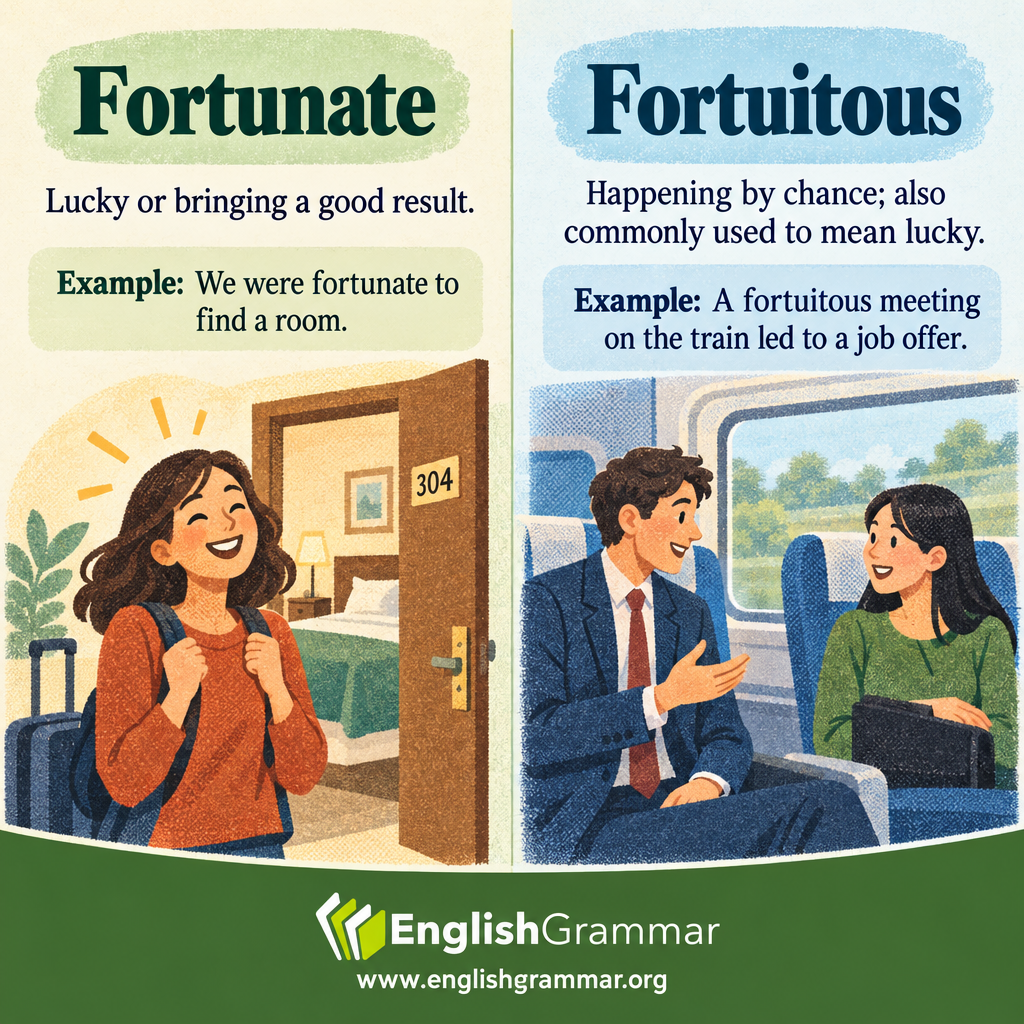
Fortunate and fortuitous can both describe welcome events, but they usually emphasize different things: a good result or an unexpected coincidence.
Fortunate means lucky or favored by good circumstances. Use it when the important point is that something turned out well. It can describe a person, a situation, or an outcome.
- We were fortunate that the storm missed our town.
- It was fortunate that someone had brought a first-aid kit.
Neither sentence needs to emphasize a chance meeting or an unplanned discovery. The focus is simply on a favorable situation.
Fortuitous traditionally means happening by chance rather than through planning. It often describes a coincidence that leads to something useful or pleasant.
- A fortuitous conversation in a café helped Maya find a new apartment.
Here, the conversation was not arranged for that purpose. Its unexpected nature is central to the description.
There is some overlap: fortuitous is also commonly used to mean lucky or favorable. That use is established, although some style guides prefer to reserve the word for chance events. It is therefore too strict to say that it can never mean lucky.
For clear everyday writing, choose fortunate when you mainly mean that the result was good. Choose fortuitous when you want to draw attention to chance or coincidence. A single event can be both: it happened unexpectedly, and it worked out well.