
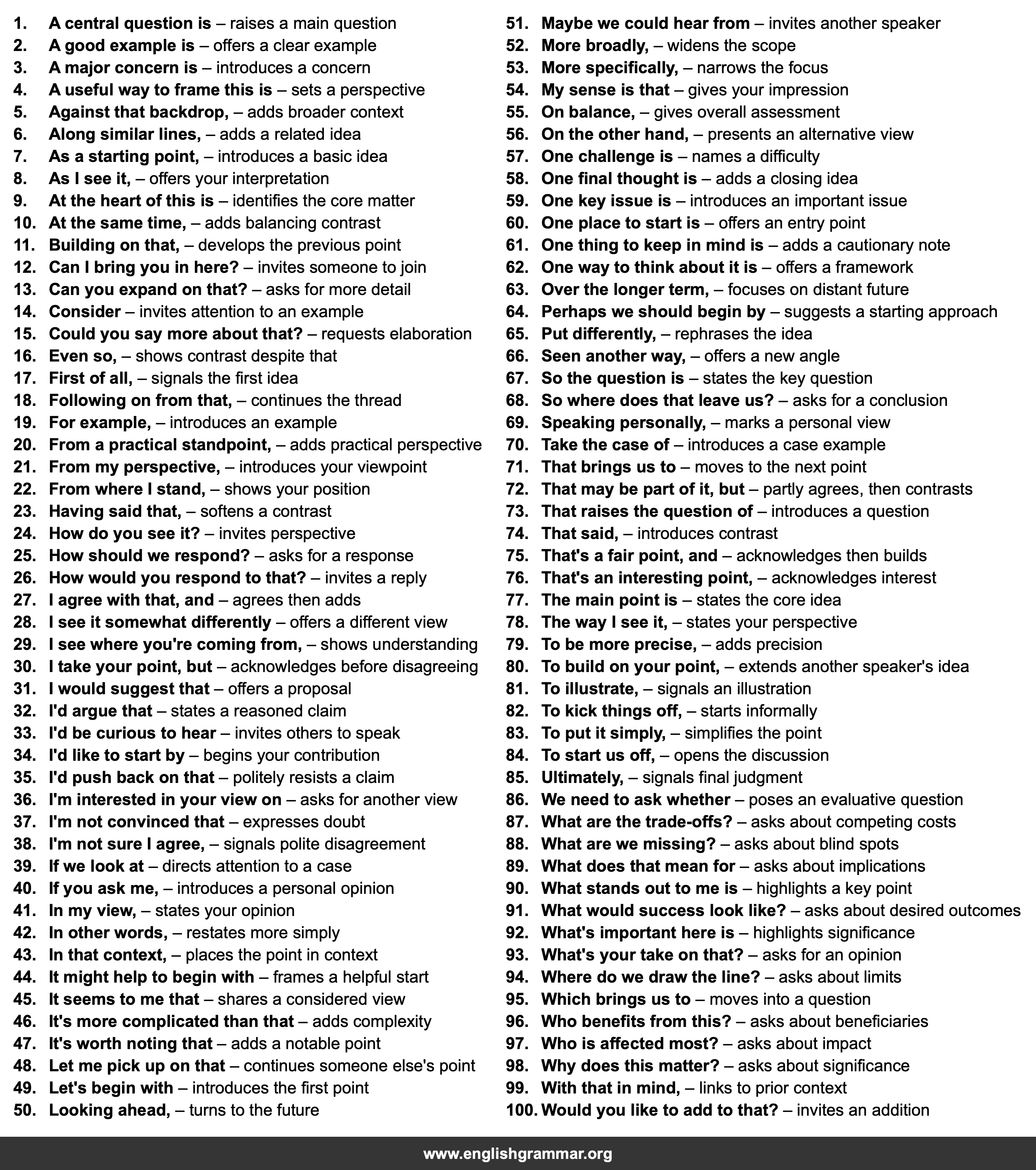
| No. | Item | Definition |
|---|---|---|
| 1. | A central question is | raises a main question |
| 2. | A good example is | offers a clear example |
| 3. | A major concern is | introduces a concern |
| 4. | A useful way to frame this is | sets a perspective |
| 5. | Against that backdrop, | adds broader context |
| 6. | Along similar lines, | adds a related idea |
| 7. | As a starting point, | introduces a basic idea |
| 8. | As I see it, | offers your interpretation |
| 9. | At the heart of this is | identifies the core matter |
| 10. | At the same time, | adds balancing contrast |
| 11. | Building on that, | develops the previous point |
| 12. | Can I bring you in here? | invites someone to join |
| 13. | Can you expand on that? | asks for more detail |
| 14. | Consider | invites attention to an example |
| 15. | Could you say more about that? | requests elaboration |
| 16. | Even so, | shows contrast despite that |
| 17. | First of all, | signals the first idea |
| 18. | Following on from that, | continues the thread |
| 19. | For example, | introduces an example |
| 20. | From a practical standpoint, | adds practical perspective |
| 21. | From my perspective, | introduces your viewpoint |
| 22. | From where I stand, | shows your position |
| 23. | Having said that, | softens a contrast |
| 24. | How do you see it? | invites perspective |
| 25. | How should we respond? | asks for a response |
| 26. | How would you respond to that? | invites a reply |
| 27. | I agree with that, and | agrees then adds |
| 28. | I see it somewhat differently | offers a different view |
| 29. | I see where you’re coming from, | shows understanding |
| 30. | I take your point, but | acknowledges before disagreeing |
| 31. | I would suggest that | offers a proposal |
| 32. | I’d argue that | states a reasoned claim |
| 33. | I’d be curious to hear | invites others to speak |
| 34. | I’d like to start by | begins your contribution |
| 35. | I’d push back on that | politely resists a claim |
| 36. | I’m interested in your view on | asks for another view |
| 37. | I’m not convinced that | expresses doubt |
| 38. | I’m not sure I agree, | signals polite disagreement |
| 39. | If we look at | directs attention to a case |
| 40. | If you ask me, | introduces a personal opinion |
| 41. | In my view, | states your opinion |
| 42. | In other words, | restates more simply |
| 43. | In that context, | places the point in context |
| 44. | It might help to begin with | frames a helpful start |
| 45. | It seems to me that | shares a considered view |
| 46. | It’s more complicated than that | adds complexity |
| 47. | It’s worth noting that | adds a notable point |
| 48. | Let me pick up on that | continues someone else’s point |
| 49. | Let’s begin with | introduces the first point |
| 50. | Looking ahead, | turns to the future |
| 51. | Maybe we could hear from | invites another speaker |
| 52. | More broadly, | widens the scope |
| 53. | More specifically, | narrows the focus |
| 54. | My sense is that | gives your impression |
| 55. | On balance, | gives overall assessment |
| 56. | On the other hand, | presents an alternative view |
| 57. | One challenge is | names a difficulty |
| 58. | One final thought is | adds a closing idea |
| 59. | One key issue is | introduces an important issue |
| 60. | One place to start is | offers an entry point |
| 61. | One thing to keep in mind is | adds a cautionary note |
| 62. | One way to think about it is | offers a framework |
| 63. | Over the longer term, | focuses on distant future |
| 64. | Perhaps we should begin by | suggests a starting approach |
| 65. | Put differently, | rephrases the idea |
| 66. | Seen another way, | offers a new angle |
| 67. | So the question is | states the key question |
| 68. | So where does that leave us? | asks for a conclusion |
| 69. | Speaking personally, | marks a personal view |
| 70. | Take the case of | introduces a case example |
| 71. | That brings us to | moves to the next point |
| 72. | That may be part of it, but | partly agrees, then contrasts |
| 73. | That raises the question of | introduces a question |
| 74. | That said, | introduces contrast |
| 75. | That’s a fair point, and | acknowledges then builds |
| 76. | That’s an interesting point, | acknowledges interest |
| 77. | The main point is | states the core idea |
| 78. | The way I see it, | states your perspective |
| 79. | To be more precise, | adds precision |
| 80. | To build on your point, | extends another speaker’s idea |
| 81. | To illustrate, | signals an illustration |
| 82. | To kick things off, | starts informally |
| 83. | To put it simply, | simplifies the point |
| 84. | To start us off, | opens the discussion |
| 85. | Ultimately, | signals final judgment |
| 86. | We need to ask whether | poses an evaluative question |
| 87. | What are the trade-offs? | asks about competing costs |
| 88. | What are we missing? | asks about blind spots |
| 89. | What does that mean for | asks about implications |
| 90. | What stands out to me is | highlights a key point |
| 91. | What would success look like? | asks about desired outcomes |
| 92. | What’s important here is | highlights significance |
| 93. | What’s your take on that? | asks for an opinion |
| 94. | Where do we draw the line? | asks about limits |
| 95. | Which brings us to | moves into a question |
| 96. | Who benefits from this? | asks about beneficiaries |
| 97. | Who is affected most? | asks about impact |
| 98. | Why does this matter? | asks about significance |
| 99. | With that in mind, | links to prior context |
| 100. | Would you like to add to that? | invites an addition |