
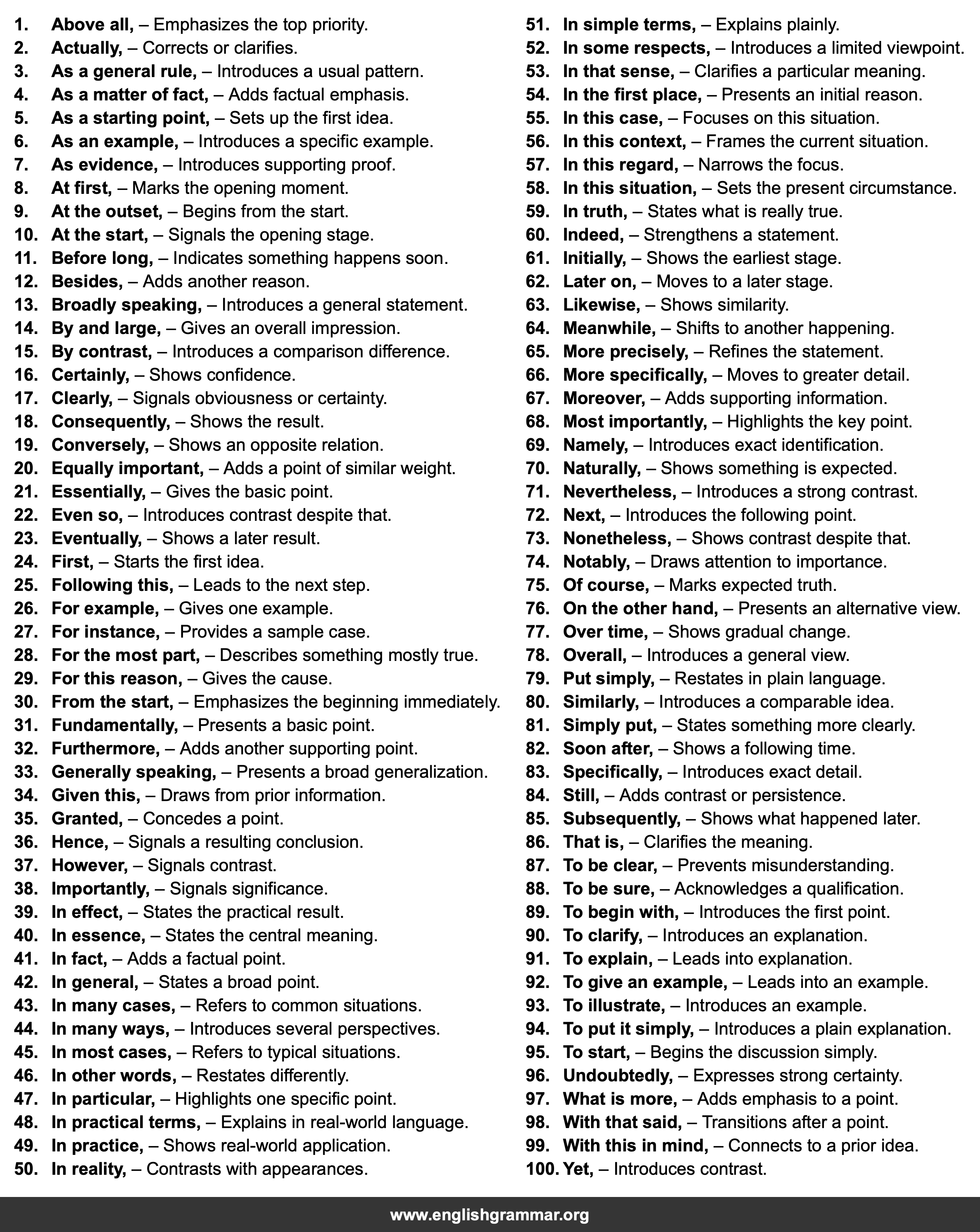
| No. | Item | Definition |
|---|---|---|
| 1. | Above all, | Emphasizes the top priority. |
| 2. | Actually, | Corrects or clarifies. |
| 3. | As a general rule, | Introduces a usual pattern. |
| 4. | As a matter of fact, | Adds factual emphasis. |
| 5. | As a starting point, | Sets up the first idea. |
| 6. | As an example, | Introduces a specific example. |
| 7. | As evidence, | Introduces supporting proof. |
| 8. | At first, | Marks the opening moment. |
| 9. | At the outset, | Begins from the start. |
| 10. | At the start, | Signals the opening stage. |
| 11. | Before long, | Indicates something happens soon. |
| 12. | Besides, | Adds another reason. |
| 13. | Broadly speaking, | Introduces a general statement. |
| 14. | By and large, | Gives an overall impression. |
| 15. | By contrast, | Introduces a comparison difference. |
| 16. | Certainly, | Shows confidence. |
| 17. | Clearly, | Signals obviousness or certainty. |
| 18. | Consequently, | Shows the result. |
| 19. | Conversely, | Shows an opposite relation. |
| 20. | Equally important, | Adds a point of similar weight. |
| 21. | Essentially, | Gives the basic point. |
| 22. | Even so, | Introduces contrast despite that. |
| 23. | Eventually, | Shows a later result. |
| 24. | First, | Starts the first idea. |
| 25. | Following this, | Leads to the next step. |
| 26. | For example, | Gives one example. |
| 27. | For instance, | Provides a sample case. |
| 28. | For the most part, | Describes something mostly true. |
| 29. | For this reason, | Gives the cause. |
| 30. | From the start, | Emphasizes the beginning immediately. |
| 31. | Fundamentally, | Presents a basic point. |
| 32. | Furthermore, | Adds another supporting point. |
| 33. | Generally speaking, | Presents a broad generalization. |
| 34. | Given this, | Draws from prior information. |
| 35. | Granted, | Concedes a point. |
| 36. | Hence, | Signals a resulting conclusion. |
| 37. | However, | Signals contrast. |
| 38. | Importantly, | Signals significance. |
| 39. | In effect, | States the practical result. |
| 40. | In essence, | States the central meaning. |
| 41. | In fact, | Adds a factual point. |
| 42. | In general, | States a broad point. |
| 43. | In many cases, | Refers to common situations. |
| 44. | In many ways, | Introduces several perspectives. |
| 45. | In most cases, | Refers to typical situations. |
| 46. | In other words, | Restates differently. |
| 47. | In particular, | Highlights one specific point. |
| 48. | In practical terms, | Explains in real-world language. |
| 49. | In practice, | Shows real-world application. |
| 50. | In reality, | Contrasts with appearances. |
| 51. | In simple terms, | Explains plainly. |
| 52. | In some respects, | Introduces a limited viewpoint. |
| 53. | In that sense, | Clarifies a particular meaning. |
| 54. | In the first place, | Presents an initial reason. |
| 55. | In this case, | Focuses on this situation. |
| 56. | In this context, | Frames the current situation. |
| 57. | In this regard, | Narrows the focus. |
| 58. | In this situation, | Sets the present circumstance. |
| 59. | In truth, | States what is really true. |
| 60. | Indeed, | Strengthens a statement. |
| 61. | Initially, | Shows the earliest stage. |
| 62. | Later on, | Moves to a later stage. |
| 63. | Likewise, | Shows similarity. |
| 64. | Meanwhile, | Shifts to another happening. |
| 65. | More precisely, | Refines the statement. |
| 66. | More specifically, | Moves to greater detail. |
| 67. | Moreover, | Adds supporting information. |
| 68. | Most importantly, | Highlights the key point. |
| 69. | Namely, | Introduces exact identification. |
| 70. | Naturally, | Shows something is expected. |
| 71. | Nevertheless, | Introduces a strong contrast. |
| 72. | Next, | Introduces the following point. |
| 73. | Nonetheless, | Shows contrast despite that. |
| 74. | Notably, | Draws attention to importance. |
| 75. | Of course, | Marks expected truth. |
| 76. | On the other hand, | Presents an alternative view. |
| 77. | Over time, | Shows gradual change. |
| 78. | Overall, | Introduces a general view. |
| 79. | Put simply, | Restates in plain language. |
| 80. | Similarly, | Introduces a comparable idea. |
| 81. | Simply put, | States something more clearly. |
| 82. | Soon after, | Shows a following time. |
| 83. | Specifically, | Introduces exact detail. |
| 84. | Still, | Adds contrast or persistence. |
| 85. | Subsequently, | Shows what happened later. |
| 86. | That is, | Clarifies the meaning. |
| 87. | To be clear, | Prevents misunderstanding. |
| 88. | To be sure, | Acknowledges a qualification. |
| 89. | To begin with, | Introduces the first point. |
| 90. | To clarify, | Introduces an explanation. |
| 91. | To explain, | Leads into explanation. |
| 92. | To give an example, | Leads into an example. |
| 93. | To illustrate, | Introduces an example. |
| 94. | To put it simply, | Introduces a plain explanation. |
| 95. | To start, | Begins the discussion simply. |
| 96. | Undoubtedly, | Expresses strong certainty. |
| 97. | What is more, | Adds emphasis to a point. |
| 98. | With that said, | Transitions after a point. |
| 99. | With this in mind, | Connects to a prior idea. |
| 100. | Yet, | Introduces contrast. |