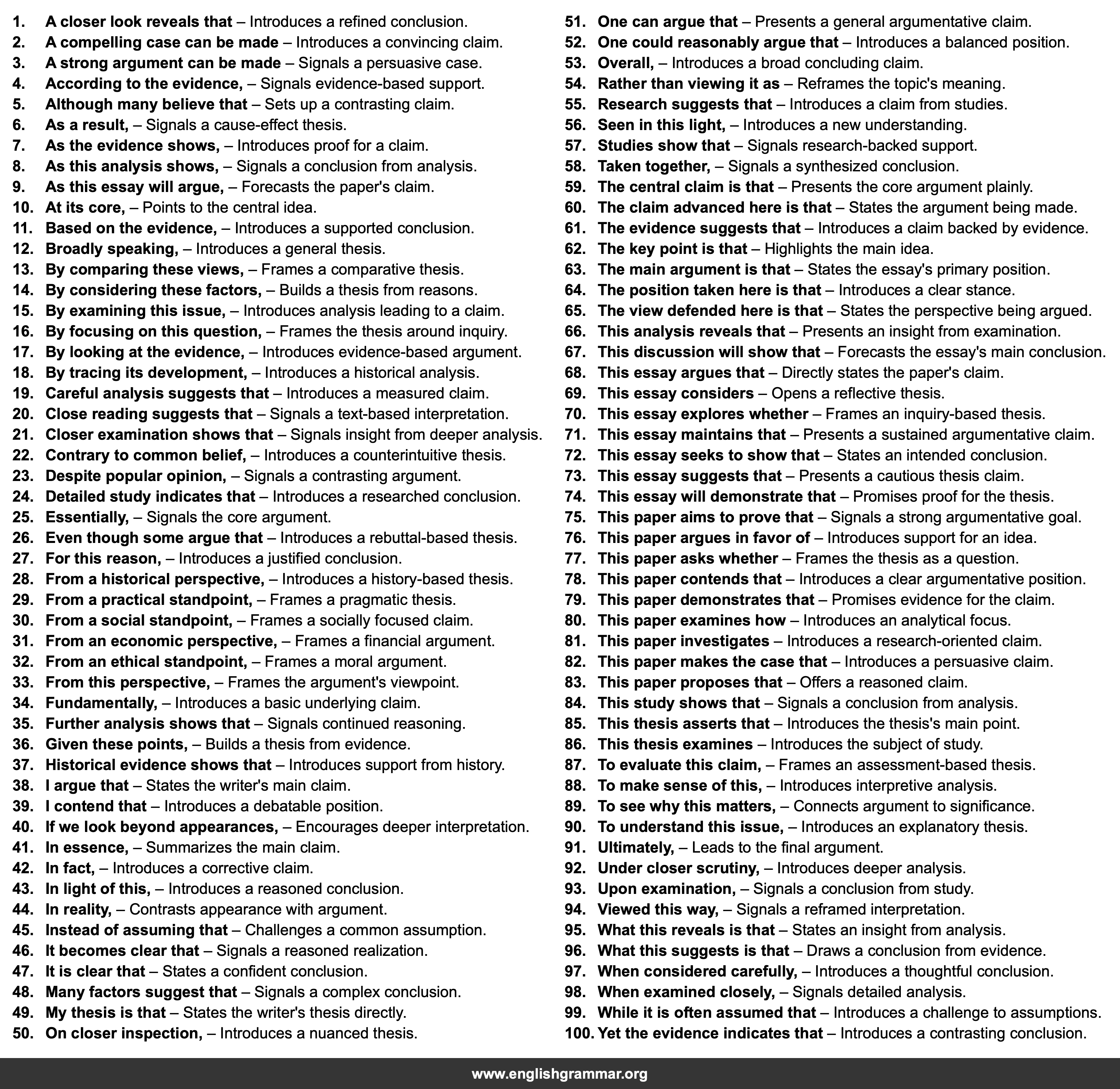
| No. | Item | Definition |
|---|---|---|
| 1. | A closer look reveals that | Introduces a refined conclusion. |
| 2. | A compelling case can be made | Introduces a convincing claim. |
| 3. | A strong argument can be made | Signals a persuasive case. |
| 4. | According to the evidence, | Signals evidence-based support. |
| 5. | Although many believe that | Sets up a contrasting claim. |
| 6. | As a result, | Signals a cause-effect thesis. |
| 7. | As the evidence shows, | Introduces proof for a claim. |
| 8. | As this analysis shows, | Signals a conclusion from analysis. |
| 9. | As this essay will argue, | Forecasts the paper’s claim. |
| 10. | At its core, | Points to the central idea. |
| 11. | Based on the evidence, | Introduces a supported conclusion. |
| 12. | Broadly speaking, | Introduces a general thesis. |
| 13. | By comparing these views, | Frames a comparative thesis. |
| 14. | By considering these factors, | Builds a thesis from reasons. |
| 15. | By examining this issue, | Introduces analysis leading to a claim. |
| 16. | By focusing on this question, | Frames the thesis around inquiry. |
| 17. | By looking at the evidence, | Introduces evidence-based argument. |
| 18. | By tracing its development, | Introduces a historical analysis. |
| 19. | Careful analysis suggests that | Introduces a measured claim. |
| 20. | Close reading suggests that | Signals a text-based interpretation. |
| 21. | Closer examination shows that | Signals insight from deeper analysis. |
| 22. | Contrary to common belief, | Introduces a counterintuitive thesis. |
| 23. | Despite popular opinion, | Signals a contrasting argument. |
| 24. | Detailed study indicates that | Introduces a researched conclusion. |
| 25. | Essentially, | Signals the core argument. |
| 26. | Even though some argue that | Introduces a rebuttal-based thesis. |
| 27. | For this reason, | Introduces a justified conclusion. |
| 28. | From a historical perspective, | Introduces a history-based thesis. |
| 29. | From a practical standpoint, | Frames a pragmatic thesis. |
| 30. | From a social standpoint, | Frames a socially focused claim. |
| 31. | From an economic perspective, | Frames a financial argument. |
| 32. | From an ethical standpoint, | Frames a moral argument. |
| 33. | From this perspective, | Frames the argument’s viewpoint. |
| 34. | Fundamentally, | Introduces a basic underlying claim. |
| 35. | Further analysis shows that | Signals continued reasoning. |
| 36. | Given these points, | Builds a thesis from evidence. |
| 37. | Historical evidence shows that | Introduces support from history. |
| 38. | I argue that | States the writer’s main claim. |
| 39. | I contend that | Introduces a debatable position. |
| 40. | If we look beyond appearances, | Encourages deeper interpretation. |
| 41. | In essence, | Summarizes the main claim. |
| 42. | In fact, | Introduces a corrective claim. |
| 43. | In light of this, | Introduces a reasoned conclusion. |
| 44. | In reality, | Contrasts appearance with argument. |
| 45. | Instead of assuming that | Challenges a common assumption. |
| 46. | It becomes clear that | Signals a reasoned realization. |
| 47. | It is clear that | States a confident conclusion. |
| 48. | Many factors suggest that | Signals a complex conclusion. |
| 49. | My thesis is that | States the writer’s thesis directly. |
| 50. | On closer inspection, | Introduces a nuanced thesis. |
| 51. | One can argue that | Presents a general argumentative claim. |
| 52. | One could reasonably argue that | Introduces a balanced position. |
| 53. | Overall, | Introduces a broad concluding claim. |
| 54. | Rather than viewing it as | Reframes the topic’s meaning. |
| 55. | Research suggests that | Introduces a claim from studies. |
| 56. | Seen in this light, | Introduces a new understanding. |
| 57. | Studies show that | Signals research-backed support. |
| 58. | Taken together, | Signals a synthesized conclusion. |
| 59. | The central claim is that | Presents the core argument plainly. |
| 60. | The claim advanced here is that | States the argument being made. |
| 61. | The evidence suggests that | Introduces a claim backed by evidence. |
| 62. | The key point is that | Highlights the main idea. |
| 63. | The main argument is that | States the essay’s primary position. |
| 64. | The position taken here is that | Introduces a clear stance. |
| 65. | The view defended here is that | States the perspective being argued. |
| 66. | This analysis reveals that | Presents an insight from examination. |
| 67. | This discussion will show that | Forecasts the essay’s main conclusion. |
| 68. | This essay argues that | Directly states the paper’s claim. |
| 69. | This essay considers | Opens a reflective thesis. |
| 70. | This essay explores whether | Frames an inquiry-based thesis. |
| 71. | This essay maintains that | Presents a sustained argumentative claim. |
| 72. | This essay seeks to show that | States an intended conclusion. |
| 73. | This essay suggests that | Presents a cautious thesis claim. |
| 74. | This essay will demonstrate that | Promises proof for the thesis. |
| 75. | This paper aims to prove that | Signals a strong argumentative goal. |
| 76. | This paper argues in favor of | Introduces support for an idea. |
| 77. | This paper asks whether | Frames the thesis as a question. |
| 78. | This paper contends that | Introduces a clear argumentative position. |
| 79. | This paper demonstrates that | Promises evidence for the claim. |
| 80. | This paper examines how | Introduces an analytical focus. |
| 81. | This paper investigates | Introduces a research-oriented claim. |
| 82. | This paper makes the case that | Introduces a persuasive claim. |
| 83. | This paper proposes that | Offers a reasoned claim. |
| 84. | This study shows that | Signals a conclusion from analysis. |
| 85. | This thesis asserts that | Introduces the thesis’s main point. |
| 86. | This thesis examines | Introduces the subject of study. |
| 87. | To evaluate this claim, | Frames an assessment-based thesis. |
| 88. | To make sense of this, | Introduces interpretive analysis. |
| 89. | To see why this matters, | Connects argument to significance. |
| 90. | To understand this issue, | Introduces an explanatory thesis. |
| 91. | Ultimately, | Leads to the final argument. |
| 92. | Under closer scrutiny, | Introduces deeper analysis. |
| 93. | Upon examination, | Signals a conclusion from study. |
| 94. | Viewed this way, | Signals a reframed interpretation. |
| 95. | What this reveals is that | States an insight from analysis. |
| 96. | What this suggests is that | Draws a conclusion from evidence. |
| 97. | When considered carefully, | Introduces a thoughtful conclusion. |
| 98. | When examined closely, | Signals detailed analysis. |
| 99. | While it is often assumed that | Introduces a challenge to assumptions. |
| 100. | Yet the evidence indicates that | Introduces a contrasting conclusion. |
