
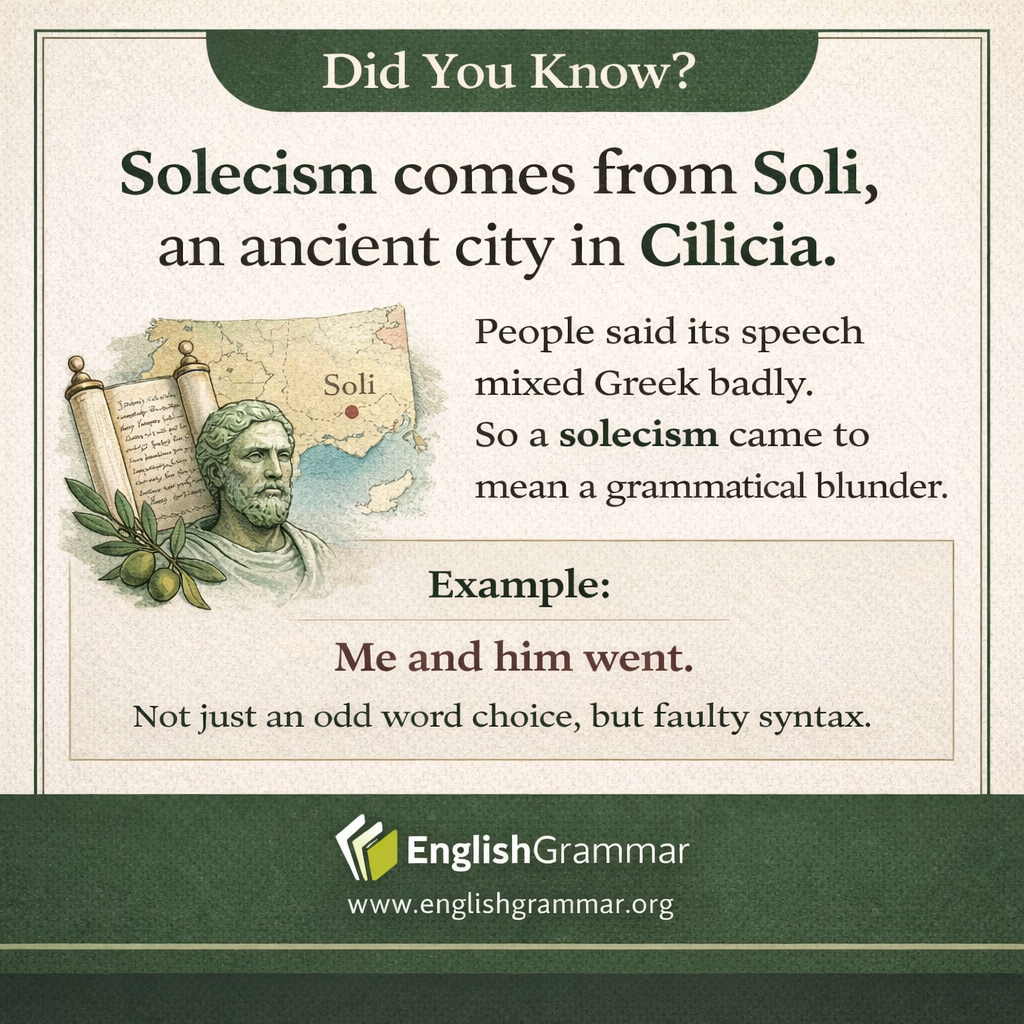
Solecism comes from Soli, an ancient city in Cilicia, in what is now southern Turkey. In classical Greek, people associated the city with speech that sounded mixed, nonstandard, or grammatically off. Because of that reputation, the word soloikismos developed the sense of speaking incorrectly.
When the term passed into Latin and then English, its meaning narrowed. Today, a solecism usually means a grammatical mistake, especially one involving syntax, agreement, or case.
- Solecism: “Me and him went.”
- More standard form: “He and I went.”
The word is useful because it points to a specific kind of error. It is not just any awkward wording or unusual vocabulary choice. A solecism is a fault in how the sentence is put together.
Writers also sometimes use the word more loosely for a breach of good manners or accepted custom, but the core meaning in language is still grammatical incorrectness. The history of the term preserves an old cultural judgment: a place name became a label for “bad Greek,” and then for bad grammar more generally.
