
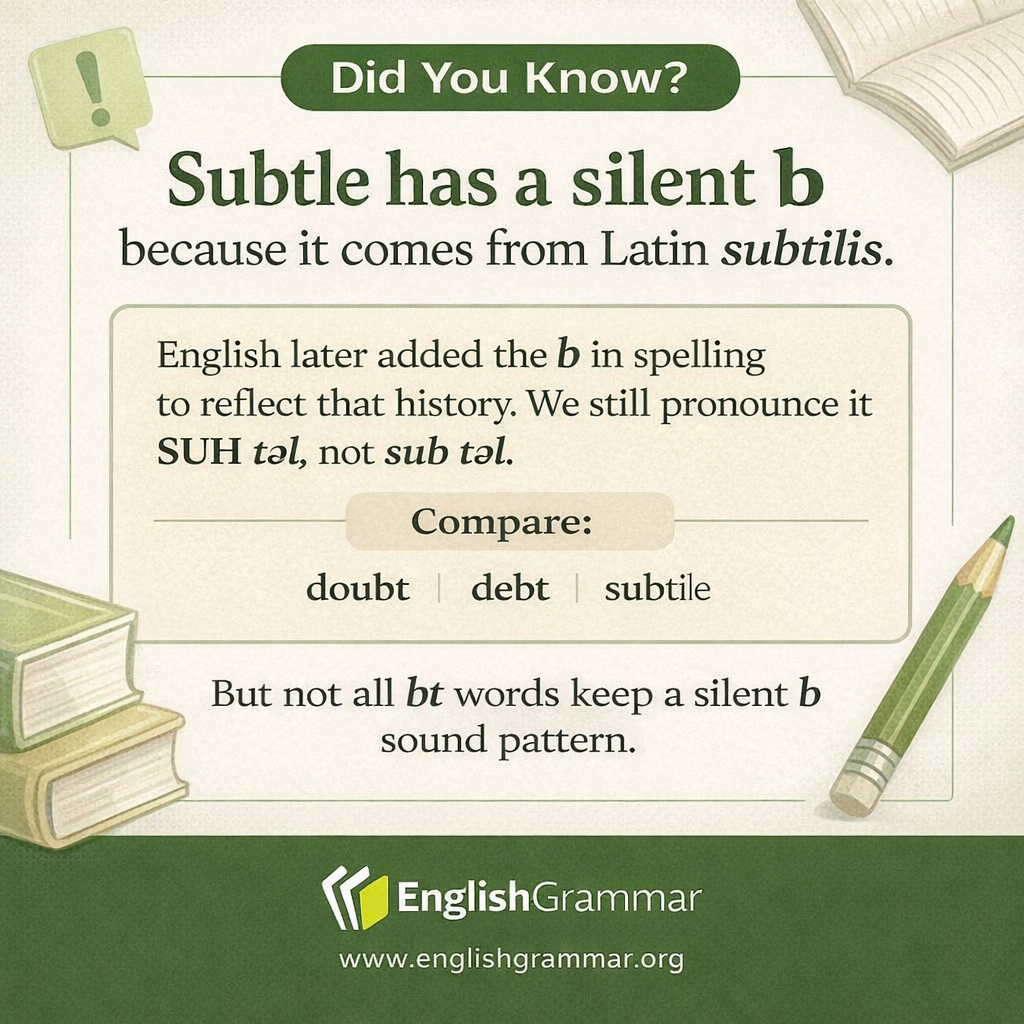
Subtle has a silent b because its spelling was influenced by its Latin ancestor, subtilis. Earlier forms in English and French often appeared without the b, and the word was pronounced more like suttle. Later, writers restored the b to make the connection to Latin more visible.
That means the spelling changed more than the pronunciation did. Today, subtle is usually said as SUH təl, not sub təl.
This kind of spelling history appears in a few other words too. For example:
- doubt: the b reflects Latin dubitare
- debt: the b was added to reflect Latin debitum
- subtle: the b points back to Latin subtilis
These words remind us that English spelling is not based only on modern pronunciation. Sometimes it also preserves a word’s history. In subtle, the silent b is a spelling marker of origin, not a sound we say aloud.