
• Skip to primary navigation
  • Skip to main content
  • Skip to primary sidebar
Home of English Grammar
  • Home
  • Course
  • Exercises
  • Grammar Rules
  • Matches
  • Posts
  • Tools
    • Grammar Checker
    • Very Replacer
    • Word Counter
  • Vocabulary Lists
  • Archives
    • Social Media Posts
    • Writing Guides
  • Sign in
  • Join free

How “taboo” came from Tongan “tapu”

May 17, 2026

Taboo comes from Tongan

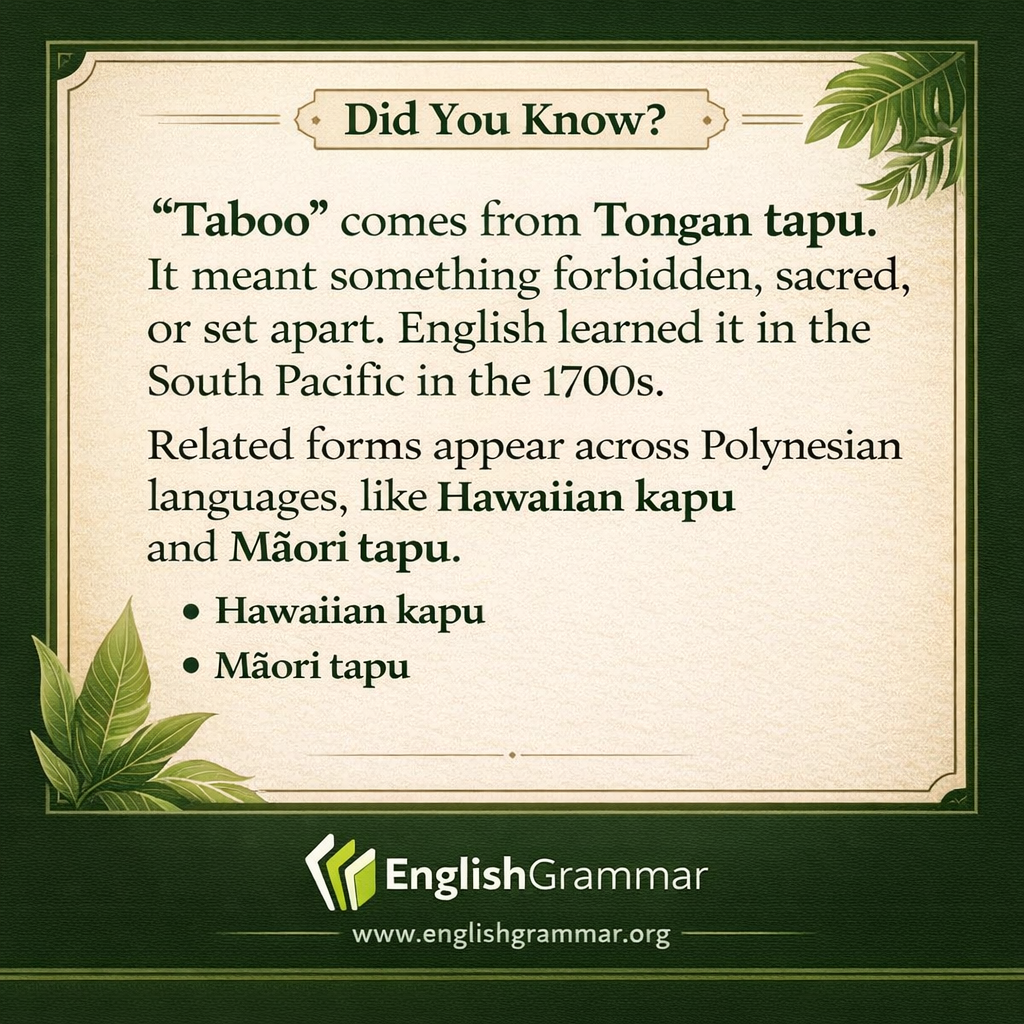
The English word taboo comes from the Tongan word tapu. In Tongan, tapu referred to something that was forbidden, sacred, or set apart. It was not just about social discomfort. It could describe people, places, objects, or actions that were restricted for religious, cultural, or social reasons.

English speakers encountered the word in the South Pacific during the late 1700s. It became established in English as taboo, with a spelling adapted to English pronunciation and writing habits.

This word is also part of a wider Polynesian family of related forms:

  • Tongan: tapu
  • Māori: tapu
  • Hawaiian: kapu

These related words show that the idea was not unique to one island or one language. The exact use could vary by culture, but the core meaning often involved restriction and sacredness.

In modern English, taboo usually means something a society avoids or treats as unacceptable. For example, people may call certain topics taboo subjects. That modern use is broader than the original sense, but it still keeps the idea of something socially or culturally off limits.

Improve your English grammar, vocabulary and writing

We take you step by step from beginner to advanced, even if you struggled with English at school or have always had trouble remembering the rules.

  • 10 modules, 112 lessons and 730 questions
  • Just log in and learn anytime and anywhere
  • Your progress is saved in your account
  • Download the 2027 Grammar Guide (PDF)
Join free

Already have an account? Sign in

See what’s in the course

Primary Sidebar

2.4M760.9K165.9K

Free 2027 Grammar Guide

  • Download Grammar Guide (PDF)
  • Online grammar course, A1 to C2
  • Weekly exercises and vocabulary
  • Join over 3 million English learners

We respect your privacy. Unsubscribe anytime.

Already have an account? Sign in

Grammar Checker - Try Now

Latest Posts

  • 100 Best Synonyms for “Unreal” November 2, 2026
  • 100 Best Synonyms for “Regard” November 2, 2026
  • 100 Best Synonyms for “Respite” November 2, 2026
  • 100 Proverbs from Around the World Every Adult Should Know November 2, 2026
  • 100 Best Synonyms for “Inappropriate” November 2, 2026
  • 100 Best Synonyms for “Unprecedented” November 2, 2026
  • Ample vs. plentiful vs. abundant vs. bountiful vs. copious vs. profuse November 2, 2026
  • 100 Best Synonyms for “Respectfully” November 2, 2026
  • Creepy, spooky, eerie, sinister, macabre, and bloodcurdling: What’s the difference? November 2, 2026
  • 100 Best Synonyms for “Improvement” November 2, 2026
Home of English Grammar

Free English grammar exercises, rules and vocabulary lists, with new exercises every week. Join the leading English grammar site with over 3 million followers.

Join free

Learn

  • Exercises
  • Matches
  • Grammar rules
  • Vocabulary lists
  • Writing guides
  • Online tools

More

  • Top social media posts
  • Various posts
  • Contact

Account

  • Join free
  • Grammar Course
  • Free grammar guide (PDF)

Copyright © 2026 EnglishGrammar.org

  • Disclaimer
  • Privacy policy
  • Terms
  • Sitemap