
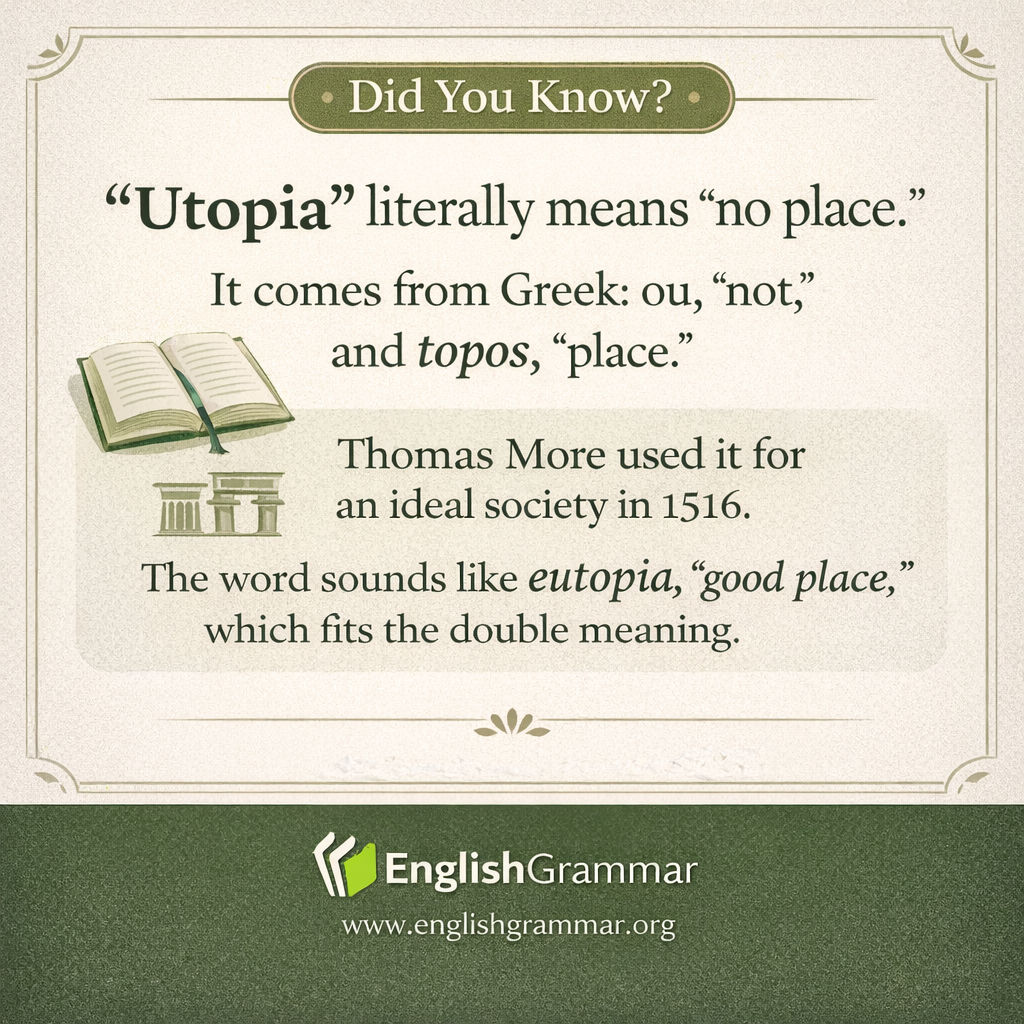
Utopia literally means no place. The word is usually traced to Greek roots: ou, meaning not or no, and topos, meaning place. English speakers often use utopia to mean a perfect society, but the original idea contains a built in tension. It names an ideal world while also suggesting that such a world exists nowhere.
This is not an accident. The writer Thomas More introduced the term in his 1516 book Utopia, which describes an imagined society. The name works as wordplay because it also echoes eutopia, which means good place. So the word can suggest two ideas at once: a good place and no place.
- Literal sense: no place
- Common modern sense: an ideal society
- Useful contrast: dystopia describes a deeply flawed or oppressive society
For example, someone might say, “The novel imagines a utopia where everyone has enough food and time.” The sentence uses utopia in its modern sense, but the older meaning reminds us that such perfection may be impossible in the real world.