

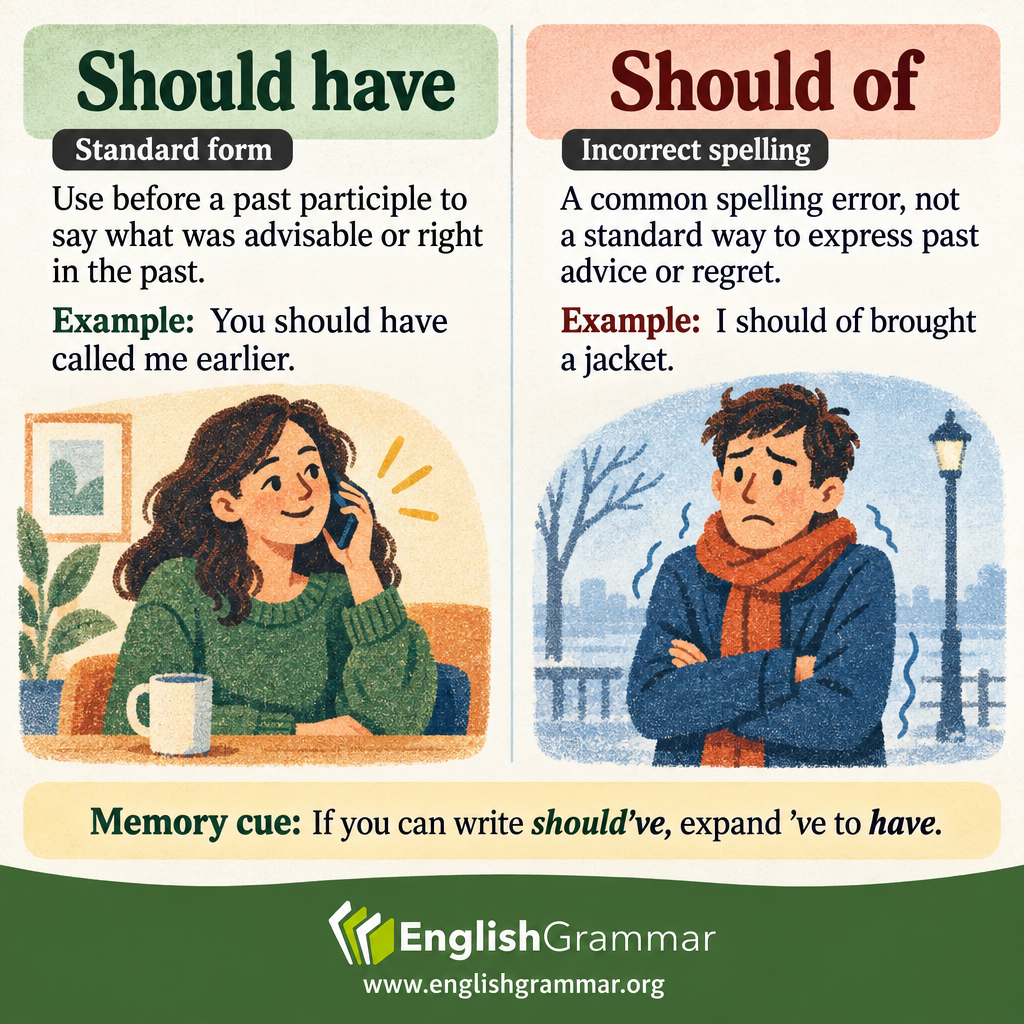
Should have is the standard form for talking about something that was advisable or right in the past. It often expresses regret: you now think a different action would have been better.
Use should have + a past participle. A past participle is a verb form such as checked, taken, or gone. For many verbs, it ends in -ed, but some have irregular forms.
- You should have checked the address before leaving.
- We should have taken the earlier train.
The first sentence gives advice about a past action. The second suggests that taking an earlier train would have been a better choice. Both look back at something that has already happened.
Should of is a common spelling error in this construction. The confusion comes from speech: should’ve, the contraction of should have, can sound like “should of.” However, the contraction contains have, not of.
- Incorrect: She should of saved her work.
- Correct: She should have saved her work.
In everyday writing, the contracted version is also correct: She should’ve saved her work. In more formal writing, the full form is often preferred. When checking a sentence, look at the word after should: this past-action pattern needs have followed by a past participle.
