
• Skip to primary navigation
  • Skip to main content
  • Skip to primary sidebar
Home of English Grammar
  • Home
  • Course
  • Exercises
  • Grammar Rules
  • Matches
  • Posts
  • Tools
    • Grammar Checker
    • Very Replacer
    • Word Counter
  • Vocabulary Lists
  • Archives
    • Social Media Posts
    • Writing Guides
  • Join free

Where the word Yahoo came from

July 1, 2026

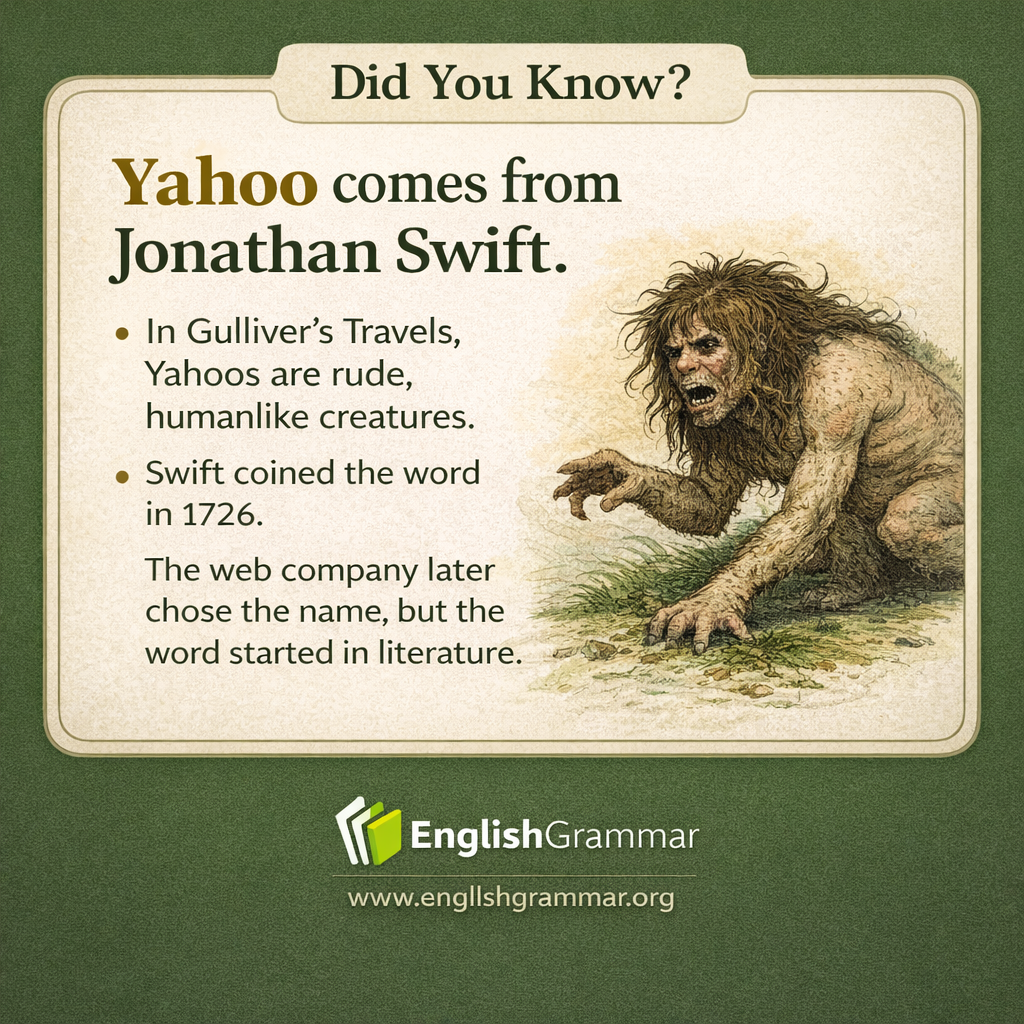
"Yahoo" was invented by Jonathan Swift.

Yahoo did not begin with the internet company. It first appeared in Jonathan Swift’s Gulliver’s Travels, published in 1726.

In the book, the Yahoos are wild, rude, humanlike creatures. Swift uses them as part of his satire, contrasting them with the rational horses called the Houyhnhnms. The name was invented for the story, so it is considered a literary coinage.

Over time, yahoo also became a common noun in English. It can mean a coarse, noisy, or uncultured person.

  • Swift’s original use: the Yahoos in Gulliver’s Travels
  • Later general use: He acted like a yahoo at the game.

The company Yahoo!, founded in the 1990s, adopted the older word as its name. So when people say “Yahoo” today, they may mean the brand, but the term itself comes from eighteenth century literature.

Improve your English grammar, vocabulary and writing

We take you step by step from beginner to advanced, even if you struggled with English at school or have always had trouble remembering the rules.

  • 10 modules, 112 lessons and 730 questions
  • Just log in and learn anytime and anywhere
  • Your progress is saved in your account
  • Download the 2027 Grammar Guide (PDF)
Join free

Already have an account? Sign in

See what’s in the course

Primary Sidebar

2.4M761.4K165.8K

Free 2027 Grammar Guide

  • Download Grammar Guide (PDF)
  • Online grammar course, A1 to C2
  • Weekly exercises and vocabulary
  • Join over 3 million English learners

We respect your privacy. Unsubscribe anytime.

Already have an account? Sign in

Grammar Checker - Try Now

Latest Posts

  • 100 Best Synonyms for “Communicative” October 23, 2026
  • Icky vs. gross vs. nasty vs. disgusting vs. revolting vs. vile October 23, 2026
  • Comparatives Exercise October 23, 2026
  • 100 Best Synonyms for “Proposition” October 23, 2026
  • 100 Best Synonyms for “Stagnation” October 23, 2026
  • 100 Best Synonyms for “Dumb” October 23, 2026
  • The origin and meaning of “off the cuff” October 23, 2026
  • 100 Phrases for Declining Requests at Work Politely October 23, 2026
  • 100 Best Synonyms for “Plausible” October 23, 2026
  • Maybe, perhaps, possibly, conceivably, probably and definitely: How to choose October 23, 2026
Home of English Grammar

Free English grammar exercises, rules and vocabulary lists, with new exercises every week. Join the leading English grammar site with over 3 million followers.

Join free

Learn

  • Exercises
  • Matches
  • Grammar rules
  • Vocabulary lists
  • Writing guides
  • Online tools

More

  • Top social media posts
  • Various posts
  • Contact

Account

  • Join free
  • Grammar Course
  • Free grammar guide (PDF)

Copyright © 2026 EnglishGrammar.org

  • Disclaimer
  • Privacy policy
  • Terms
  • Sitemap